


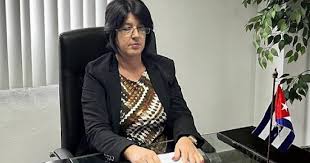
Cuba’s Minister for Labour and Social Security, Marta Elena Feitó Cabrera, has resigned under intense public and political pressure following controversial comments she made denying the existence of beggars on the island nation. The resignation was confirmed shortly after widespread outrage erupted among Cubans both at home and in the diaspora, leading to a rare public rebuke from President Miguel Díaz-Canel himself.
Feitó Cabrera, speaking during a session of the National Assembly earlier in the week, claimed that there were “no beggars in Cuba” and described people rummaging through garbage bins as opportunists “pretending to be beggars to make easy money.” She further labeled such individuals as “illegal participants in the recycling service.”
The remarks ignited a firestorm of criticism, viewed as not only insensitive but emblematic of a governing elite disconnected from the daily hardships faced by ordinary Cubans. The island nation is currently undergoing one of its most severe economic crises in decades, marked by growing poverty, prolonged food shortages, rising inflation, power outages, and an acute scarcity of essential goods including medicine and fuel.
President Díaz-Canel, while not mentioning Feitó Cabrera directly, responded pointedly in the same parliamentary session, warning that Cuba’s leadership must not be “condescending” or “disconnected from the realities” of its citizens. His veiled censure signaled that the government was aware of the damaging optics her comments had created, both domestically and internationally.
The backlash was swift and unrelenting. Prominent Cuban economist Pedro Monreal reacted sarcastically on X (formerly Twitter), writing, “It must be that there are also people disguised as ‘ministers’.” Civil society groups and intellectuals published an open letter demanding her resignation, describing her comments as “an insult to the Cuban people.”
The scale and speed of the public reaction was especially noteworthy in a country where open dissent is typically stifled, anti-government protests are banned, and critics risk imprisonment. Feitó Cabrera’s ouster therefore marks one of the rare instances in recent Cuban history where public opinion appears to have directly influenced political accountability at the highest levels.
With worsening living conditions and an increasingly disillusioned population, the incident has exposed cracks in Cuba’s official narrative of equity and resilience. Observers say the government’s swift acceptance of Feitó Cabrera’s resignation may be an attempt to quell further dissent and avoid inflaming growing dissatisfaction with the regime’s handling of the economic crisis.
CUBAN LABOUR MINISTER FORCED TO RESIGN AFTER CONTROVERSIAL REMARKS DENYING POVERTY


- Advertisment -