


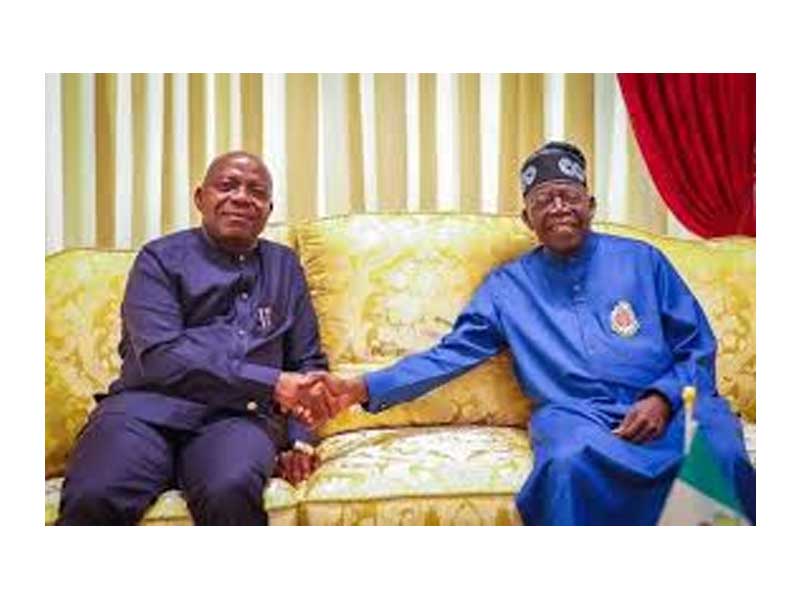
Governor Alex Otti of Abia State has deepened ongoing political, legal, and diplomatic engagements surrounding the controversial conviction of Indigenous People of Biafra (IPOB) leader, Mazi Nnamdi Kanu, following a strategic visit to President Bola Ahmed Tinubu at the Presidential Villa in Abuja on Tuesday. The meeting, which took place behind closed doors, has generated renewed national attention due to its timing, political undertones, and the continued agitation surrounding Kanu’s imprisonment.
President Tinubu received Governor Otti in what insiders have described as a critical intervention meeting aimed at exploring viable federal-level solutions to address the long-standing tension emanating from the South-East over the IPOB leader’s continued detention. Although official details of their discussion have not yet been released, reliable sources within the presidency hinted that the conversation was closely tied to current efforts to chart a new path toward resolving the contentious matter.
This engagement comes barely two weeks after the Federal High Court in Abuja delivered a life imprisonment sentence on Nnamdi Kanu on November 20, 2025. The ruling, which convicted him on terrorism-related charges, triggered immediate protests, social unrest, diplomatic appeals, and strong reactions from several Igbo socio-cultural groups demanding his release. Civil rights organizations, legal experts, traditional rulers, and political leaders across the region have also intensified advocacy, insisting that Kanu’s prolonged detention is fueling social tension and economic instability in the South-East.
Governor Otti has recently emerged as one of the strongest voices calling for a peaceful and lawful resolution of the matter. His Tuesday meeting with the president is regarded as a continuation of his interventionist strategy aimed at securing federal cooperation in addressing the widespread grievances associated with Kanu’s incarceration.
Before meeting the president, Otti had earlier visited Nnamdi Kanu at the Sokoto Correctional Centre, where the IPOB leader is serving his sentence. That visit was widely publicized, symbolizing a renewed push from Abia State—Kanu’s home state—to engage directly with relevant authorities. Otti did not embark on the Sokoto visit alone; he was accompanied by a delegation that reflected both legal authority and familial representation. The team included Kanu’s younger brother, Emmanuel Kanu; the Abia State Attorney-General and Commissioner for Justice, Ikechukwu Uwanna, SAN; and Otti’s Special Adviser on Media and Publicity, Ferdinand Ekeoma.
During the prison visit, Governor Otti assured that the Abia State Government remains committed to pursuing every legitimate pathway available under the law to work toward Kanu’s eventual release. He noted that the conviction does not preclude the right to appeal, and affirmed that he is actively executing an agreed-upon strategy with key stakeholders.
In his words, Otti said:
“While Mazi Nnamdi Kanu is free to appeal his conviction, I’m happy to inform you that I have activated, and will continue to work on, the already agreed strategy until his freedom is secured.”
These comments have largely fueled speculations that a broader coalition—comprising political leaders, legal experts, human rights advocates, and federal actors—is quietly coordinating steps aimed at achieving a negotiated settlement. Observers believe that Otti’s meeting with President Tinubu is part of this coordinated plan, especially given the current climate of national security concerns and the president’s stated commitment to promoting national cohesion.
The situation surrounding Kanu’s imprisonment has remained one of Nigeria’s most sensitive political issues in recent years. His arrest, extradition, and trial have been marred by debates over due process, alleged human rights violations, and the wider implications for peace in the South-East. Continuous protests and sit-at-home activities orchestrated by supporters have significantly disrupted economic activity in the region. Analysts argue that any attempt to resolve the matter must combine political will, dialogue, judicial review, and trust-building between the federal government and the region’s stakeholders.
The meeting between Governor Otti and President Tinubu therefore stands out as a potentially pivotal moment. It is seen as part of a growing realization that a political solution may be necessary to complement ongoing legal processes. Though the presidency has kept details confidential for now, the mere fact that such a meeting occurred has generated optimism among many who believe that a breakthrough could be on the horizon.
On the other hand, critics have expressed caution, noting that similar high-profile meetings in the past did not yield substantial outcomes. They argue that until concrete steps—such as a presidential directive, legal review, or negotiated settlement—are announced, the public should temper expectations. Nonetheless, many agree that Otti’s involvement represents a renewed, more strategic approach to the matter.
Political commentators also highlight the growing pressure on the federal government to seek a lasting resolution. They believe that Nnamdi Kanu’s case has evolved beyond a legal matter and now represents a political, social, and security challenge that requires deliberate engagement. For President Tinubu, navigating this issue successfully could strengthen his image as a unifying leader committed to national peace.
As at the time this report was filed, no official statement has been issued by either the presidency or the Abia State Government detailing the outcome of the meeting. However, the visit has intensified speculation within political and legal circles that high-level discussions aimed at facilitating Kanu’s release or negotiating improved conditions are gaining momentum.
Meanwhile, several advocacy groups have applauded Governor Otti for taking proactive steps rather than adopting a passive stance. They argue that leadership requires courage and initiative, especially when dealing with issues that deeply affect the sentiments of one’s constituents. Otti’s recent actions, including his engagement with the president, are being interpreted as a demonstration of political maturity, responsibility, and commitment to peace.
While Nigerians await official updates, one thing remains clear: the meeting between President Tinubu and Governor Otti marks another significant step in the long-running legal and political battle over the fate of Nnamdi Kanu. Whether this step will lead to his release, a review of his sentence, or a broader dialogue among national stakeholders remains to be seen. But for now, all eyes remain on Aso Rock and the strategic moves unfolding behind the scenes.