


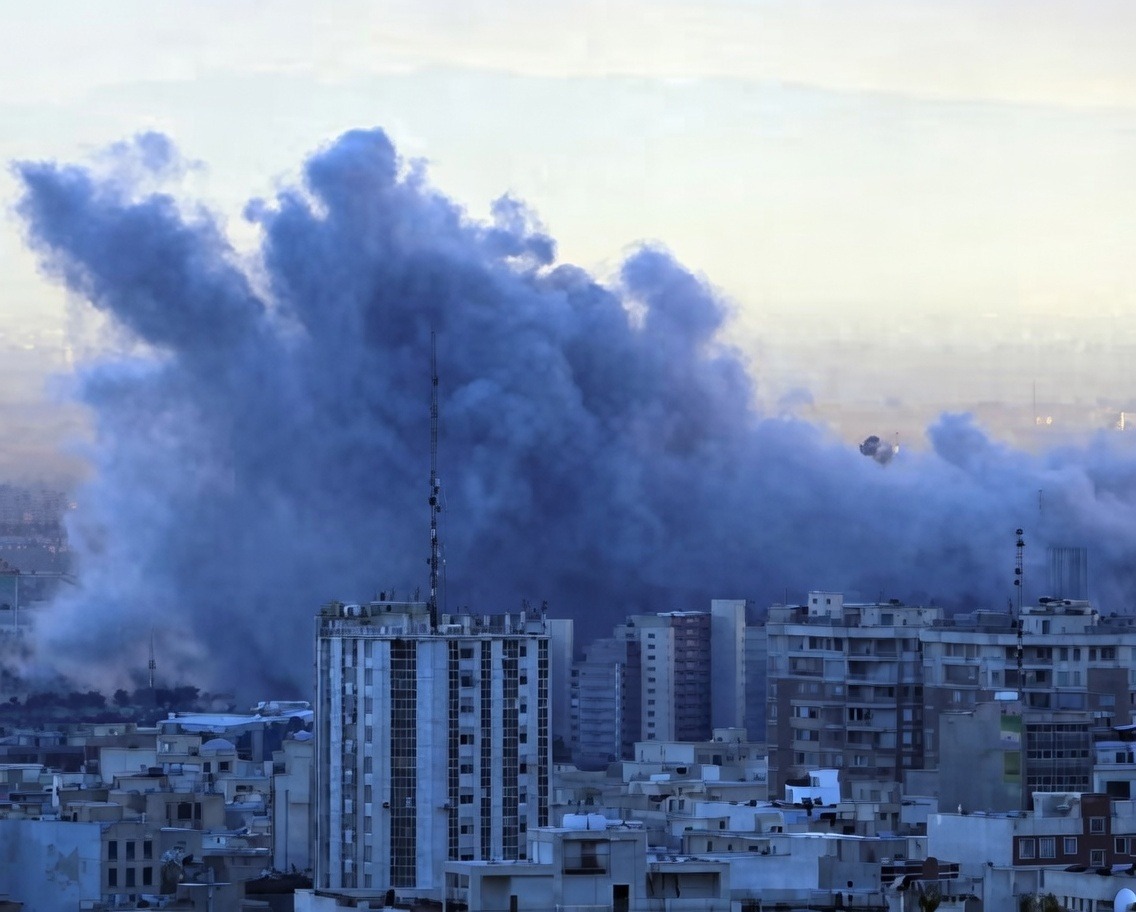
On 3 March 2026, escalating military exchanges across the Middle East intensified global concerns that the growing confrontation between Iran and the United States, with the active military involvement of Israel, could develop into a wider international conflict. As missiles were reportedly launched across the Gulf region and naval forces increased patrols along key maritime routes, analysts and diplomatic observers in cities ranging from Washington, D.C. to Tehran and Tel Aviv began raising questions about whether the crisis could trigger a broader geopolitical confrontation with global implications.
The crisis intensified after coordinated strikes reported on 1 March 2026 targeted Iranian military and strategic infrastructure in several locations, including facilities near Isfahan and Shiraz. According to regional security analysts and statements attributed to officials close to the Israeli government led by Prime Minister Benjamin Netanyahu, the strikes were aimed at missile storage depots, military command installations, and infrastructure believed to be linked to Iran’s nuclear program.
Iranian authorities, led by President Ebrahim Raisi and senior commanders of the Islamic Revolutionary Guard Corps, condemned the strikes and promised retaliation. On 2 March 2026, Iranian officials announced that their response would not be limited to a single front but would target what they described as the “network of military aggression” supporting Israel and the United States in the region.
Missile and drone strikes were subsequently reported near several strategic locations across the Gulf region. On 3 March 2026, security alerts were issued around American military installations in Manama in Bahrain, where the headquarters of the United States Fifth Fleet is located. The naval command plays a central role in American maritime security operations throughout the Gulf and surrounding waters.
Additional security warnings were issued in Doha in Qatar, where the Al Udeid Air Base hosts one of the largest United States military facilities in the Middle East. Similar alerts were reported near military infrastructure in Abu Dhabi in the United Arab Emirates and in energy-producing regions of Saudi Arabia.
While Iranian officials stated that their operations were aimed at military installations rather than civilian targets, Gulf governments now face a complex strategic dilemma. Hosting American forces offers security protection but also exposes these countries to potential retaliation during periods of heightened confrontation.
The strategic origins of the crisis stretch back decades. Tensions between Iran and the United States sharply escalated after the Iranian Revolution, which overthrew the government of Mohammad Reza Pahlavi and brought to power a new Islamic political order led by Ruhollah Khomeini. Since that time, relations between Tehran and Washington have been marked by deep mistrust and periodic confrontation.
In recent years, tensions intensified over Iran’s nuclear program. On 14 July 2015, Iran and several world powers, including the United States, Russia, China, France, the United Kingdom, and Germany, signed the Joint Comprehensive Plan of Action in Vienna. The agreement imposed restrictions on Iran’s nuclear activities in exchange for sanctions relief.
However, on 8 May 2018, the administration of then-United States President Donald Trump announced that Washington would withdraw from the agreement, arguing that it failed to adequately limit Iran’s long-term nuclear capabilities. The withdrawal led to renewed sanctions and a gradual escalation of tensions across the region.
Israel has consistently warned that it would not tolerate the emergence of a nuclear-armed Iran. Israeli officials, including Prime Minister Benjamin Netanyahu, have repeatedly stated that preventing Iran from developing nuclear weapons is a matter of national survival for the country.
The current confrontation also highlights the vulnerability of global energy infrastructure located in the Gulf region. The Persian Gulf contains some of the world’s largest oil reserves, and a significant portion of global energy exports passes through the narrow Strait of Hormuz, situated between Iran and Oman.
Energy analysts warn that any disruption to the strait could have immediate global consequences. Roughly one-fifth of the world’s oil shipments pass through this strategic waterway each day. Even temporary disruptions could trigger sharp increases in global oil prices and destabilize energy markets across Europe, Asia, and Africa.
Military developments have also extended beyond the Middle East. On 4 March 2026, reports emerged of a naval confrontation in waters near Sri Lanka in the Indian Ocean, a region that serves as a major artery for global shipping traffic connecting Asia, Africa, and Europe.
According to preliminary reports from maritime security observers, a clash occurred between Iranian and American naval forces approximately 200 nautical miles southwest of Colombo. During the encounter, an Iranian warship was reportedly sunk by American naval forces. Although neither government immediately released full operational details, the incident signaled a dramatic geographic expansion of the confrontation.
The Indian Ocean carries a large share of global trade, including energy shipments traveling from the Middle East to Asian markets. Any sustained military presence or conflict in these waters could disrupt shipping routes vital to the global economy.
Another critical dimension of the crisis involves armed groups aligned with Iran across the Middle East. The Lebanese organization Hezbollah, led by Secretary-General Hassan Nasrallah, has historically maintained close ties with Tehran. Militias in Iraq and allied forces operating in Syria and Yemen have also been described by Western analysts as part of a broader network of Iranian-aligned groups.
In recent days, cross-border exchanges between Hezbollah and Israeli forces have intensified along the frontier near southern Tyre and northern Haifa, raising fears that the confrontation could expand into Lebanon.
The involvement of global powers will play a decisive role in determining the trajectory of the crisis. The United States government under President Joe Biden has reaffirmed its commitment to Israel’s security while calling for restraint to prevent a broader regional war.
Iran maintains strategic diplomatic and economic relationships with both Russia and China. Russian President Vladimir Putin and Chinese President Xi Jinping have both urged de-escalation, while also criticizing what they describe as destabilizing Western military actions in the region.
History offers stark examples of how regional crises can evolve into global wars when major powers become entangled in escalating alliances. The World War I began on 28 July 1914 following a localized crisis in the Balkans but rapidly expanded through interconnected alliances among European powers. Similarly, the World War II began on 1 September 1939 with the German invasion of Poland before eventually engulfing multiple continents.
Even without a direct global military confrontation, the economic consequences of the current crisis are already being felt. Energy markets experienced volatility during trading on 4 March 2026 as traders assessed the risks to supply routes. Shipping insurance rates for vessels operating in the Gulf increased significantly, reflecting concerns about potential attacks on commercial vessels.
For developing economies, including countries across Africa such as Nigeria, rising fuel prices could translate into inflationary pressure and increased costs of transportation and electricity generation.
Diplomatic observers warn that the coming weeks will be critical in determining whether the confrontation stabilizes or escalates further. Decisions taken in capitals such as Washington, Tehran, Tel Aviv, Moscow, and Beijing may ultimately determine whether the conflict remains a regional crisis or becomes one of the defining geopolitical confrontations of the twenty-first century.