


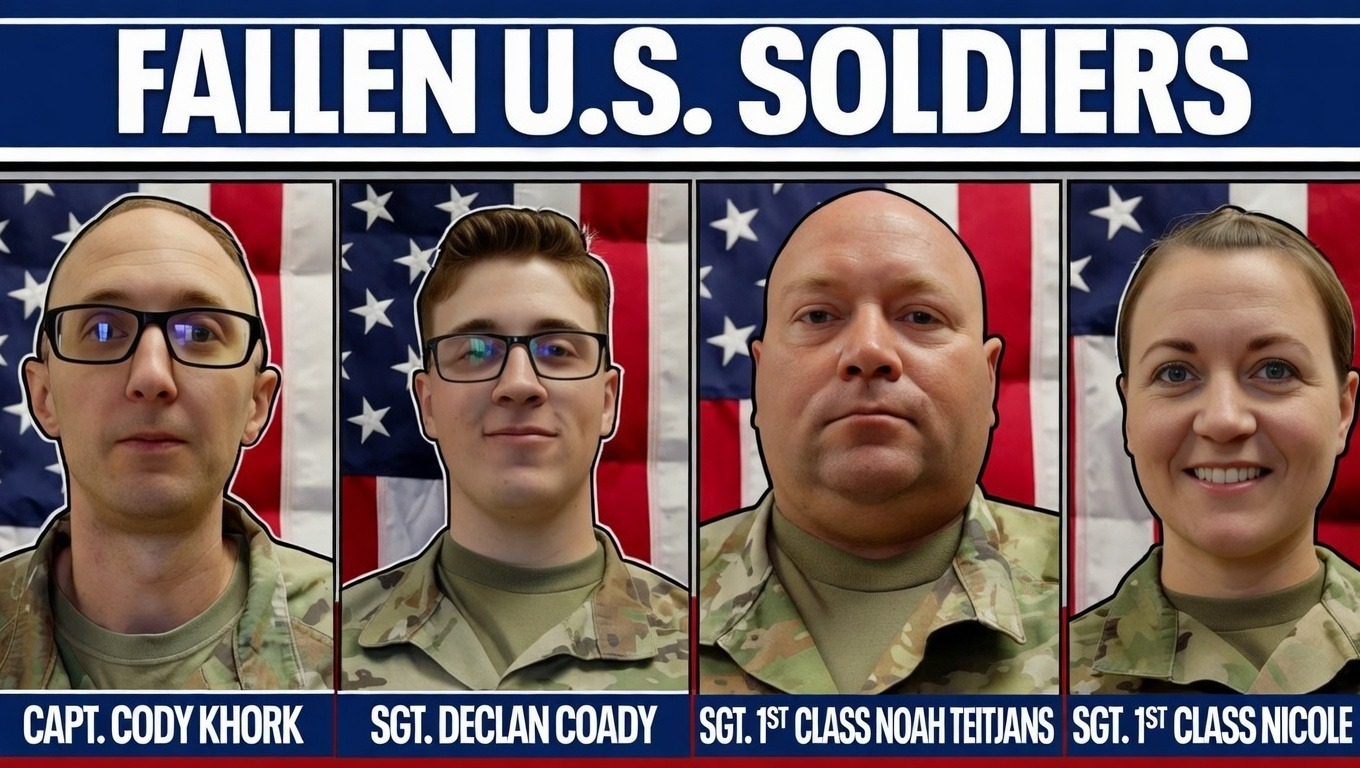
The United States Department of Defense on Tuesday, March 3, 2026, formally identified four U.S. Army Reserve soldiers who were killed in a drone strike during a military operation in Kuwait, as senior American and Kuwaiti officials launched a joint investigation into the incident that has further heightened tensions across the Middle East.
In a detailed briefing at the Pentagon in Arlington, Virginia, Major General Patrick S. Ryder, Press Secretary to the Department of Defense, confirmed that the attack occurred on Sunday evening, March 1, 2026, at approximately 8:40 p.m. local time. The strike targeted a forward operating site within the perimeter of Camp Arifjan, one of the largest U.S. military installations in Kuwait, located about 55 kilometers south of Kuwait City.
The soldiers killed in the attack were identified as Captain Michael R. Thompson, 37, of Dallas, Texas; Staff Sergeant Alicia M. Gomez, 29, of San Antonio, Texas; Sergeant First Class Daniel K. Harper, 41, of Columbus, Ohio; and Specialist Aaron L. Whitaker, 24, of Tampa, Florida. All four were assigned to the 451st Expeditionary Sustainment Command, a U.S. Army Reserve logistics unit deployed to Kuwait in support of Operation Spartan Shield, the long-standing U.S. mission aimed at deterring aggression and strengthening regional defense partnerships.
According to preliminary findings released by the Pentagon, the drone involved in the attack was a one-way unmanned aerial system carrying an explosive payload. Officials said the aircraft evaded or overwhelmed certain base-level counter-drone defenses before detonating near a vehicle maintenance and staging area where the soldiers were conducting routine operational checks.
Major General Ryder stated that initial intelligence assessments are examining whether the drone originated from outside Kuwait’s borders and whether it may be linked to Iran-aligned militia groups that have previously targeted U.S. forces in Iraq and Syria. However, he cautioned that investigators have not yet publicly attributed responsibility.
“We are working in close coordination with the Government of Kuwait to determine the precise origin and launch point of the drone,” Ryder said. “This remains an active and ongoing investigation. The Department is committed to transparency and accountability.”
U.S. Central Command, headquartered at MacDill Air Force Base in Tampa, Florida, has elevated force protection levels across its area of responsibility following the strike. Additional air defense assets and counter-unmanned aerial system capabilities are reportedly being repositioned to installations in Kuwait and neighboring Gulf states as a precautionary measure.
Kuwait’s Ministry of Defense issued a statement on Monday, March 2, 2026, condemning what it described as a “cowardly act of aggression” and reaffirming its security partnership with the United States. Sheikh Ahmad Fahad Al-Sabah, Kuwait’s Deputy Prime Minister and Minister of Defense, expressed condolences to the families of the fallen soldiers and pledged full cooperation with American investigators.
“The State of Kuwait stands firmly alongside its strategic ally, the United States of America, in confronting threats to regional stability,” Sheikh Ahmad said during a press conference in Kuwait City.
Camp Arifjan has served as a critical logistics and command hub for U.S. operations in the Middle East since the early 2000s. Kuwait has hosted thousands of American troops since the 1991 Gulf War and remains a key staging ground for operations across Iraq, Syria, and the broader Gulf region.
President Joseph R. Biden Jr. was briefed on the attack on Monday morning, March 2, 2026, according to a statement from the White House. The President directed the Secretary of Defense, Lloyd J. Austin III, to conduct a comprehensive review of force protection protocols at U.S. military installations throughout the region. In his remarks, President Biden described the fallen soldiers as “patriots who gave their lives in defense of our nation and our allies.”
Secretary Austin, speaking separately at the Pentagon, emphasized that the United States retains the right to respond if the investigation confirms hostile responsibility. “We will not tolerate attacks on our service members,” Austin said. “If an adversary is found responsible, we will respond at a time and place of our choosing.”
The attack comes at a time of escalating geopolitical strain in the Middle East. In recent months, U.S. forces have faced sporadic rocket and drone attacks in Iraq and eastern Syria attributed to militia groups opposed to the American military presence in the region. Diplomatic tensions between Washington and Tehran have also intensified following disputes over maritime security in the Persian Gulf and renewed sanctions enforcement.
Security analysts say the increasing sophistication and availability of drone technology have significantly altered the threat landscape for military installations across the region. One-way attack drones, often inexpensive and difficult to detect, have become a preferred tactic for non-state armed groups seeking to challenge technologically superior adversaries.
Military honors for the four soldiers are expected to take place later this week at Dover Air Force Base in Delaware, where their remains will be received in a dignified transfer ceremony before being transported to their respective hometowns for burial. Members of Congress from Texas and Ohio have already issued statements paying tribute to the service members, describing their deaths as a profound loss to their communities and the nation.
The Pentagon confirmed that counseling services and casualty assistance officers have been assigned to support the families of the deceased. Flags at U.S. military installations in Kuwait and across the United States were ordered lowered to half-staff in honor of the fallen soldiers.
As investigators continue to analyze forensic evidence from the drone debris and review surveillance data, U.S. officials have reiterated that operations in Kuwait will continue uninterrupted. Military leaders have stressed that while the security environment remains volatile, the United States remains committed to its defense partnerships and strategic objectives in the Gulf region.


