


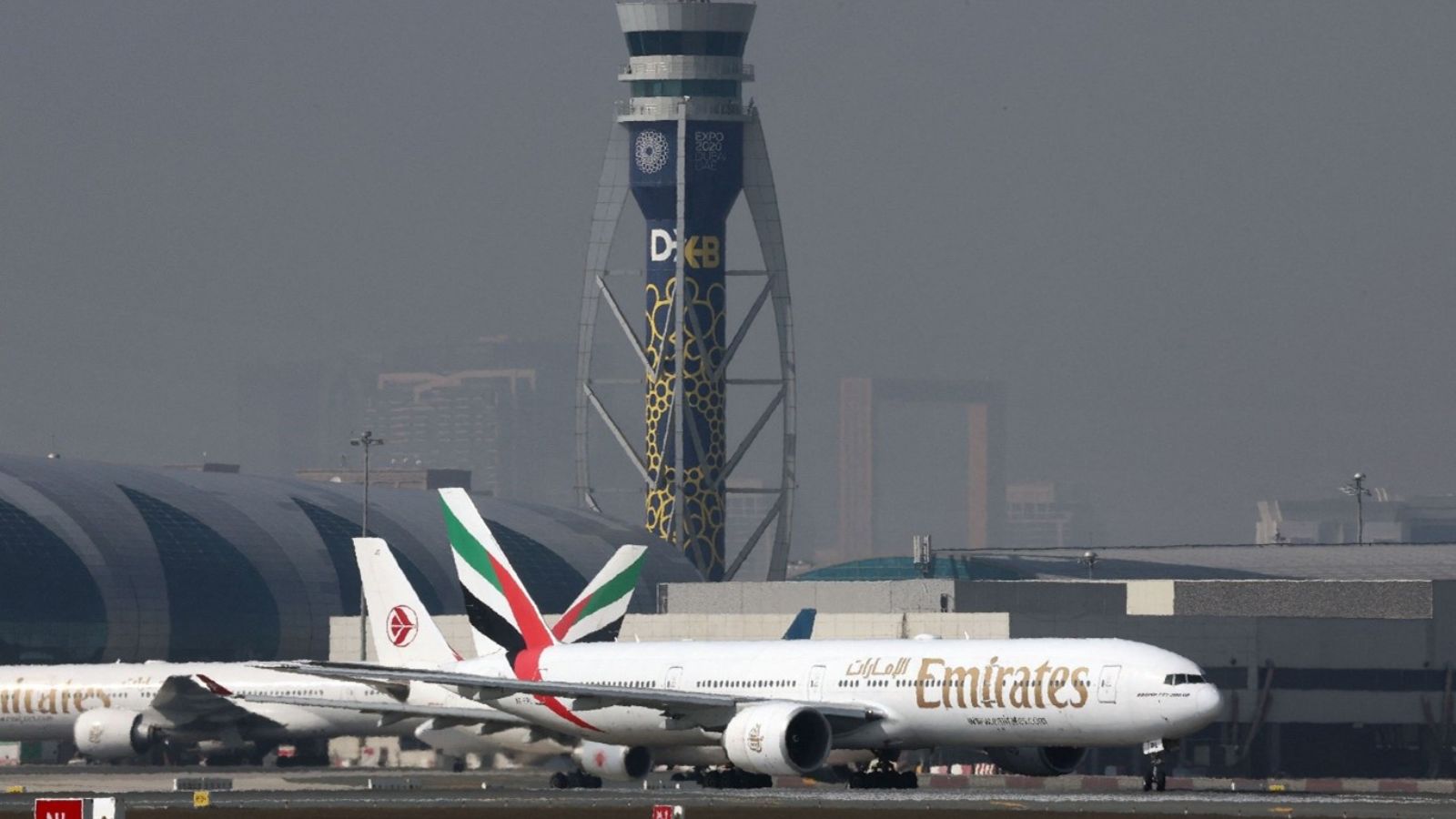
Air travel across parts of the Middle East was disrupted earlier this week as escalating regional tensions triggered temporary airspace restrictions, forcing airlines to reroute flights and suspend some operations across key aviation hubs in the Gulf region.
Authorities in the United Arab Emirates confirmed that operations at Dubai International Airport and Al Maktoum International Airport began gradually returning to normal on 5 March 2026 after earlier disruptions linked to security concerns and temporary airspace closures caused by the ongoing regional conflict.
The disruption began on 3 March 2026 when aviation authorities in several Middle Eastern countries introduced precautionary airspace restrictions following heightened military activity across parts of the Gulf. The restrictions came amid rising tensions involving Iran and several Gulf states, prompting civil aviation authorities to prioritize the safety of commercial aircraft operating in the region.
Officials from Dubai Airports, the government-owned company responsible for managing the emirate’s airports, said flight schedules were affected as airlines were required to reroute aircraft away from certain air corridors considered potentially unsafe due to the regional security situation.
Dubai International Airport, located in Dubai, is one of the busiest international passenger airports in the world and serves as a major aviation hub linking Europe, Asia, Asia, and the Middle East. Any disruption to its operations can have immediate consequences for global air travel networks.
Airlines operating from the airport, including the UAE’s flagship carrier Emirates, led by its President Tim Clark, and the Dubai-based carrier flydubai, headed by Chief Executive Officer Ghaith Al Ghaith, were forced to adjust flight schedules, delay departures, and reroute aircraft through alternative air corridors.
Airport officials said several incoming flights were temporarily delayed or diverted between 3 and 4 March 2026 as air traffic control authorities coordinated with regional aviation regulators to manage the evolving security situation.
Al Maktoum International Airport, located in the rapidly developing Dubai South district, also experienced temporary operational disruptions as airlines adjusted departure schedules and redirected aircraft away from affected airspace zones.
Speaking on 5 March 2026, a spokesperson for Dubai Airports confirmed that both airports had resumed operations gradually once aviation authorities determined that the immediate risks had subsided.
Regional aviation regulators said the temporary restrictions were necessary following reports of missile launches and drone activity linked to broader regional tensions involving Iran and several Gulf states, including Saudi Arabia, Qatar, and Bahrain.
The situation has been closely monitored by international aviation organizations. The Director General of the International Air Transport Association, Willie Walsh, warned on 4 March 2026 that geopolitical instability in strategically important regions can quickly disrupt global aviation networks.
According to Walsh, the Middle East remains one of the most important air transit corridors in the world, with thousands of long-haul flights passing through the region daily on routes connecting Europe, Asia, Africa, and Australia.
Aviation analysts noted that disruptions in Gulf airspace are particularly significant because many intercontinental flights rely on routes passing over the Persian Gulf and nearby air corridors.
The crisis has also drawn attention from political leaders in the region. The President of the United Arab Emirates, Mohamed bin Zayed Al Nahyan, held consultations with security officials in Abu Dhabi on 4 March 2026 to review the situation and ensure that aviation security measures remained effective.
Officials said the UAE government was working closely with international aviation authorities and regional partners to ensure the continued safety of commercial aviation in the Gulf region.
Despite the temporary disruptions, aviation authorities emphasized that safety systems and emergency response protocols functioned effectively and that airport operations were stabilized quickly once the immediate risks were assessed.
Passengers were advised that while airport operations had resumed, some flight delays could still occur as airlines continue to reorganize schedules and clear the backlog created during the disruption period.
The incident underscores the vulnerability of global aviation networks to geopolitical tensions, particularly in regions where major international air routes intersect with areas experiencing military or political conflict.