


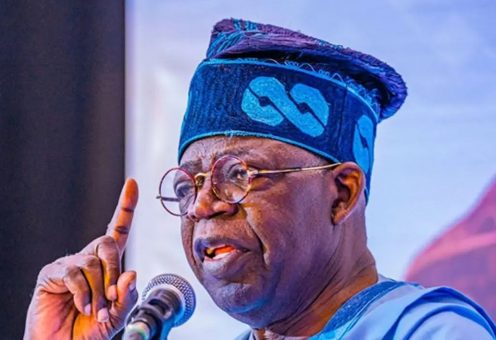
President Bola Ahmed Tinubu has reaffirmed Nigeria’s determination to defeat terrorism and preserve its national unity, declaring that the country will never surrender to violent groups seeking to destabilise the nation. The president made the declaration on Monday, 9 March 2026, during an interfaith Ramadan breaking-of-fast gathering with religious and traditional leaders held at the Presidential Villa in Abuja.
The event, which formed part of the federal government’s engagement with faith leaders during the Muslim holy month of Ramadan, brought together prominent representatives from Nigeria’s major religious organisations, traditional institutions, and senior government officials. Among those present were leaders from the Christian Association of Nigeria and the Nigeria Supreme Council for Islamic Affairs, as well as traditional rulers representing various communities across the country’s six geopolitical zones.
Addressing the gathering, President Tinubu acknowledged the persistent security challenges confronting Nigeria but emphasised that his administration remains fully committed to confronting terrorism, banditry, and other forms of violent criminality threatening national stability. He stressed that Nigeria’s security forces, including the military, police, and intelligence agencies, are intensifying coordinated operations aimed at dismantling terrorist networks and restoring peace in affected regions.
The president noted that terrorist groups operating in parts of northern Nigeria have become increasingly desperate as a result of intensified security operations. According to him, the federal government is determined to ensure that the country’s territorial integrity and democratic institutions are protected against forces attempting to undermine them.
“Nigeria will not surrender to terrorism or intimidation,” Tinubu told the gathering. “Yes, we face challenges, but our resolve as a nation remains strong. Our security agencies are confronting these threats head-on, and we will continue our operations until terrorism is defeated and lasting peace is restored across the country.”
Tinubu further emphasised that the fight against terrorism is not solely the responsibility of the armed forces but requires the collective support of citizens, community leaders, and religious institutions. He urged religious leaders to continue promoting messages of peace, tolerance, and unity within their communities while discouraging extremism and violence.
The president commended the role of religious and traditional leaders in maintaining social harmony and guiding citizens during difficult times. According to him, the interfaith Ramadan gathering symbolises Nigeria’s commitment to peaceful coexistence among its diverse religious and cultural groups.
Among the dignitaries represented at the event were leaders from the Muslim community under the authority of the Sultan of Sokoto, Sa’ad Abubakar. The delegation of traditional rulers was represented by the Etsu Nupe, Yahaya Abubakar, who emphasised the importance of unity and collaboration between government authorities and traditional institutions in addressing Nigeria’s security and developmental challenges.
In his remarks, the Etsu Nupe described the gathering as a powerful demonstration of interfaith solidarity and national unity. He called on Nigerians to continue supporting government initiatives aimed at promoting peace and stability while also encouraging citizens to remain vigilant against individuals or groups seeking to disrupt social harmony.
Also speaking at the event, the President of the Christian Association of Nigeria, Daniel Okoh, reiterated the Christian community’s commitment to supporting efforts aimed at strengthening peace and national development. Okoh urged Nigerians to remain united despite the country’s economic and security challenges, stressing that collaboration among citizens and government institutions is essential for national progress.
He also called on faith leaders across Nigeria to intensify prayers for peace, wisdom, and responsible leadership while encouraging citizens to avoid actions capable of deepening social divisions or ethnic tensions.
Beyond the issue of national security, President Tinubu used the occasion to reflect on Nigeria’s economic situation and the reforms introduced by his administration since assuming office on 29 May 2023. He noted that when his government came into power, the country faced severe fiscal pressures and structural economic challenges that required bold and sometimes difficult policy decisions.
According to the president, the economic reforms implemented by his administration—including measures aimed at strengthening public revenue and stabilising government finances—are gradually beginning to produce positive outcomes. Tinubu explained that improved revenue inflows have enabled the federal government to increase allocations to state governments, helping them meet salary obligations, invest in infrastructure, and provide essential social services to their citizens.
He added that the federal government is also implementing targeted interventions designed to support vulnerable groups, including pensioners and low-income households, as part of broader efforts to cushion the effects of economic reforms and rising living costs.
Nigeria has faced persistent security threats for more than a decade, particularly from extremist groups operating in the North-East region. The insurgency linked to groups such as Boko Haram and the Islamic State West Africa Province has resulted in thousands of deaths, displacement of communities, and destruction of infrastructure across several states, including Borno, Yobe, and Adamawa.
In addition to insurgency, several northern states have experienced widespread banditry and kidnapping activities, particularly in regions of the North-West and parts of the North-Central zone. These criminal networks have targeted rural communities, schools, highways, and farming settlements, raising concerns about national security and economic stability.
The federal government has repeatedly pledged to strengthen coordination among security agencies, invest in intelligence gathering, and deploy modern technology to enhance counter-terrorism operations. Authorities have also increased collaboration with regional partners and international allies in efforts to combat transnational terrorism and organised crime in West Africa.
President Tinubu concluded his remarks by urging Nigerians to remain resilient and optimistic about the country’s future. He emphasised that national unity, strong institutions, and the collective commitment of citizens will ultimately determine Nigeria’s ability to overcome its current challenges.
According to the president, Nigeria’s diversity remains one of its greatest strengths, and the cooperation of religious leaders, traditional institutions, and civil society organisations will continue to play a vital role in sustaining peace, strengthening democracy, and promoting national development.


