


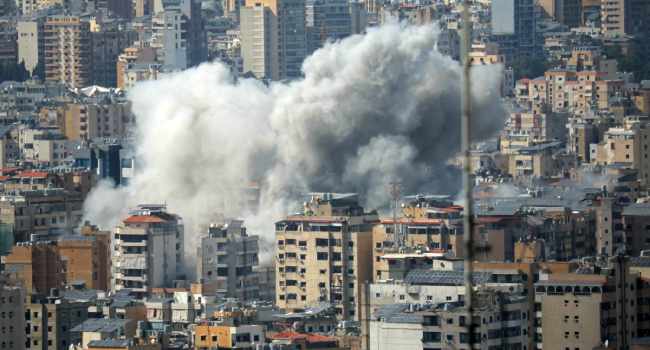
Smoke rises from the site of an Israeli strike in Beirut’s southern suburbs.
The conflict in the Middle East continues to generate diplomatic, political, and security repercussions across several regions, as governments respond to the fallout from the confrontation involving Iran, Israel, and the United States.
From renewed peace efforts in Islamabad to debates within NATO and continued violence along the Lebanon border, the latest developments highlight the far-reaching impact of the crisis.
 US Vice President JD Vance waves as he boards Air Force Two after attending talks on Iran in Islamabad on April 12, 2026. Iran and the United States failed to reach an agreement to end the war in the Middle East, US Vice President JD Vance said April 12 after marathon talks in Islamabad, adding that he was leaving negotiations after giving Tehran the “final and best offer”.
US Envoys Head to Islamabad for Iran Talks
Senior United States envoys arrived in Islamabad on Saturday in an effort to restart a new round of peace negotiations with Iran following a fragile ceasefire.
According to the White House, presidential emissaries Steve Witkoff and Jared Kushner are expected to hold an in-person meeting with Iranian representatives.
The move is being seen as part of Washington’s efforts to reduce tensions and prevent a wider regional escalation after recent hostilities disrupted energy markets and heightened security concerns.
However, uncertainty remains over whether direct negotiations will take place. Iranian state media reported that formal face-to-face talks were unlikely at this stage, suggesting discussions may instead occur through intermediaries or parallel diplomatic channels.
Meanwhile, Abbas Araghchi had already arrived in Islamabad ahead of the anticipated meetings, raising expectations that indirect contacts or backchannel diplomacy could still proceed.
Observers say Pakistan’s role as host underscores its growing importance as a neutral venue for sensitive international dialogue.
Spain Reaffirms Commitment to NATO
In Europe, Pedro Sánchez has reaffirmed that Spain remains a dependable member of NATO amid reports of possible tension with Washington over military policy related to Iran.
Sánchez said Spain is a “reliable member” of the alliance after a Reuters report claimed that the United States had considered options to suspend Spain from NATO structures due to Madrid’s refusal to support military operations against Iran.
The report cited an unnamed US official who said the Pentagon had examined punitive measures against allied nations that did not align with the US-Israeli military posture during the conflict.
Spain has maintained a cautious diplomatic line, favouring de-escalation and negotiated solutions over direct military involvement.
The controversy has renewed debate within NATO over burden-sharing, alliance unity, and how member states should respond when conflicts fall outside traditional collective defence scenarios.
Political analysts note that divisions among allies often emerge during Middle East crises, particularly when national interests, domestic politics, and energy security concerns differ.
Kuwait Releases Detained Journalist
In Kuwait, authorities have released an American-Kuwaiti journalist who had been detained during a crackdown linked to wartime media coverage.
A United States State Department official confirmed the release of Ahmed Shihab-Eldin, a media professional who has contributed to The New York Times, PBS, and Al Jazeera English.
He was reportedly arrested on March 3 over allegations of spreading false information, harming national security, and misusing his mobile phone.
The detention had raised concerns among press freedom advocates and international observers who warned against restrictions on journalists during periods of conflict.
His release may ease diplomatic pressure on Kuwait, though rights groups continue to call for stronger protections for journalists and online expression across the region.
US Freezes $344 Million in Cryptocurrency
The United States has also intensified financial pressure on Tehran by freezing cryptocurrency assets valued at $344 million over alleged ties to Iran.
US Treasury Secretary Scott Bessent said the seizure forms part of broader efforts to disrupt funding channels linked to Iranian interests.
Washington has increasingly targeted digital assets, informal financial networks, and sanctions evasion routes as part of its strategy to constrain Iran’s economic capacity during the ongoing crisis.
Officials argue that cryptocurrencies can be used to bypass traditional banking restrictions, finance procurement, or move funds across borders beyond standard regulatory systems.
The latest action comes as global markets continue to react to energy supply disruptions and uncertainty surrounding shipping routes and oil infrastructure in the Gulf region.
Energy traders remain watchful, as any prolonged instability involving Iran could affect crude exports, insurance costs, and transportation through strategic maritime corridors.

Iranians rally during a memorial, 40 days after a deadly strike on a children’s school in the southern city of Minab on the first day of the war that killed at least 165 people, most of them children, in Tehran on April 7, 2026. On February 28, Israel and the United States launched strikes on Iran, killing its supreme leader and triggering a war that spread across the Middle East.
Israeli Strikes Kill Six in Lebanon
Despite an existing ceasefire, cross-border violence between Israel and Hezbollah continues to claim lives in Lebanon.
The Lebanese health ministry said Israeli strikes on Friday killed six people and injured two others in southern Lebanon.
According to the ministry, the attacks occurred on April 24 and targeted areas near the border where tensions have remained high despite diplomatic attempts to maintain calm.
The more than six-week confrontation between Israel and Hezbollah has caused significant casualties, displacement, and infrastructure damage in border communities on both sides.
Although a ceasefire framework remains in place, repeated exchanges of fire and airstrikes have threatened to unravel the truce.
Regional diplomats have warned that any major escalation on the Lebanon front could widen the broader Middle East war and complicate already fragile peace efforts involving Iran.
Growing Global Concern
Taken together, the latest developments reflect a conflict that extends well beyond direct battlefield confrontations.
Diplomatic missions are underway in Pakistan, alliance tensions are surfacing in Europe, media freedoms are under scrutiny in the Gulf, economic pressure is increasing through sanctions and asset seizures, and violence continues on Israel’s northern frontier.
International leaders are now focused on whether ceasefire arrangements can hold and whether fresh negotiations can produce a more durable reduction in hostilities.
For now, the Middle East remains on edge, with the potential for either renewed diplomacy or renewed escalation shaping the next phase of the crisis.

