


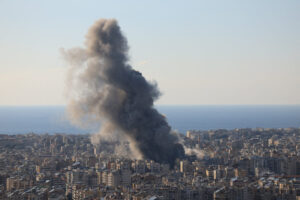
Smoke billows after an Israeli strike on Beirut’s southern suburbs, following an escalation between Hezbollah and Israel amid the U.S.-Israeli conflict with Iran, Lebanon, March 2, 2026.
Iran has accused the United States of killing five civilians during a naval operation in the strategically vital Strait of Hormuz, sharply contradicting Washington’s account of the incident and further straining an already fragile ceasefire between the two countries.
According to Iranian officials, US forces targeted two small passenger boats carrying civilians traveling from the Omani coastal town of Khasab to Iran. The vessels were reportedly destroyed, resulting in the deaths of five passengers. Iran’s state broadcaster, Islamic Republic of Iran Broadcasting, cited an unnamed military commander who said an investigation found no evidence that vessels belonging to the Islamic Revolutionary Guard Corps were hit, rejecting US claims entirely.
In contrast, US Central Command, led by Admiral Brad Cooper, stated that American forces had engaged and sunk multiple IRGC boats attempting to disrupt a naval escort mission. The operation, referred to as “Project Freedom,” was aimed at facilitating the safe passage of vessels stranded in the waterway following heightened regional tensions. Donald Trump later suggested that as many as seven Iranian boats had been destroyed.
The incident has raised serious concerns about the stability of a ceasefire agreement reached on April 8, with both sides now trading accusations that risk escalating into broader conflict. The Strait of Hormuz remains a focal point of the الأزمة as it serves as a critical artery for global energy supplies, with roughly one-fifth of the world’s traded oil passing through it.
Iran has since reinforced its position, insisting on maintaining control over the strait and introducing transit conditions it describes as reparations for damages caused by earlier US and Israeli military actions. Senior Iranian official Mohammad Bagher Ghalibaf warned that continued US activity in the region threatens maritime security and could further destabilize global energy markets.
Tensions have also spread beyond US-Iran interactions. The United Arab Emirates reported a drone and missile attack on one of its oil tankers and infrastructure in Fujairah, resulting in injuries and a significant fire at a refinery. While Iran denied direct involvement, it attributed the الأحداث to what it described as US “military adventurism.”
Meanwhile, commercial shipping has been increasingly affected. A South Korean vessel reported an onboard explosion, while global shipping companies, including Maersk, confirmed that some ships continue to transit the strait under US military escort.
Despite the escalating rhetoric, Iran’s Foreign Minister Abbas Araghchi emphasized that diplomacy remains the only viable path forward, noting that indirect talks with the US are ongoing with mediation from Pakistan.
However, President Trump has maintained a hardline stance, warning of overwhelming military retaliation if US assets are targeted, signaling that while diplomatic channels remain open, the risk of further confrontation in one of the world’s most critical waterways remains high.

