


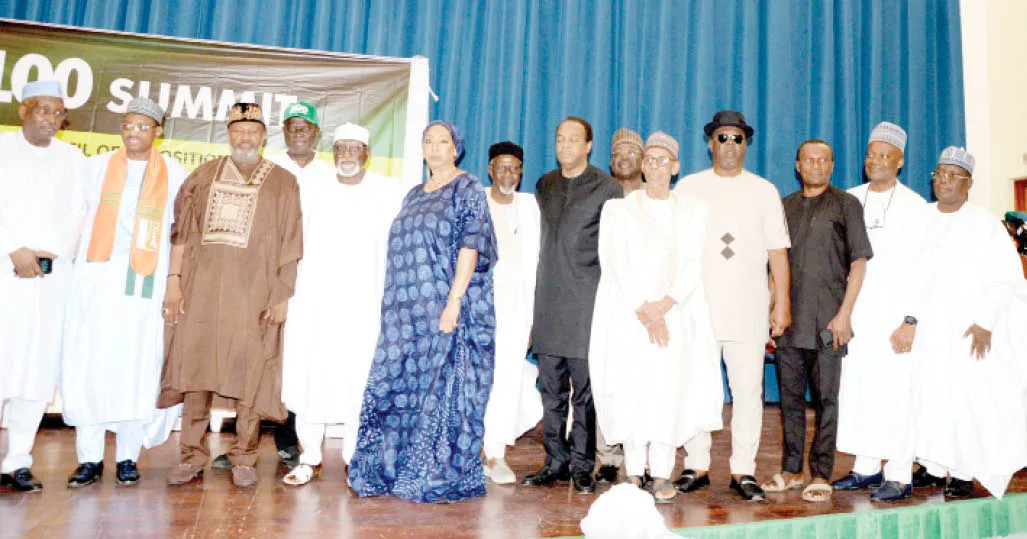
Six opposition political parties have opened negotiations on a possible alliance ahead of the 2027 general elections, with a proposed single-term transition charter and a common presidential candidate among the key ideas on the table.
The African Democratic Congress (ADC), Allied Peoples Movement (APM), Nigerian Democratic Congress (NDC), Peoples Democratic Party (PDP), Peoples Redemption Party (PRP) and Social Democratic Party (SDP) reached the agreement at the G100 First Summit of Party Leaders and Stakeholders in Abuja.
The parties agreed to begin structured negotiations aimed at determining how they can work together and present a stronger challenge to the ruling All Progressives Congress (APC).
As part of the process, five working groups will be established to develop key documents within four weeks, including a “Roadmap to a Common Presidential Candidate” and a “Single-Term Transition Charter.”
Other proposed documents include a National Covenant for Democratic Renewal, National Reform Programme and Framework for Opposition Unity.
The coalition also plans to establish three permanent organs: a Central Leadership Committee, Publicity and Communication Committee, and Legal Committee.
The Central Leadership Committee will provide political direction, while the other two bodies will coordinate public communication and address legal and constitutional matters.
2023 Election Lessons
G100 facilitator Salihu Lukman said the initiative was driven by lessons from the 2023 presidential election, when opposition votes were divided among several candidates.
According to him, opposition parties collectively secured about 13 million votes in 2023 but failed to convert their combined strength into victory because they contested separately.
Lukman argued that the opposition could learn from the political cooperation that produced a change of government in 2015, when parties agreed on the rules of cooperation before deciding who would emerge as their candidate.
He said the current process was not demanding that parties immediately dissolve or withdraw their presidential candidates.
Instead, he said the objective was to create a platform where the parties could negotiate their interests and establish a common strategy.
‘Someone Will Have to Sacrifice’
Lukman acknowledged that achieving opposition unity would require difficult political compromises.
“There is no version of this that costs nobody anything. Someone in this hall will have to accept an outcome he/she did not want. That is what unity is,” he said.
House of Representatives Minority Leader Fredrick Agbedi also urged opposition politicians to put aside personal ambitions and focus on defeating the APC.
Agbedi said the House Minority Caucus had partnered with G100 because it wanted opposition parties to streamline their ambitions and build a stronger platform capable of winning the 2027 election.
He stressed that the caucus had no preferred presidential candidate and was only interested in achieving greater unity among opposition forces.
Single Candidate Not Guaranteed
However, some opposition figures cautioned against making a single presidential candidate the only measure of the coalition’s success.
ADC National Vice Chairman, South-South, Usani Usani, asked whether failure to produce one candidate should automatically be viewed as a failure of the opposition.
He suggested that parties could instead coordinate strategically in areas where individual parties have stronger political structures.
ADC spokesman Bolaji Abdullahi similarly said the party supports opposition cooperation but argued that the objective should be broader than simply producing a common presidential candidate.
He said cooperation could extend to election monitoring, preventing electoral malpractice and presenting a united front against the ruling party.
Experts Warn of Major Challenges
Political analysts have expressed mixed views about the prospects of the proposed alliance.
Prof. Atah Pine of Benue State University said the opposition could struggle to convince major presidential contenders to withdraw their ambitions. He suggested that the parties might instead develop a strategic arrangement based on their relative strengths across different parts of the country.
Prof. Saleh Dauda of the University of Abuja, however, said a single opposition candidate was possible if major contenders were willing to sacrifice their personal ambitions for a common cause.
He identified the willingness of politicians to step aside for another candidate as one of the biggest obstacles facing the proposed coalition.
Prof. Hassan Saliu of the University of Ilorin also warned that personal ambitions and ideological differences could undermine the alliance, urging the opposition to learn from Nigeria’s political history.
With the 2027 election approaching, the opposition parties now face the difficult task of turning their agreement in Abuja into a workable political alliance — and ultimately deciding whether they can unite behind one candidate or pursue a broader strategy to challenge the APC.