


 ABUJA, Nigeria — The National Commission for Almajiri and Out-of-School Children Education has come under scrutiny after allocating ₦8.4 billion in its 2026 budget for road construction projects, despite road infrastructure falling outside the agency’s statutory responsibilities.
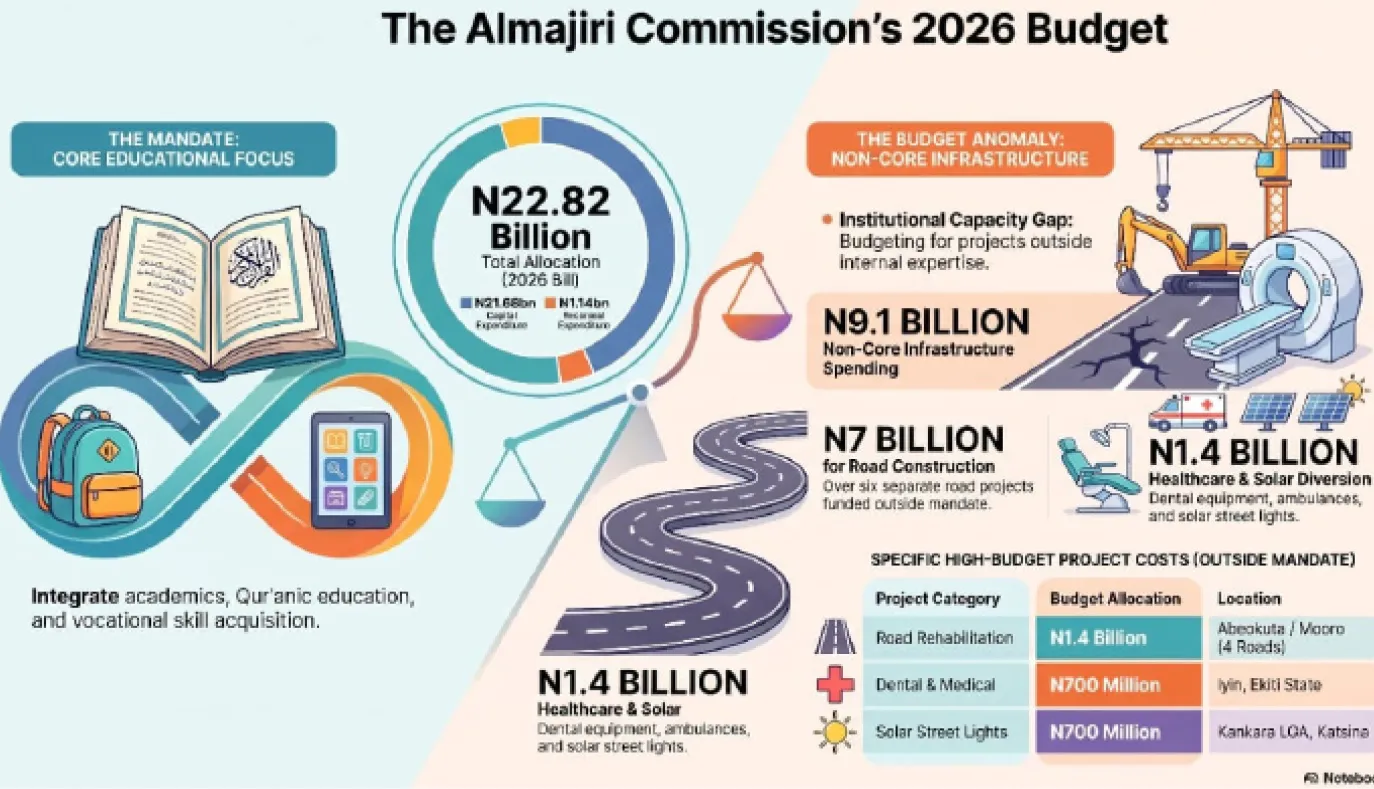
An analysis of the 2026 Appropriation Act shows that the commission received a total allocation of ₦22.82 billion, comprising ₦21.68 billion for capital projects and ₦1.14 billion for recurrent expenditure.
Beyond road construction, the commission also budgeted for projects including ambulances, dental equipment, solar-powered streetlights and empowerment programmes across Ogun, Ekiti and Katsina states, prompting concerns over whether the spending aligns with its legal mandate.
Commission’s Core Mandate Focuses on Education
Established by an Act of Parliament in May 2023 under the supervision of the Federal Ministry of Education, the commission was created to tackle Nigeria’s growing out-of-school children crisis by integrating formal education, Qur’anic learning and vocational skills.
Its statutory responsibilities include coordinating Almajiri education programmes, supporting state governments, improving learning centres, training teachers, providing educational materials, promoting school enrolment and implementing child protection measures.
However, budget analysts note that infrastructure projects such as road construction and medical facility upgrades are not listed among the commission’s legally assigned functions.
Road Projects Receive Largest Share
Budget documents indicate that the commission earmarked billions of naira for road construction and rehabilitation projects across several states.
Among the allocations are:
₦1.4 billion for multiple road projects in Ogun State, including roads in Abeokuta, Lusada, Soyoye and Imeko.
₦2.1 billion for additional road rehabilitation projects in Ipokia and other communities in Ogun State.
₦2.1 billion for internal road construction projects in Katsina State.
₦1.4 billion for internal roads within Government Science College, Iyin, Ekiti State.
The commission also proposed:
₦700 million for ambulances, dental chairs, X-ray machines and furniture for a dental centre in Ekiti State.
₦700 million for solar-powered streetlights in communities within Kankara Local Government Area of Katsina State.
₦700 million for women and youth empowerment initiatives in Katsina State.
Budget Office Points to National Assembly
When contacted, Executive Secretary of the commission, Dr. Muhammad Sani Idris, said he would need time to review the details before commenting publicly.
A source within the Budget Office of the Federation, who spoke anonymously, explained that such projects are often introduced during the National Assembly’s budget review process.
According to the source, lawmakers sometimes insert constituency projects into the budgets of federal agencies, regardless of whether the projects fall within the agencies’ statutory mandates.
The source added that agencies often implement such projects after budget approval, even when they are unrelated to their primary responsibilities.
Senate Source Says Practice Is Common
A source familiar with the Senate Appropriations Committee described the practice as longstanding.
According to the source, constituency projects are routinely assigned to various government agencies for implementation once funding is approved.
The source said lawmakers monitor the execution of such projects while the selected agencies serve as implementing bodies, irrespective of their original mandates.
Civil Society Groups Raise Alarm
Civil society organisations and public finance experts have criticised the allocations, warning that assigning projects outside an agency’s legal responsibilities weakens accountability and reduces the effectiveness of public institutions.
Executive Director of the Civil Society Legislative Advocacy Centre (CISLAC), Auwal Musa Rafsanjani, described the budget as an example of mandate distortion.
He argued that agencies established to address educational challenges should focus their resources on improving learning outcomes rather than executing infrastructure projects traditionally handled by ministries responsible for public works.
According to him, such practices create confusion over institutional responsibilities, weaken transparency and complicate oversight.
Experts Warn Education May Suffer
Fiscal transparency advocate Dr. Umar Yakubu said Nigeria’s estimated 20 million out-of-school children require greater investment in classrooms, teachers, learning materials and educational technology rather than road projects.
He warned that diverting resources away from education could undermine the commission’s ability to achieve its objectives.
Yakubu also questioned why the National Assembly approved projects unrelated to the commission’s mandate, saying the practice risks turning specialised agencies into vehicles for unrelated constituency projects.
Similarly, Ibrahim Yusuf, Chairman of the Gombe Network of Civil Society Organisations, described the allocations as another example of misplaced priorities in public spending.
He called for stronger oversight of the budgeting process and urged the executive, legislature and anti-corruption agencies to ensure government institutions spend public funds strictly within their legal mandates.
The commission has yet to issue a detailed explanation regarding the controversial allocations.
Almajiri Commission Budgets N8.4bn for Road Projects, Sparks Accountability Concerns


- Advertisment -