


For years, Nigeria has never been short of ideas.
Across universities, research centres, technology hubs and workshops, Nigerian innovators have continued to develop solutions to some of the country’s biggest challenges. The problem, however, has often been what happens next.
Too many promising ideas remain prototypes, research papers or demonstrations without making the difficult journey into factories, businesses and everyday life.
That is the gap the National Agency for Science and Engineering Infrastructure (NASENI) says it is now determined to close.
As part of the Tinubu administration’s Renewed Hope Agenda, the agency is pushing to move Nigerian innovations beyond laboratories and into the marketplace, with a focus on technology transfer, manufacturing, commercialisation and strategic partnerships.
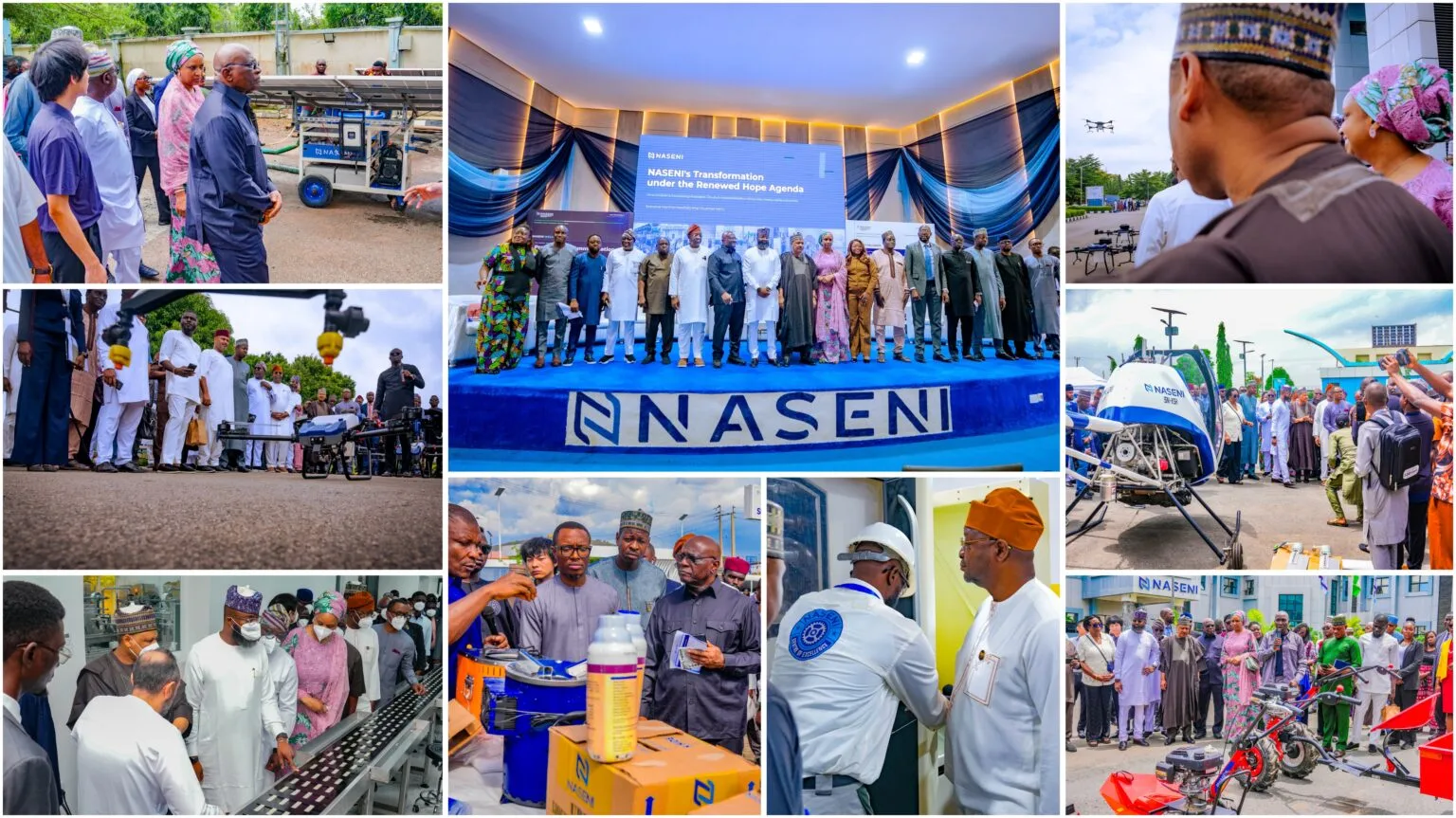
A Presidential Renewed Hope Media Tour gave journalists, government officials and private-sector representatives an opportunity to see some of these projects firsthand during a visit to NASENI facilities in Abuja on August 4, 2026.
What they saw included locally assembled electric vehicles, e-tricycles, drones, solar technologies, agricultural innovations, medical diagnostic kits and sophisticated reverse-engineering equipment.
For the officials on the tour, the message was clear: Nigeria has the talent to develop technologies locally if the right institutions, investments and partnerships are put in place.
Beyond the Laboratory
NASENI Executive Vice Chairman and Chief Executive Officer, Khalil Suleiman Halilu, said the agency is moving away from the traditional model where research institutions develop prototypes without taking responsibility for their commercialisation.
Instead, NASENI is building its strategy around what it calls the 3Cs: Creation, Collaboration and Commercialisation.
The idea is straightforward: create indigenous solutions, collaborate with partners to improve and scale them, and ultimately turn successful innovations into products and businesses.
Halilu, however, stressed that Nigerian industrialisation does not mean manufacturing every single component locally.
In a global economy, even the world’s largest technology companies depend on international supply chains. For Nigeria, he said, the smarter approach is to identify areas where the country has an advantage, develop expertise in those areas and use partnerships to fill technological gaps.
If successful, the strategy could create jobs, reduce production costs, shorten supply chains and lower dependence on imported products.
Medical Technology Takes Centre Stage
One of NASENI’s notable projects is its partnership with Troment at its facility in Idu, Abuja.
The factory is supporting local production of rapid diagnostic kits, with the agency aiming to reduce Nigeria’s dependence on imported rapid-test kits by about 80 percent.
Beyond reducing imports, the project is intended to create domestic expertise that can support continued innovation in medical technology.
For a country that spends significant amounts importing medical equipment and supplies, developing this capacity could have major economic and healthcare implications.
Building a Clean-Energy Industry
NASENI is also expanding into renewable energy and alternative fuels.
At Gora in Nasarawa State, the agency is developing a 40-hectare Solar Industrial Park designed to support solar manufacturing on a larger scale.
Other projects include CNG conversion and refuelling facilities in Abuja and a partnership supporting solar streetlight production in Ogun State.
The projects come as Nigeria continues searching for ways to improve energy security while reducing the cost of electricity, transportation and industrial production.
Electric Vehicles Made in Nigeria
Electric mobility is another major part of NASENI’s industrialisation push.
During the media tour, visitors saw locally assembled electric vehicles, e-tricycles and electric bikes.
The programme is aimed at helping Nigeria develop expertise in an industry that is rapidly changing the global automobile market.
Rather than simply importing electric vehicles, NASENI is seeking to build local capacity around their production, maintenance and supporting technologies.
Drones for Security and Agriculture
The agency is also investing heavily in unmanned aerial technology.
NASENI showcased drones designed for applications including surveillance, agriculture, building maintenance and precision operations.
Some of its surveillance drones are capable of precise take-off, navigation, return and landing, while agricultural drones can be programmed to spray crops autonomously.
The agency has also trained drone pilots, including female engineers, and hopes to expand UAV training to government agencies, farmers and other users.
The technology could become increasingly important in agriculture, security and environmental monitoring.
Reverse Engineering: Making Nigeria Less Dependent
One of the most striking technologies showcased during the tour was NASENI’s advanced reverse-engineering capability.
At its Centre of Excellence, engineers use sophisticated equipment to analyse industrial components and recreate them locally.
A seven-axis scanner at the centre can reportedly capture physical components with accuracy measured in just a few microns before converting them into computer-aided design files.
This means Nigerian engineers can potentially reproduce damaged or imported components without waiting for foreign manufacturers or sending parts overseas.
For local manufacturers, that could mean faster repairs, lower costs and reduced dependence on imported spare parts.
The centre can also reverse-engineer samples and produce customised moulds for mass production.
Even Scrap Is Being Reused
NASENI is applying its manufacturing philosophy to industrial waste as well.
Scrap iron generated from its operations is recycled through an in-house furnace and transformed into new products, including horseshoes.
The agency describes this as part of its zero-waste manufacturing approach—turning materials that would normally become waste into useful industrial inputs.
Investing in Nigeria’s Young Innovators
Technology, however, is only one part of the equation.
NASENI is also investing in the people who will operate and expand Nigeria’s future industrial economy.
Its FutureMakers Programme introduces children between the ages of five and 16 to science, technology, engineering and mathematics.
Programmes such as DELT-Her and SheFly are focused on increasing women’s participation in engineering, research and drone technology.
The agency also runs skills-development programmes and the InnovateNaija Challenge, which it says has a ₦500 million prize fund aimed at identifying and supporting promising Nigerian innovations.
Successful innovators receive mentorship and opportunities to connect with factories and commercial partners capable of helping them take their ideas to market.
From Innovation to Investment
NASENI has also established NASENI HoldCo as its commercial and investment vehicle.
The agency’s showroom is designed to connect Nigerian technologies with investors, businesses and consumers, while research commercialisation grants are intended to help researchers turn academic discoveries into market-ready products.
This focus on commercialisation could be one of the most important changes in NASENI’s approach.
An invention sitting in a laboratory may be impressive, but its economic impact remains limited until someone can manufacture it, sell it, employ people to produce it and develop a sustainable business around it.
Government Wants Nigerians to Buy Nigerian Technology
Minister of Information and National Orientation Mohammed Idris said the developments at NASENI deserve greater public attention.
He called on the media to communicate government programmes more effectively while acknowledging that there is still much work to be done.
Other members of the Presidential Communications Team also stressed the importance of government agencies and public institutions patronising Nigerian-made technologies.
Special Adviser to the President on Policy and Coordination, Hadiza Bala Usman, emphasised strategic communication, public-sector patronage and greater visibility for Nigerian innovations.
Special Adviser to the President on Media and Public Communication, Sunday Dare, described the NASENI tour as a major eye-opener and said the agency could play an important role in ensuring the Nigeria First Policy translates public spending into stronger domestic industrial capacity.
The Bigger Picture
NASENI’s strategy ultimately goes beyond producing machines.
The agency’s six strategic areas—innovation, clean energy, Made-in-Nigeria manufacturing, food systems, future skills and strategic technologies—are all connected by one objective: industrialisation.
Nigeria does not necessarily need to manufacture everything it consumes.
But it needs to develop the ability to manufacture more of what it can, understand and adapt the technologies it imports, create strong partnerships, train its people and turn promising ideas into commercially viable businesses.
That is the real test for NASENI.
If the agency can successfully move innovations from laboratories to factories, and from factories into markets, the impact could go far beyond technology.
It could mean new industries, skilled jobs, stronger local businesses, increased exports and less dependence on imports.
For decades, Nigeria’s challenge has been turning its enormous pool of ideas into economic value.
NASENI is now betting that the next chapter will be about making those ideas work—not just on paper or in laboratories, but on factory floors and in the hands of Nigerians.
From Ideas to Industry: How NASENI Is Turning Nigerian Innovation Into Jobs, Factories and Businesses


- Advertisment -