


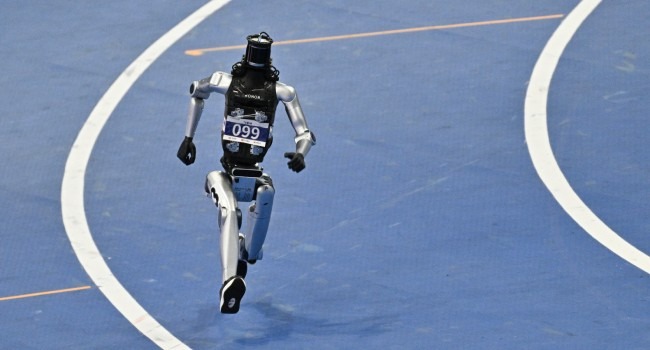
A Chinese humanoid robot has stunned spectators at the World Robot Games in Beijing after clocking a time faster than Usain Bolt’s 100-metre world record, as China continues to showcase its growing strength in robotics.
Faceless humanoid robots took over an Olympic speed skating arena in Beijing over the weekend, competing in athletics, boxing, football and martial arts events.
The biggest surprise came from Tiangong Ultra, a white, headless humanoid robot that reportedly completed the 100-metre sprint in 9.39 seconds, according to Chinese state broadcaster CCTV.
The time was faster than Jamaican sprint legend Usain Bolt’s world record of 9.58 seconds, set in 2009.
Robot Breaks Another Record
Tiangong Ultra did not stop at the 100-metre race.
The same robot reportedly smashed the 400-metre record the following day, completing the race in 38.16 seconds, with the time later revised to 38.15 seconds.
The humanoid was developed by a government-backed research centre in Beijing, highlighting China’s growing investment in artificial intelligence and robotics.
During one of the races, however, the robot nearly lost its balance as it raced around the track.
It swung its arms wildly and leaned forward before wobbling towards the finish line. Despite the shaky performance, it managed to stay upright and complete the race.
Not Every Robot Was A Winner
While some robots impressed spectators with their speed, others struggled badly.
Several failed to even start their races, while others moved around the track at little more than walking pace. Some robots collapsed almost immediately after the starting signal.
The unusual performances provided plenty of entertainment for the crowd, with spectators laughing and cheering as the machines struggled to stay on their feet.
The football competition was also filled with funny moments, including a toddler-sized robot that kicked the ball over the pitch and beyond the knee-high barriers.
In the boxing event, one humanoid stumbled towards the edge of the ring before collapsing over the ropes. Human handlers eventually had to carry it away.
Spectators Want Robots To Face Humans
The robot competitions attracted hundreds of spectators, including families and children who watched the machines compete.
For 72-year-old Beijing resident Hou Yali, the records were impressive, but she believes the real test would be to see robots compete directly against humans.
She said such competitions would make it easier to determine whether robots could truly surpass humans rather than simply demonstrate speed.
Hou added that she would also like to see robots perform everyday tasks such as cleaning homes and preparing meals.
The Beijing games offered a glimpse into the rapid development of humanoid technology, but the mixed performances also showed that robots still have plenty of room for improvement.