


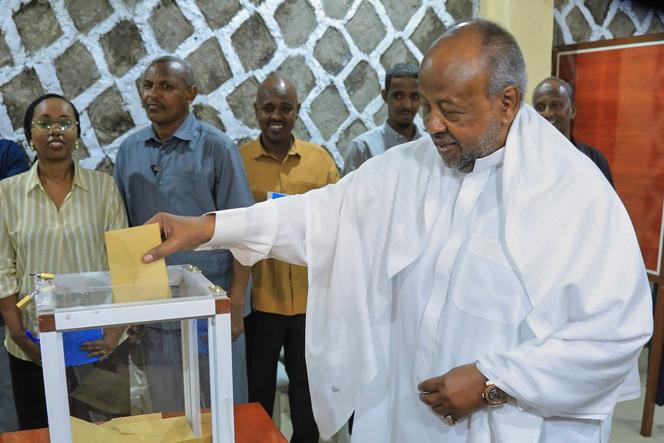
 President Ismaïl Omar Guelleh of Djibouti has been reelected for a sixth term in office after official results from Friday’s presidential election showed him winning an overwhelming 97.81 percent of the vote. The outcome further extends his more than two-decade hold on power in the strategically important Horn of Africa nation.
The 78-year-old leader, who first assumed office in 1999, has remained one of Africa’s longest-serving presidents. His latest victory comes despite earlier assurances that his fifth term would be his last. Those expectations were later overtaken by constitutional changes that enabled him to remain eligible for office beyond the previous age limit of 75.
Election authorities described the poll as peaceful and orderly, while celebrations broke out at the presidential palace where supporters gathered to congratulate the incumbent.
Government officials hailed the result as a clear endorsement of Guelleh’s leadership and his record of maintaining stability in a region often marked by political unrest and insecurity.
However, the election has also drawn criticism from opposition voices and democracy advocates, who questioned the competitiveness of the process and the broader political environment in which it was conducted.
Guelleh faced only one challenger in the contest, Mohamed Farah Samatar, a former member of the ruling party. Political analysts had widely predicted a landslide victory for the president, noting that the election lacked the robust competition usually associated with pluralistic democratic systems.
Several opposition groups chose to boycott the poll, citing long-standing concerns over restrictions on political freedoms, media independence, and the ability of rival candidates to campaign freely. Critics described the election as a “masquerade” and a “foregone conclusion,” arguing that the result merely formalized an outcome many believed had been predetermined.
The latest vote highlights the entrenched nature of Djibouti’s political system, which has been dominated by one family and its allies for decades. Guelleh succeeded his uncle, former President Hassan Gouled Aptidon, who led the country from independence in 1977 until 1999. Since then, Guelleh has consolidated power through successive elections, constitutional amendments, and a firm grip over the state apparatus.
Supporters of the president credit him with preserving order and transforming Djibouti into a strategically vital state despite its small population of around one million people and limited natural resources. Located at the southern entrance of the Red Sea near one of the world’s busiest maritime routes, Djibouti occupies a position of enormous geopolitical significance.
Its proximity to the Bab el-Mandeb Strait, a chokepoint linking the Red Sea to the Gulf of Aden and the wider Indian Ocean, has made the country a focal point for international military and commercial interests. Djibouti hosts foreign military bases belonging to several major powers, including the United States, China, France, and Japan. Other nations, such as Italy, also maintain military personnel in the country.
These military partnerships generate significant revenue for the Djiboutian government and have helped underpin the national economy. In addition, the country’s ports serve as a critical trade lifeline for neighboring Ethiopia, a landlocked nation of more than 120 million people that relies heavily on Djibouti’s infrastructure for access to global markets.
Guelleh’s administration has frequently presented these achievements as evidence of effective governance, arguing that continuity in leadership has enabled Djibouti to attract foreign investment, strengthen security cooperation, and build key infrastructure.
Yet human rights organizations and political critics paint a different picture. They accuse the government of suppressing dissent, limiting press freedom, and curtailing civil liberties. Independent media outlets have faced pressure over the years, while opposition leaders have repeatedly alleged harassment and political exclusion.
Analysts say the combination of strategic importance and relative stability has often muted international criticism of governance concerns in Djibouti. Many foreign governments view the country as an indispensable security partner in a volatile region affected by piracy, terrorism threats, and conflicts in neighboring states such as Somalia, Sudan, and Yemen.
The latest reelection therefore reflects not only Guelleh’s domestic political dominance, but also the wider geopolitical realities that have strengthened his position over time.
Despite criticism, Guelleh remains firmly in control, and there is little indication of any immediate challenge to his rule. His decisive victory suggests that Djibouti’s current political order is set to continue, with the ruling establishment maintaining authority over the country’s institutions and future direction.
For many Djiboutians, the election result signals continuity and stability. For others, it underscores the limited prospects for democratic change in a nation where leadership has remained concentrated in the same circle for generations.
As Guelleh begins another term, attention is likely to focus on whether his administration can address calls for greater political openness while sustaining economic growth and managing Djibouti’s critical role on the international stage.
With the country’s strategic relevance only increasing amid shifting global power dynamics, Djibouti’s internal politics and leadership trajectory will continue to attract close scrutiny from regional observers and world powers alike.