


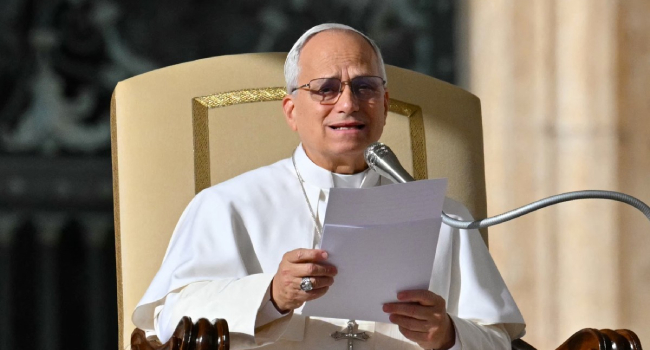
 Pope Leo XIV has clarified that recent remarks widely interpreted as a response to criticism from Donald Trump were never intended to spark a public confrontation with the American political figure.
Speaking to journalists on Saturday while travelling to Angola during his ongoing African tour, the pontiff said he regretted that his earlier comments had been misunderstood as an attempt to challenge Trump.
According to the Pope, a speech in which he condemned “tyrants” for plundering the world had been prepared long before Trump reportedly said he was “not a big fan” of the American-born pope.
The controversial remarks were delivered in Cameroon, the second stop on his African visit, where he addressed a range of global issues including inequality, leadership failure, and exploitation of vulnerable nations.
The Pope stressed that the timing of the speech created a false impression of political retaliation.
“It was perceived as if I were trying to start a new debate with the president, which doesn’t interest me at all,” he told reporters.
His statement appears aimed at cooling speculation that tensions were developing between the Vatican and Trump following the former U.S. president’s public criticism.
Focus on Global Challenges, Not Political Disputes
Rather than engaging in political disputes, Pope Leo has used his 11-day African tour to focus attention on broader global concerns, particularly peace, truth, technology, and environmental justice.
On Friday, the pontiff delivered one of his strongest speeches yet, warning about the dangers of artificial intelligence and the social consequences of unchecked digital expansion.
Addressing students and academics at the Catholic University of Central Africa in Yaounde, Cameroon, he said AI technologies risk deepening division and misinformation if not guided by ethics and responsibility.
“The challenge posed by these systems is greater than it appears,” he said. “It is not just about the use of new technologies, but about the gradual replacement of reality by its simulation.”
He warned that when truth becomes distorted or replaced by manipulated digital content, societies become more vulnerable to fear, violence, and political division.
“In this way, polarisation, conflict, fear and violence spread,” the Pope said.
The remarks reflect growing concern among world leaders and religious institutions over the rapid development of artificial intelligence, especially its role in spreading false information, intensifying political hostility, and undermining trust in democratic institutions.
Environmental Cost of the Digital Boom
In the same address, Pope Leo also criticised the environmental destruction linked to the global demand for rare earth minerals used in modern technology.
Rare earths are essential for producing smartphones, batteries, electric vehicles, and advanced computing systems. However, their extraction has often been associated with land degradation, pollution, and exploitation of poorer communities.
The Pope said the benefits of technological progress should not come at the cost of human dignity or environmental collapse.
His comments are especially significant during a visit to Africa, a continent rich in natural resources but often burdened by extractive industries that leave local communities with little economic benefit.
A More Vocal Papacy Emerging
Pope Leo’s latest comments signal a more outspoken phase of his papacy. Earlier in his leadership, he was seen as cautious and measured in addressing contentious international issues. However, this African tour has revealed a stronger willingness to speak directly on matters affecting humanity.
From war and political oppression to technology and ecological damage, the Pope has repeatedly called for moral leadership and international solidarity.
Observers say the trip has become a defining moment in his papacy, presenting him as a global spiritual voice willing to confront modern crises while avoiding personal political battles.
No Interest in Political Rivalries
Despite renewed media attention over Trump’s criticism, Pope Leo made clear that he does not intend to become involved in partisan conflict.
His clarification suggests a deliberate effort to keep the Church focused on humanitarian and spiritual priorities rather than personal disputes with political leaders.
As his African journey continues, the Pope’s message remains centered on peace, truth, justice, and responsible leadership in an increasingly divided world.