


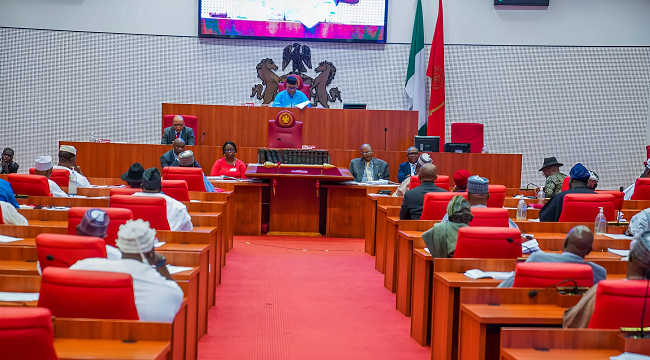
The Nigerian Senate.
The Senate of Nigeria has called for the immediate rescue of passengers abducted by suspected sea pirates along the Calabar–Oron waterways, while also demanding urgent action to tackle worsening insecurity across Nigeria’s inland maritime routes.
The Senate’s resolution followed growing concern over the hijacking of a commercial passenger boat travelling from Calabar to Oron, where at least 15 passengers were reportedly kidnapped during the attack.
Lawmakers expressed particular concern that several of the victims were prospective candidates for the 2026 Unified Tertiary Matriculation Examination, commonly known as UTME.

A photo combo of JAMB’s logo and UTME candidates.
The development has heightened fears not only over the safety of those abducted but also the possible disruption of their academic future.
Motion of Urgent National Importance
The matter was brought before the chamber through a motion of urgent national importance sponsored by Senator Ekong Sampson.
Presenting the motion, the senator drew attention to the increasing threat of piracy, kidnapping, and violent attacks on waterways used daily by traders, students, workers, and residents in the Niger Delta region.
He noted that the latest incident highlights serious gaps in maritime security despite repeated assurances from relevant authorities.
Lawmakers across party lines supported the motion, stressing that the lives of citizens must be protected whether on roads, rail lines, or waterways.
How the Attack Happened
According to accounts presented during plenary, the passenger boat was ambushed mid-journey by heavily armed pirates.
The attackers reportedly intercepted the vessel, seized control at gunpoint, and diverted passengers to unknown destinations.
The frightening incident reportedly left families of the victims in distress and increased anxiety across riverine communities in Cross River State and Akwa Ibom State.
Witness reports indicate that the assailants operated with speed and coordination, raising fresh concerns about organised criminal networks operating in coastal waters.
Senate Orders Immediate Security Response
In response, the Senate directed key security agencies to launch coordinated search-and-rescue operations for the safe return of all abducted passengers.
The chamber specifically called on:
- Nigerian Navy
- Nigeria Police Force
- Marine Police units
Other relevant security agencies
Lawmakers urged authorities to deploy all necessary resources, including intelligence, patrol teams, surveillance assets, and rapid response units to locate the victims and apprehend those responsible.

The Senate said no effort should be spared in securing the release of the abducted passengers.
Investigation into Maritime Insecurity
Beyond the immediate rescue mission, the Senate also ordered a broader investigation into the recurring security breaches along inland waterways in the Niger Delta.
To this end, it mandated its committees on:
- Navy
- Marine Transport
- National Security and Intelligence
to examine the root causes of piracy and criminal activity along the Calabar–Oron route and other vulnerable waterways.
The committees are expected to recommend practical solutions that can improve maritime safety, strengthen law enforcement presence, and restore public confidence in water transport.
Strategic Importance of the Calabar–Oron Route
Lawmakers noted that the Calabar–Oron waterway remains a major transport and commercial corridor connecting parts of Cross River and Akwa Ibom states.
The route is widely used by:
- Traders transporting goods
- Students travelling for examinations
- Workers commuting between states
- Residents in riverine communities
- Small-scale business operators
However, despite its economic importance, the route has increasingly become vulnerable to piracy, kidnapping, smuggling, and armed robbery.
The Senate warned that continued insecurity on the corridor could damage commerce, discourage travel, and weaken local economies.
Concern Over UTME Candidates
A major aspect of the Senate debate focused on reports that some of the abducted passengers were candidates preparing to sit for the 2026 UTME conducted by Joint Admissions and Matriculation Board.
Lawmakers said the incident exposes the dangers faced by young Nigerians who are often required to travel long distances to examination centres.
They warned that security threats, transportation difficulties, and poor logistics should not be allowed to destroy the educational dreams of students.
Senate Urges JAMB to Review Exam Logistics
As part of its resolutions, the Senate urged JAMB to reassess its candidate placement system.
Lawmakers called for reforms that would reduce the need for interstate travel and ensure candidates are posted to centres closer to their residences whenever possible.
According to the Senate, such reforms would:
- Improve candidate safety
- Reduce transport stress
- Lower travel costs for families
- Minimise exam lateness and absenteeism
- Protect students in insecure areas
The chamber said examination planning must take into account Nigeria’s current security realities.
Reference to Benue Kidnap Incident
The Senate also linked its concerns to another recent abduction involving passengers on a Benue Links bus travelling from Makurdi to Otukpo on April 15.
In that case, gunmen abducted 15 passengers and took them into a forest.
Security operatives later rescued 13 victims, while two reportedly escaped. Seven suspects were arrested.
Although initial reports denied that the victims included exam candidates, Governor Hyacinth Alia later confirmed that eight of those abducted were UTME candidates.
That revelation sparked nationwide calls for their examinations to be rescheduled.
Growing National Security Concerns
The latest Senate intervention reflects increasing concern over how insecurity is affecting transportation, education, and everyday life across Nigeria.
From highways to waterways, criminal attacks continue to disrupt mobility and expose vulnerable citizens to danger.
Analysts say stronger intelligence-sharing, more visible patrols, technology-driven surveillance, and closer coordination among agencies are needed to reverse the trend.