


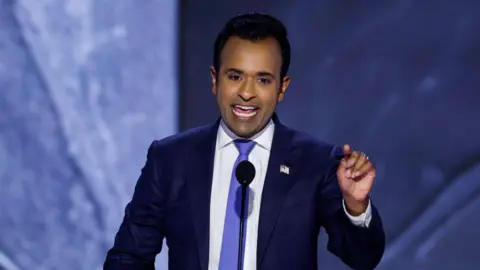
Vivek Ramaswamy
Vivek Ramaswamy has secured the Republican nomination for governor of Ohio, positioning the businessman-turned-politician for a closely watched general election contest in one of America’s most politically influential Midwestern states.
According to unofficial results reported by US media, Ramaswamy comfortably defeated his only major challenger, Casey Putsch an automotive designer and YouTube content creator in Tuesday’s Republican primary. His victory clears the way for a November showdown with Democratic nominee Amy Acton, the former Ohio public health director who became a prominent figure during the Covid-19 pandemic response.
Ramaswamy, a biotech entrepreneur who rose to national prominence during his 2024 presidential bid, enters the race with strong backing from former President Donald Trump. Trump publicly praised him on social media, describing him as “young, strong, and smart,” while signalling confidence in his ability to carry the Republican banner in Ohio. Vice President JD Vance, who previously represented Ohio in the US Senate, also participated in early voting efforts, underscoring the party’s unified push behind Ramaswamy’s candidacy.
From presidential outsider to state frontrunner
Ramaswamy first entered US national politics in 2023, positioning himself as an outsider candidate with a sharp media presence and aggressive debate style. Though his presidential campaign failed to gain sufficient voter support and ended early, it significantly raised his national profile. He later became a vocal supporter of Trump and worked as a campaign surrogate during the 2024 election cycle.
He also played a role in discussions around the proposed “Department of Government Efficiency,” a Trump-aligned initiative aimed at streamlining federal bureaucracy, before stepping back as the project evolved.
For his Ohio governor campaign, Ramaswamy has leaned heavily on his personal wealth and political visibility. Reports from The Columbus Dispatch indicate he has loaned his campaign around $25 million (£18.4 million), giving him a financial advantage in shaping statewide messaging and advertising.
A general election shaped by Covid-era politics
The November election is expected to revolve heavily around the legacy of the Covid-19 pandemic, particularly Ohio’s response under Republican Governor Mike DeWine, who is term-limited and cannot seek re-election.
Democratic nominee Amy Acton served as Ohio’s public health director during the pandemic and became one of the most visible public officials guiding the state through lockdowns, school closures, and emergency health measures. While Ohio adopted a comparatively moderate approach under DeWine, including temporary restrictions on public gatherings and in-person dining, the decisions remain politically divisive years later.
Acton, who ran unopposed in her primary, framed her campaign around affordability and economic relief. “It shouldn’t be this hard,” she said during her victory speech, pledging to prioritize working families and reduce the cost pressures facing Ohio residents.
Ramaswamy, meanwhile, has already begun attacking Acton’s pandemic record. In recent campaign messaging, he accused her of overreach during the crisis, including claims that she improperly influenced election-related decisions allegations that Governor DeWine has publicly disputed. DeWine has stated that he personally directed many of the emergency health measures, distancing Acton from claims of unilateral authority.
A shifting political landscape in Ohio
Ohio, once considered a key swing state, has shifted increasingly toward Republicans in recent election cycles. That trend, combined with strong national Republican backing and high-profile endorsements, gives Ramaswamy a structural advantage heading into November.
However, Democrats see Acton’s public health background and focus on cost-of-living issues as a counterbalance, particularly among suburban voters and moderates who may be wary of partisan pandemic debates.
Analysts expect the race to be among the most expensive and closely watched gubernatorial contests of 2026, with national implications for both parties as they test messaging ahead of future federal elections.
Wider Republican primary tensions
Elsewhere, Republican primaries in Indiana highlighted ongoing divisions within the party. Several state senators who previously opposed former President Trump’s proposed redistricting plan faced Trump-backed challengers in Tuesday’s contests.
Early results show multiple incumbents losing their seats, reflecting continued Trump influence over intra-party elections and the consequences faced by Republicans who resisted his redistricting push aimed at strengthening GOP electoral advantages.
In total, five Trump-supported challengers reportedly defeated incumbent senators, while one incumbent managed to hold their seat, with results still pending in another race.
What comes next
With his primary victory secured, Ramaswamy now transitions to a general election campaign that will test his ability to expand beyond Republican voters and appeal to independents in a politically evolving state.
The Ohio governor’s race is expected to intensify significantly in the coming months, with both campaigns focusing on economic conditions, public trust in government, and competing interpretations of the pandemic-era policy decisions that continue to shape American politics.

