

Google search engine
HomeNewsZambian Government Takes Possession of Edgar Lungu’s Body Amid Ongoing Repatriation Dispute

Zambian Government Takes Possession of Edgar Lungu’s Body Amid Ongoing Repatriation Dispute

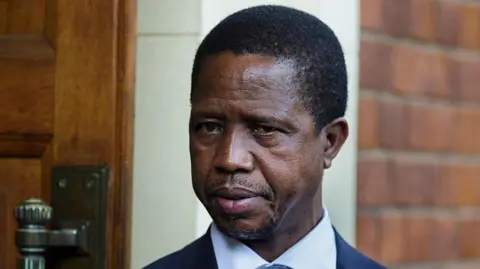
Getty Images A head and shoulders image of Edgar Lungu. His  blue collar and dark jacket can just be seen at the bottom of the picture.

Edgar Lungu led Zambia for six years from 2015

The government of Zambia has announced that it has taken possession of the body of former President Edgar Lungu, deepening a long-running dispute with his family over funeral arrangements and the final resting place of the late leader.

The development marks the latest chapter in an emotionally charged controversy that has unfolded since Lungu died in South Africa last June at the age of 68.

According to an official statement issued by Zambia’s Attorney General Mulilo Kabesha, the transfer of the body followed the family’s failure to proceed with an appeal against an earlier South African court ruling that permitted the Zambian state to repatriate the remains.

The government has maintained that, as a former head of state, Lungu should receive full national honours and be buried in Zambia alongside previous presidents at the designated presidential burial site in the capital, Lusaka.

However, members of the former president’s family have strongly opposed the government’s position, insisting that Lungu wished for a private burial and had expressed clear preferences regarding his funeral before his death.

The disagreement has exposed political tensions linked to the bitter rivalry between Lungu and his successor, President Hakainde Hichilema.

Relations between the two leaders were tense for years, shaped by fierce electoral competition, legal battles, and political confrontation during and after Lungu’s presidency.

Lungu served as Zambia’s president from 2015 until 2021, when he was defeated in a landslide election victory by Hichilema. That transfer of power was widely praised internationally as a democratic milestone, but domestic political divisions between supporters of both men remained.

Following Lungu’s death in Pretoria, the issue of funeral arrangements quickly became contentious. The family reportedly argued that the former president did not want Hichilema involved in his funeral or burial ceremonies.

Government officials, however, insisted that national protocol required state involvement, given Lungu’s status as a former president who once served as commander-in-chief and head of state.

Negotiations between both sides reportedly broke down, leading the matter to be contested in South African courts.

Last August, a South African court ruled in favour of the Zambian government, authorizing the repatriation of the former president’s remains and allowing the state to proceed with a funeral that would include official honours.

Lungu’s family challenged that ruling and filed an appeal, seeking to prevent the transfer and preserve their right to determine funeral arrangements.

In the latest turn, the Zambian government said the appeal could no longer proceed because the family had failed to continue the process within the required legal framework.

Attorney General Kabesha said this cleared the way for the government to take custody of the remains.

But the family has disputed that account.

Speaking on a Zambian YouTube-based news platform on Wednesday evening, family spokesman Makebi Zulu said the appeals process had not collapsed and that proper legal procedures had been followed.

He argued that the government’s actions were premature and contested the claim that the family had lost its legal standing.

The family’s lawyers have now filed an urgent application before the High Court in South Africa seeking an order that the former president’s body be returned to the funeral home where it had previously been kept.

That legal challenge could trigger another round of litigation and potentially delay burial plans further.

The dispute has generated widespread public interest in Zambia, where Edgar Lungu remains a significant political figure with loyal supporters, particularly within the opposition Patriotic Front party.

Many observers say the disagreement goes beyond funeral protocol and reflects unresolved political rivalries in the country.

For the government, granting a state funeral would symbolize national unity, respect for institutions, and recognition of Lungu’s role as a former head of state.

For the family and some supporters, a private burial would honour what they say were Lungu’s personal wishes and shield the ceremony from political symbolism.

The standoff has also raised broader questions about how African nations manage the funerals of former presidents, especially where political divisions remain sharp after they leave office.
State funerals often carry constitutional significance and ceremonial importance, but they can also become politically sensitive when families disagree with governments.

Zambia has generally been viewed as one of southern Africa’s more stable democracies, with peaceful transfers of power and active institutions.

However, the Lungu repatriation dispute has shown how personal rivalries and partisan tensions can persist even after leadership transitions.

As legal proceedings continue in South Africa, uncertainty remains over when and where the former president will finally be buried.

For many Zambians, the hope is that the matter can be resolved with dignity, respect, and sensitivity to both national tradition and family wishes.

The final outcome is likely to shape not only Lungu’s legacy, but also perceptions of political reconciliation in Zambia’s democratic future.


Previous article
Next article
Two Men Disqualified After Competing in Women’s Category at Prestigious South African Marathon A major controversy has emerged at one of South Africa’s most celebrated road races after two men were disqualified for competing in the women’s category of the renowned Two Oceans Marathon. The incident, which officials say involved the unauthorized swapping of race bibs, has overshadowed the achievements of legitimate competitors and reignited debate over ethics, fairness, and security in long-distance running events. The annual Two Oceans Marathon, held in Cape Town, is one of Africa’s most iconic endurance races. It features a 56-kilometre ultramarathon and a 21.1-kilometre half-marathon, attracting more than 16,000 runners from South Africa and around the world. Finishing in the top 10 is considered a significant accomplishment, particularly in such a competitive field. However, this year’s women’s race results were thrown into question after race officials discovered that two male runners had crossed the finish line among the top 10 women. The men were identified as Luke Jacobs and Nic Bradfield. They initially finished seventh and tenth respectively in the women’s standings. Following an internal review, both runners were disqualified, and the women who had been pushed out of the top 10 were reinstated and formally recognized for their rightful finishing positions. Race officials say the matter is now being referred to the event’s disciplinary structures for further action. How the Deception Was Uncovered According to Stuart Mann, a board member who helped expose the irregularities, the deception first came to light after social media posts raised suspicion. One of the runners, Luke Jacobs, reportedly shared photographs from the race online. Observers noticed that the bib number he wore carried the name “Larissa,” prompting questions about whether he had competed using a bib registered to a female athlete. Subsequent investigations confirmed that Jacobs had raced using a bib assigned to Larissa Parekh, who had entered the women’s division. Jacobs later issued a written apology. “I made an error in judgment and did not consider the consequences. I should not have taken part,” he said. Further scrutiny uncovered a second case involving Nic Bradfield. Officials noted inconsistencies between visual finish-line observations and electronic timing records collected through tracking chips embedded in bibs. While race officials had physically seen the first 10 women finish, electronic chip data indicated that two other women had crossed, even though they had not been visibly identified at the line. That discrepancy led investigators to determine that Bradfield had raced using a bib assigned to Tegan Garvey. Garvey later acknowledged that she had given her bib to Bradfield after suffering a hip injury shortly before the race. “The day before, my hip gave in completely, leaving me unable to even walk. I felt bad to give up my race entry so my friend ran in my place,” she said. Serious Ethical and Competitive Concerns Race bib swapping—where one person runs under another participant’s registered identity—is a known issue in endurance sports, but officials say the Two Oceans case is especially troubling because it directly altered the women’s competitive rankings. By occupying top-10 positions, the two men denied deserving female runners immediate recognition for their performances. In elite and amateur road racing, top placements can carry important benefits including prize money, sponsorship visibility, ranking points, qualification standards, and future invitations. Even when no prize money is involved, placing in the top 10 at a race of this stature is a major milestone for athletes who train extensively to compete at high level. Officials say such misconduct damages trust in race systems and undermines the integrity of honest participants. Safety Risks Beyond Cheating Mann also emphasized that bib swapping is not only unethical but can create serious medical and logistical risks. Race bibs are linked to participant records that often include emergency contacts, age category, and in some cases health-related information. If a runner collapses or requires urgent medical assistance, responders rely on that registration data. When a different person is wearing the bib, treatment decisions or identification efforts may be compromised. “Wrong medication may be administered to the wrong person” in an emergency, Mann warned. Large marathons also use participant data for crowd management, timing accuracy, insurance coverage, and post-race accountability. Unauthorized substitutions can disrupt all of these systems. Why Bib Swapping Happens According to race administrators, bib transfers can happen for multiple reasons. Some runners who become injured or unable to participate may not want to lose the money paid for registration and therefore pass entries informally to friends. Others may seek to obtain a faster official finishing time under someone else’s registration profile, which can then be used to qualify for future events with stricter entry standards. However, most organized races prohibit unauthorized bib transfers unless conducted through official procedures within set deadlines. The reason is simple: participant identity matters for fairness, safety, and accurate competition records. Possible Sanctions The Two Oceans Marathon has indicated that Jacobs and Bradfield will face disciplinary proceedings before the race’s disciplinary subcommittee. In addition, Parekh and Garvey—who were registered entrants whose bibs were used—have apologized and reportedly face two-year bans from the event. Depending on race rules and affiliation structures, sanctions could also affect eligibility in future races or relationships with athletics bodies. Organizers have not yet announced whether broader reforms will follow, but incidents of this nature often lead to tighter verification measures. Technology as the Deciding Factor Ironically, while the runners initially crossed unnoticed, it was modern race technology that ultimately exposed the deception. Most major marathons now use timing chips embedded in bibs or shoes to track splits, start times, and finish times. These systems generate detailed data trails that can reveal anomalies when compared with video footage, checkpoints, or official observations. In this case, the mismatch between who was seen finishing and who was electronically recorded triggered deeper scrutiny. Combined with publicly available social media evidence, officials were able to reconstruct what happened. Protecting Women’s Competition The controversy has drawn particular attention because it occurred in the women’s category, where legitimate athletes lost deserved placements. Sports administrators say protecting category integrity is essential, especially in races where athletes compete for recognition after months of disciplined preparation. The reinstatement of the displaced women has been welcomed by many in the running community, though some observers note that delayed recognition can never fully replace the moment of crossing the line in a rightful position. Reputation of a Landmark Race The Two Oceans Marathon is widely respected for its scenic route, strong competition, and historic place in South African sport. Known as “the world’s most beautiful marathon” by supporters, the event is a major fixture on the running calendar and draws elite athletes, club runners, and recreational participants alike. Organizers will now be eager to ensure that this year’s controversy does not overshadow the event’s broader reputation. Wider Lessons for Road Racing The case serves as a warning to marathon organizers worldwide that identity fraud in races can take many forms and may require stronger preventive systems. Possible measures include enhanced pre-race ID checks, biometric verification for elite categories, transfer controls, checkpoint photography, and automated anomaly detection using chip data. For athletes, the message is equally clear: shortcuts that seem harmless can carry consequences for fellow competitors, race credibility, and personal reputation. In the end, while two runners sought an unfair advantage—or at minimum ignored established rules—it was transparency, technology, and community vigilance that restored the official record. And for the women whose rightful places were eventually recognized, the corrected results reaffirm that integrity remains central to sport.
RELATED ARTICLES

LEAVE A REPLY

Please enter your comment!
Please enter your name here

- Advertisment -
Google search engine

Most Popular

Recent Comments