


The Federal Government’s decision to more than double the minimum monthly salary of Nigerian soldiers—from ₦49,000 to ₦100,000—has been hailed as a step in the right direction. Yet, new figures from the National Bureau of Statistics (NBS) suggest the increase may still fall short of meeting the realities of Nigeria’s rising cost of living.
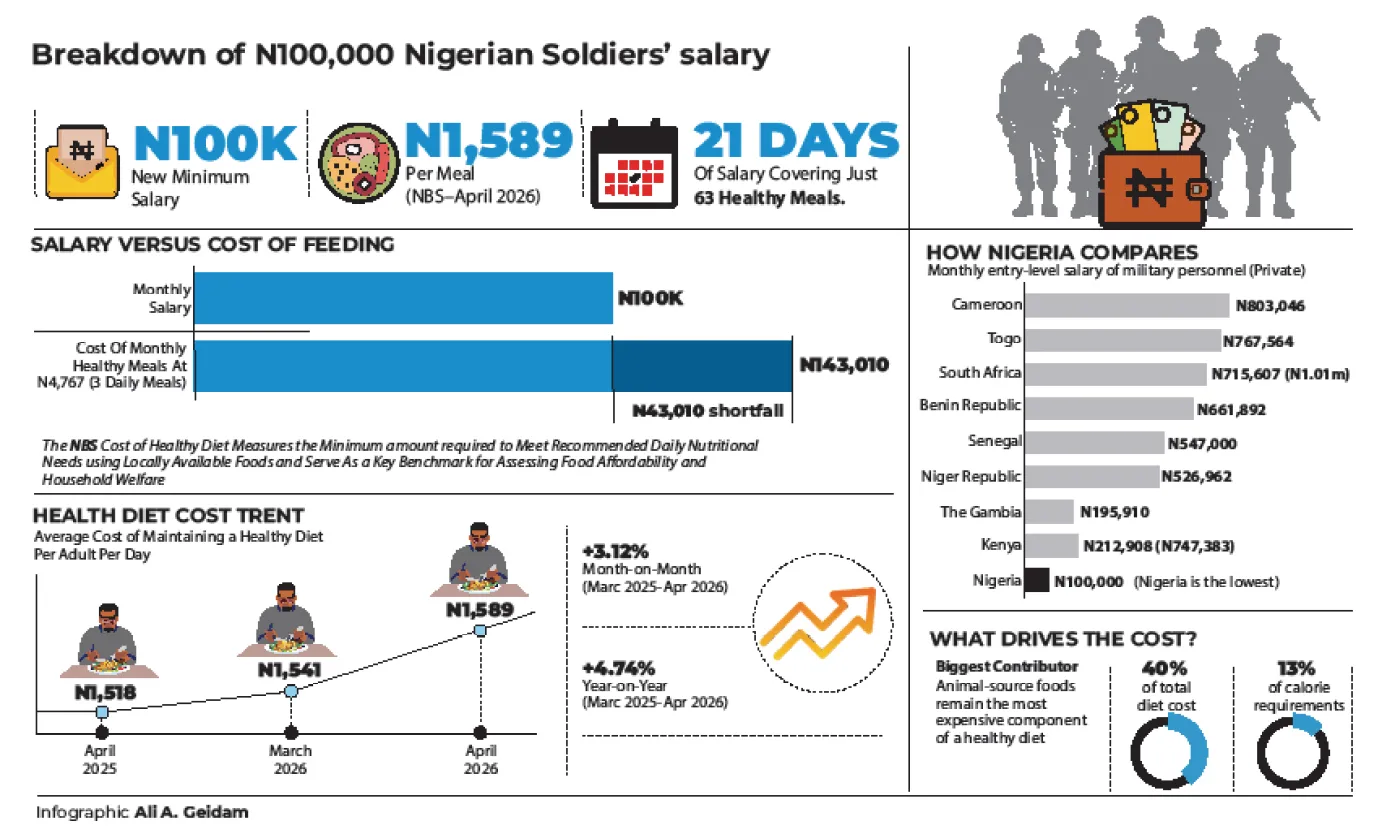
According to the NBS Cost of a Healthy Diet report for April 2026, an average healthy meal now costs ₦1,589 per adult. Based on three meals a day, that amounts to approximately ₦4,767 daily or about ₦143,000 every month—well above the new minimum salary for soldiers.
The figures imply that a soldier earning ₦100,000 monthly could only afford about 21 days of healthy meals if food alone consumed the entire salary, leaving nothing for rent, transportation, healthcare, education or other household expenses.
Government defends salary increase
Defence Minister Christopher Musa recently announced the pay rise, describing it as part of ongoing reforms by President Bola Tinubu’s administration to improve the welfare and morale of members of the Armed Forces.
“When they started, a soldier was collecting ₦49,000 monthly. We tried so hard, now he’s collecting ₦100,000,” the minister said during a television interview.
Musa acknowledged that Nigeria’s defence sector still requires greater funding but insisted the government remains committed to improving the welfare of military personnel.
He also dismissed social media claims suggesting soldiers receive poor-quality meals, saying a viral video that fueled the allegation had been deliberately manipulated.
Cost of living remains a major challenge
The NBS reported that the average daily cost of a healthy diet increased from ₦1,541 in March to ₦1,589 in April 2026, reflecting continued food inflation across the country.
Protein-rich foods remain the most expensive part of a balanced diet, accounting for the largest share of meal costs despite contributing a relatively small portion of daily calorie requirements.
The bureau noted that the index measures the minimum cost of one healthy meal using locally available foods. When projected over three meals a day, however, it highlights the growing financial burden on low-income earners—including military personnel.
The challenge becomes even greater for soldiers responsible for supporting spouses, children and other dependants.
Soldiers earn allowances—but not everyone benefits equally
In addition to their salaries, members of the Armed Forces receive various allowances under the Consolidated Armed Forces Salary Structure (CONAFSS), including housing, transport, hazard, utility, leave and meal-related benefits.
Personnel deployed on counter-terrorism operations, special warfare missions and other high-risk assignments may also qualify for operational allowances.
However, many of these benefits depend on rank, posting and deployment, meaning not every soldier receives the same level of financial support.
Nigeria lags behind several African countries
Despite the recent salary increase, Nigerian soldiers reportedly earn significantly less than their counterparts in several African countries.
Available salary comparisons indicate that entry-level military personnel in South Africa, Kenya, Cameroon, Benin Republic, Senegal, Togo, The Gambia and Niger Republic receive considerably higher monthly pay when converted to naira.
The disparity has renewed calls for a comprehensive review of military remuneration and welfare packages.
Calls grow for a living wage
Civil society organisations argue that the real issue is not the percentage increase in salaries but whether soldiers can afford a decent standard of living.
Friday Odeh, Country Director of Accountability Lab Nigeria, said government policies should be measured by purchasing power rather than headline figures.
“If public data shows that three square meals alone consume most of a soldier’s salary, then remuneration has not kept pace with the cost of living,” he said.
The International Society for Social Justice and Human Rights (ISSJHR) also urged the Federal Government to review military welfare comprehensively by expanding housing support, healthcare, pensions, life insurance and educational assistance for soldiers’ families.
Experts warn poor nutrition could affect military readiness
Nutrition specialist Esther Olorunfunmi Sayo warned that inadequate access to healthy meals could weaken soldiers’ physical fitness, mental performance and operational effectiveness.
She recommended subsidised nutritious meals in military barracks, stronger ration systems and regular welfare reviews that reflect inflation and current economic conditions.
More Than a Salary Debate
While many have welcomed the increase in soldiers’ pay, the conversation has shifted beyond the size of the salary itself.
For many observers, the bigger question is whether those entrusted with protecting the country can realistically afford a decent standard of living in today’s economy. As inflation continues to erode purchasing power, calls are growing for broader reforms that combine competitive wages with improved welfare, housing, healthcare and family support for Nigeria’s military personnel.