


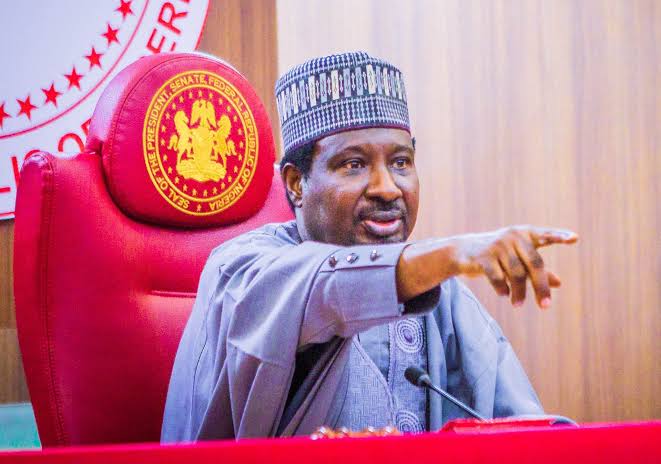
Deputy President of the Senate, Senator Barau Jibrin, has emerged as the leading sponsor of private-member bills in Nigeria’s 10th Senate, having sponsored 42 bills between June 2023 and June 2026.
The disclosure was made in a statement issued by his office as the National Assembly marks its third anniversary. According to the statement, the volume of legislation sponsored by the lawmaker reflects an active legislative agenda focused on governance reforms, economic development, education, healthcare, agriculture, technology, and constitutional amendments.
Records released by the office show that Senator Barau sponsored 13 bills in 2023, nine in 2024, seventeen in 2025, and three in 2026. Out of the total number of bills introduced, five have successfully passed through the legislative process and received approval from the National Assembly.
Among the notable bills already passed are the North-West Development Commission Establishment Bill, aimed at accelerating development and addressing socio-economic challenges in the region; the National Identity Management Commission Repeal and Re-enactment Bill, designed to strengthen Nigeria’s identity management framework; the Agricultural Research Council Amendment Bill; the Federal Medical Centre, Gwarzo Establishment Bill; and the Federal University of Science and Technology, Kabo Establishment Bill.
The proposed legislation sponsored by the Deputy Senate President covers a wide range of emerging national issues. These include the Development Planning and Project Continuity Bill, which seeks to ensure the completion of critical government projects across administrations; the In-Vitro Fertilisation Bill, intended to provide a legal framework for fertility treatment services; and the Renewable Energy Bill, aimed at promoting clean and sustainable energy solutions.
Other significant proposals include the Government Performance and Accountability Bill, the E-Health Bill, and legislation seeking to regulate digital financial systems, including cryptocurrency and virtual asset service providers. The inclusion of technology-focused bills reflects increasing efforts by lawmakers to address the opportunities and challenges presented by Nigeria’s growing digital economy.
Political analysts note that the number of bills sponsored by Senator Barau is significant given his responsibilities as Deputy President of the Senate, a position that requires him to oversee legislative proceedings, coordinate Senate activities, and support the leadership of the National Assembly. In addition, he serves as the First Deputy Speaker of the ECOWAS Parliament, a role that involves regional legislative engagement across West Africa.
Supporters of the lawmaker argue that his legislative initiatives demonstrate a commitment to addressing developmental challenges through policy reforms and institutional strengthening. They point to the diversity of the bills as evidence of efforts to influence multiple sectors of the economy and public administration.
As the 10th National Assembly completes its third year in office, attention is expected to focus not only on the number of bills introduced by lawmakers but also on the impact of enacted legislation on governance, economic growth, social development, and the daily lives of Nigerians.
Observers say the coming year will provide an important opportunity to assess how many of the pending bills advance through the legislative process and contribute to the broader objectives of national development and reform.