


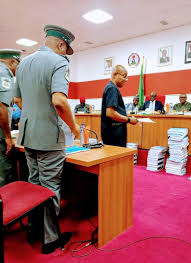
The Senate Public Accounts Committee (SPAC) has cleared the Nigeria Customs Service (NCS) of allegations that it failed to remit N62.2 billion into the Federation Account, following an investigative hearing on audit queries raised by the Office of the Auditor-General for the Federation.
The decision came after the committee reviewed explanations provided by the Comptroller-General of Customs, , regarding financial observations contained in the 2019 audit report.
The Senate panel had invited the Customs leadership to respond to a total of 77 audit queries relating to alleged financial infractions and administrative discrepancies identified in the 2019 and 2020 audit reports. The hearing formed part of the National Assembly’s constitutional responsibility to scrutinize the management of public funds and ensure accountability within government institutions.
One of the most significant allegations involved an alleged under-remittance of N62.2 billion. According to the Auditor-General’s report, Customs generated N691.24 billion in revenue in 2017 but remitted only N629.23 billion into the Federation Account, leaving a balance of N62.2 billion that appeared unaccounted for.
Responding to the query, Adeniyi explained that the figure in question was not revenue withheld by Customs but represented various statutory levies collected on behalf of other government agencies and intervention funds. He argued that the amount was mistakenly classified as revenue that should have been paid into the Federation Account.
The Customs boss explained that while some collections are legally required to be remitted directly into the Federation Account, others are designated for specific purposes and beneficiaries under existing laws and government policies. These include levies imposed on products such as wheat, textiles, and wines, which are earmarked for sector-specific development programmes and do not form part of federally distributable revenue.
According to him, the alleged under-remittance arose from a misinterpretation of the classification of these funds rather than any deliberate failure by the agency to remit government revenue.
Following the explanation, members of the committee accepted Customs’ position and vacated the N62.2 billion query. The committee concluded that the amount had been improperly categorized in the audit report and therefore could not be considered an actual under-remittance.
The hearing also addressed two additional audit observations for which Customs provided similar clarifications. However, lawmakers questioned why the agency failed to resolve the issues at earlier stages of the audit process before they escalated to a formal parliamentary investigation.
A member of the committee, Senator , expressed concern that matters which could have been clarified administratively were allowed to progress to the Senate level.
In response, Adeniyi noted that the period under review coincided with a challenging phase in relations between the National Assembly and the Nigeria Customs Service, which may have contributed to communication gaps and unresolved misunderstandings regarding audit findings.
To ensure a thorough resolution of the remaining issues, the committee, chaired by Senator , announced the establishment of a special reconciliation sub-committee. The body will work directly with Customs officials and representatives of the Auditor-General’s office to examine and reconcile the remaining 74 audit queries.
The move is expected to provide a clearer understanding of financial records, operational procedures, and revenue classifications within the Customs Service. It also reflects the Senate’s effort to balance accountability with fairness by ensuring that audit observations are subjected to detailed scrutiny before conclusions are reached.
Financial experts note that audit queries do not necessarily indicate wrongdoing but are often raised to clarify discrepancies, improve record-keeping, and strengthen public financial management. The reconciliation process will therefore be crucial in determining whether the remaining observations stem from administrative lapses, reporting inconsistencies, or actual financial irregularities.
The outcome of the investigation is expected to contribute to ongoing efforts to enhance transparency, accountability, and efficiency in Nigeria’s revenue-generating agencies, particularly at a time when government is seeking to boost non-oil revenue and improve fiscal discipline.
With the N62.2 billion allegation now set aside, attention will shift to the reconciliation of the outstanding audit queries and the implementation of measures aimed at preventing similar disputes in future financial reporting and audit exercises.