


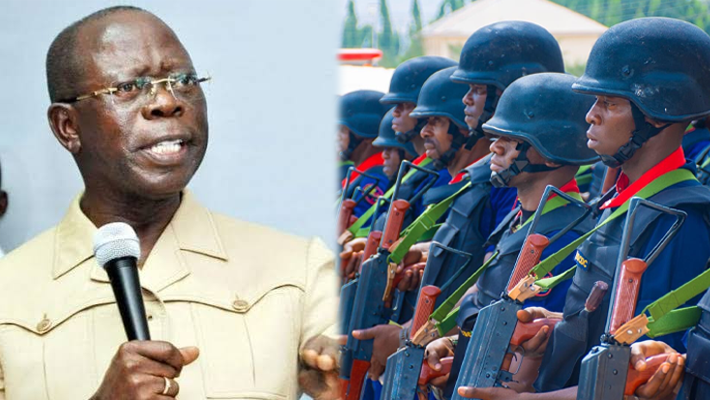
The Chairman of the Senate Committee on Interior, , has called for a comprehensive review of the Nigeria Security and Civil Defence Corps (NSCDC) Establishment Act, arguing that the agency’s current structure no longer reflects the realities of the increasingly dangerous security environment in which its personnel operate.
Oshiomhole made the remarks in Abuja during the launch of a new book titled “Nigeria’s Security Dilemma: Rivalries and Implications Vol. 1,” authored by Dr. Olusola Odumosu, the Federal Capital Territory Commandant of the NSCDC. The event brought together security experts, policymakers, government officials and stakeholders to discuss challenges confronting Nigeria’s security architecture.
The former Edo State governor questioned whether the word “civil” in the agency’s name still accurately captures its responsibilities, noting that NSCDC operatives are regularly deployed to confront heavily armed criminals involved in illegal mining, oil theft, vandalism of critical infrastructure, kidnapping and other organised crimes.
According to Oshiomhole, the original concept of a civil defence organisation was largely centred on community protection and emergency response. However, he argued that the operational reality today has evolved significantly, requiring personnel to engage criminal elements who possess sophisticated weapons and increasingly advanced tactics.
He maintained that security operatives cannot effectively confront dangerous armed groups while operating with inadequate equipment or limited operational capabilities. According to him, agencies tasked with protecting national assets and public infrastructure must be empowered with modern tools, training and resources that match the threats they face.
The senator stressed that Nigeria’s security environment has changed dramatically over the years, with criminal networks becoming more organised, better financed and technologically advanced. As a result, he argued that security institutions must adapt accordingly if they are to remain effective.
Beyond equipment and operational capacity, Oshiomhole highlighted the need for stronger collaboration among security agencies. He observed that many of Nigeria’s security challenges persist partly because institutions often work in isolation rather than as a coordinated national security network.
According to him, effective intelligence gathering and information sharing remain among the most important tools in combating crime and insecurity. He noted that criminal groups frequently exploit gaps in coordination among agencies, making collaboration essential to successful security operations.
The lawmaker expressed concern over what he described as lingering distrust among security institutions, inter-agency rivalry and competition for operational recognition. He argued that such practices undermine national security objectives and reduce the effectiveness of security responses.
Oshiomhole further stated that security challenges should never be viewed through political, regional or institutional lenses. He stressed that protecting lives and property is a national responsibility that transcends party affiliations and political interests.
According to him, insecurity affects all Nigerians regardless of ethnicity, religion or political association, making it imperative for all stakeholders to work together toward common security goals.
The senator also called on security leadership to ensure that directives issued from headquarters are supported with adequate logistics, operational resources and welfare packages for personnel on the front lines. He noted that morale and motivation remain critical factors in determining the effectiveness of security agencies.
Speaking at the event, the author of the book and FCT NSCDC Commandant, Dr. Olusola Odumosu, echoed similar concerns about coordination among security institutions. He argued that no single security agency possesses all the expertise, resources or intelligence required to address Nigeria’s complex security challenges.
Odumosu emphasized that modern security threats are multidimensional and require a collective response involving intelligence agencies, law enforcement organisations, military formations and community stakeholders.
According to him, inter-agency rivalry remains one of the greatest obstacles to achieving a coordinated and effective national security strategy. He warned that competition among agencies often results in duplication of efforts, communication breakdowns and missed opportunities to prevent criminal activities.
The security expert urged institutions to prioritise cooperation over competition, arguing that national security outcomes should take precedence over organisational interests.
Observers at the event noted that the discussions reflect broader concerns about Nigeria’s evolving security landscape. In recent years, the country has faced challenges ranging from terrorism and banditry to kidnapping, cybercrime, oil theft and attacks on critical infrastructure.
Analysts say the increasing complexity of these threats has renewed calls for reforms within the nation’s security architecture, including improved intelligence coordination, enhanced training, better funding and clearer operational mandates for various agencies.
The debate over the role of the NSCDC has also gained attention because the agency has become increasingly involved in protecting critical national assets, combating illegal mining, safeguarding energy infrastructure and supporting law enforcement operations in several parts of the country.
Many security experts argue that as the responsibilities of the Corps continue to expand, there may be a need to review existing laws, operational frameworks and resource allocations to ensure the organisation can effectively discharge its mandate.
The launch of the book provided another platform for stakeholders to reflect on Nigeria’s security challenges and the reforms required to build a more responsive and coordinated security system.
As calls for stronger collaboration and institutional reforms grow louder, policymakers and security experts agree that addressing insecurity will require not only improved legislation and equipment but also greater unity, trust and strategic cooperation among all agencies responsible for protecting the nation and its citizens.