


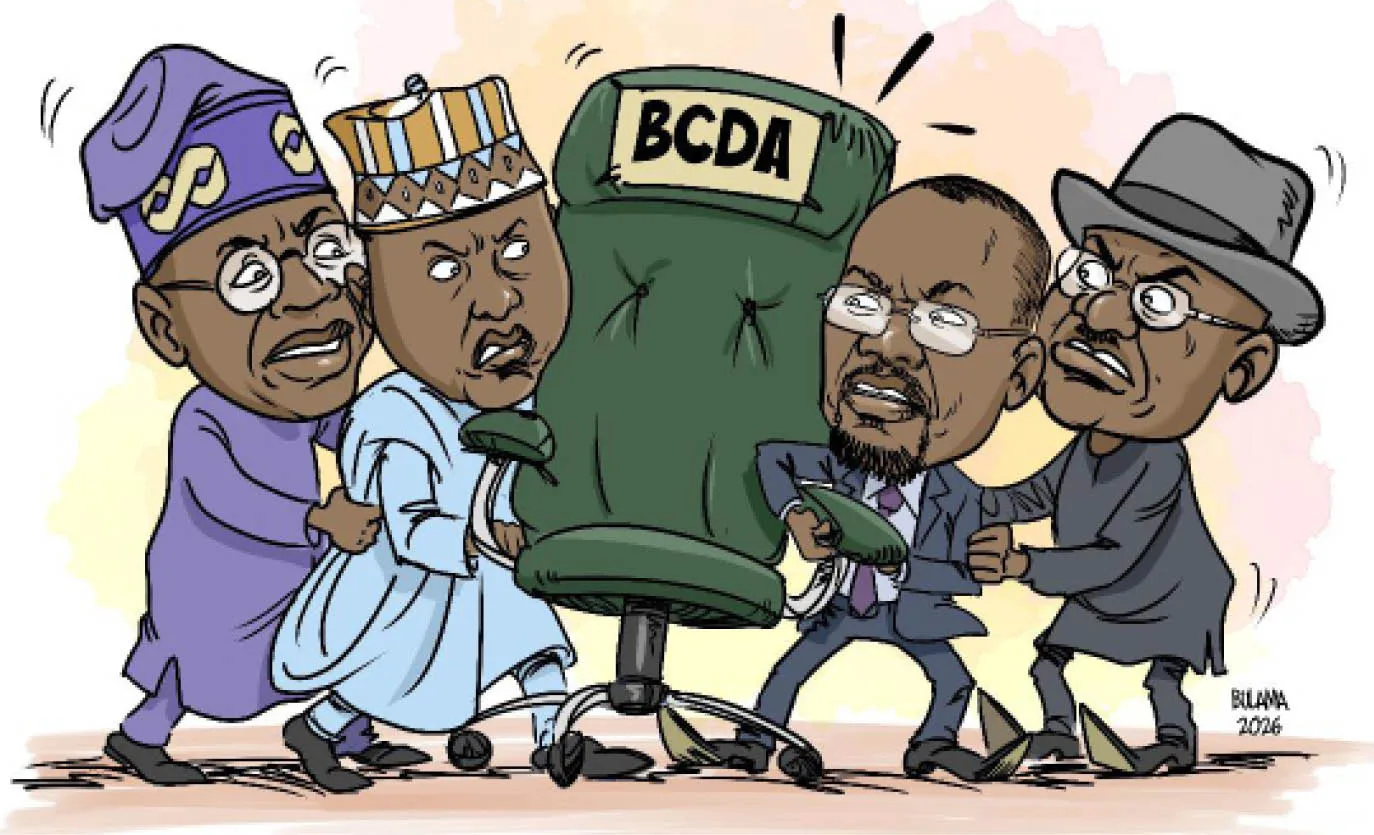
A leadership crisis is brewing at the Border Communities Development Agency (BCDA) as its Executive Secretary, Dr. Dakorinama Alabo George, has dismissed President Bola Ahmed Tinubu’s directive requiring political appointees seeking elective office to resign before party primaries.
George, a former Rivers State Commissioner for Works and a known ally of Federal Capital Territory Minister Nyesom Wike, insists he remains the lawful head of the agency despite the Presidency announcing former House of Representatives spokesperson Abdulrazak Sa’ad Namdas as his replacement.
The controversy stems from President Tinubu’s March 2026 directive ordering all political appointees intending to contest the 2027 general elections to resign from their positions before participating in party primaries.
George was widely reported to have stepped down to pursue the All Progressives Congress (APC) governorship ticket in Rivers State. Although he later withdrew from the race before the primary election, the Presidency subsequently announced Namdas as the new Executive Secretary of the BCDA.
However, George has denied ever resigning from office, arguing that the appointment of a replacement was based on incorrect information.
Speaking on the controversy, he cited Section 88(1) of the Electoral Act, maintaining that the law only requires political appointees to resign before taking part in party primaries and does not prescribe any deadline for doing so.
According to him, because he withdrew before the APC governorship primary, there was no legal obligation for him to resign.
“The law is the law, and anything outside the law—even a directive—does not stand,” George said, insisting that no vacancy existed at the agency.
Despite the Presidency’s announcement, George has continued to perform official duties as Executive Secretary, including attending high-level government meetings on behalf of the agency.
Presidential spokesman Bayo Onanuga, however, dismissed claims that George remains the legitimate occupant of the office, insisting that Namdas is the duly appointed Executive Secretary.
Lawyers disagree with George’s position
Legal experts have faulted George’s interpretation of the Electoral Act.
Senior Advocate of Nigeria (SAN), Salman Jawondo, said while the Electoral Act does not specify a resignation timeline for political appointees seeking elective office, it does not override the President’s constitutional authority to appoint or remove officials.
He explained that once the President appoints a replacement, the tenure of the previous office holder automatically comes to an end.
Another legal practitioner and human rights advocate, Hameed Ajibola Jimoh, echoed the same view, noting that appointive offices are held at the pleasure of the appointing authority.
According to him, the President has the constitutional power to terminate such appointments at any time, regardless of whether the affected official agrees with the decision.
Civil society urges legal resolution
The Civil Society Legislative Advocacy Centre (CISLAC) has called for the dispute to be resolved through the courts rather than through public disagreements.
Its Executive Director, Auwal Musa Rafsanjani, urged all parties to respect the rule of law and seek judicial interpretation of the relevant legal provisions.
The Committee for the Defence of Human Rights (CDHR) also appealed to the Presidency to clarify the leadership situation at the agency, warning that prolonged uncertainty could weaken public confidence in government institutions.
Questions over implementation
The controversy has also sparked criticism from within the APC.
Party chieftain Nuruddeen Hammanyero questioned why Namdas had reportedly not received his appointment letter weeks after the Presidency announced his appointment.
He called on the Office of the Secretary to the Government of the Federation (SGF) to explain the delay, arguing that the situation has created unnecessary confusion over the implementation of presidential decisions.
With George refusing to vacate office, the Presidency insisting that Namdas remains the lawful appointee, and legal experts divided over the interpretation of the law, the BCDA leadership dispute continues to raise questions about executive authority, political appointments and the rule of law.


