


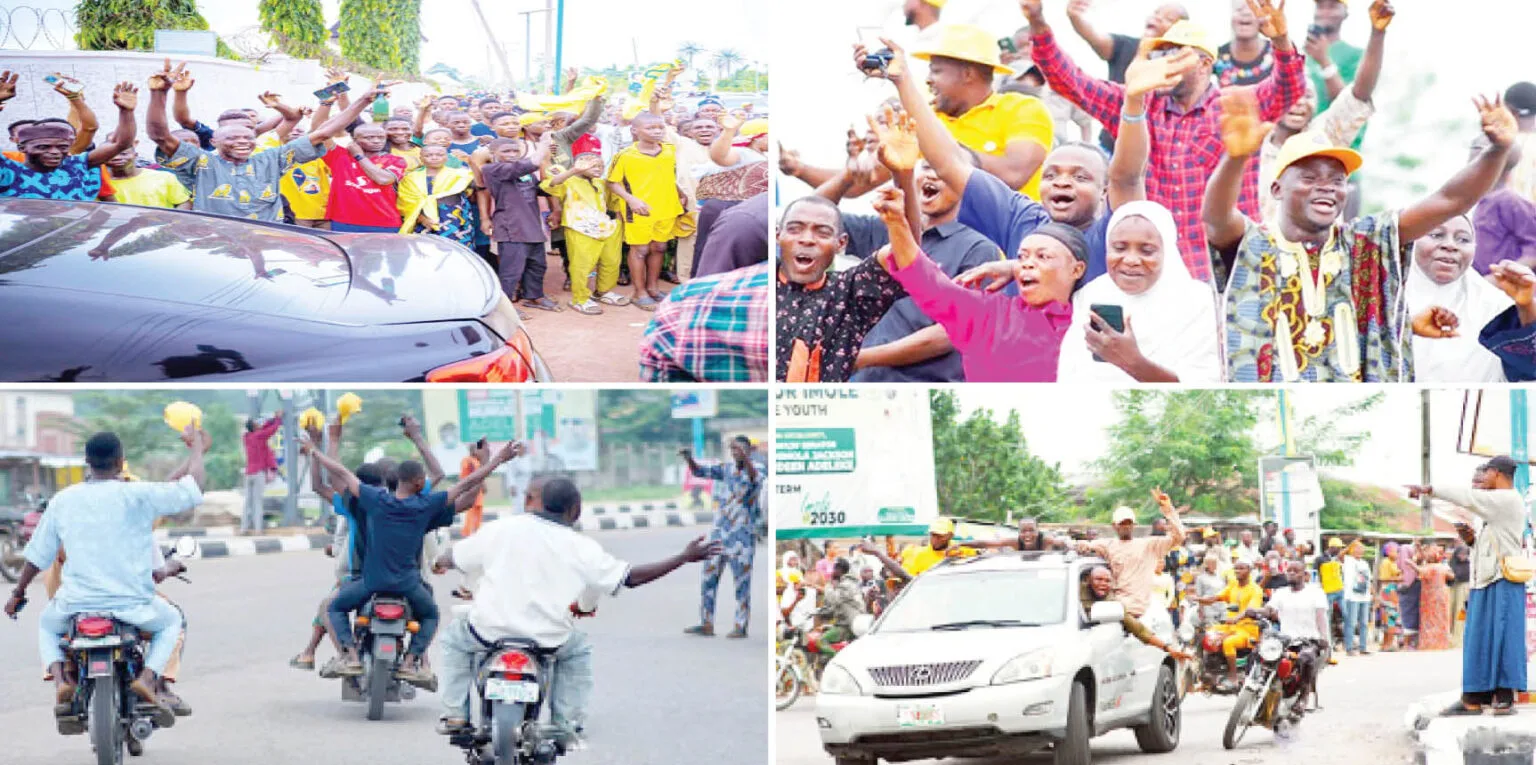
Governor Ademola Adeleke has secured another term in office after defeating the All Progressives Congress (APC) candidate, Asiwaju Munirudeen Bola Oyebamiji, in the 2026 Osun State governorship election.
The result was significant not only because Adeleke successfully defended his seat, but also because he did so against a formidable political machine that included senior APC leaders, governors and other influential political figures.
Adeleke, who contested under the Accord Party after leaving the Peoples Democratic Party (PDP), polled 511,067 votes to defeat Oyebamiji, who secured 444,815 votes. African Democratic Congress (ADC) candidate Najeem Folasayo Salaam came a distant third with 17,180 votes.
The result gave Adeleke a winning margin of 66,252 votes, more than double the 28,344-vote margin by which he defeated former Governor Gboyega Oyetola in 2022.
A Three-Horse Race That Became a Battle of Political Machines
Although 15 political parties fielded candidates, the election quickly developed into a contest dominated by Adeleke, Oyebamiji and Salaam.
Adeleke’s journey to the ballot was far from straightforward. His political crisis within the PDP eventually led to his defection to Accord, while questions surrounding the party’s eligibility to field a candidate also created uncertainty before the election.
He nevertheless overcame the legal and political hurdles and emerged as the incumbent candidate.
The campaign period was tense, with allegations of violence and intimidation exchanged between the major parties. Several people were reportedly killed or injured before election day, prompting the deployment of large numbers of security personnel across the state.
Despite fears of violence, voters turned out in significant numbers on election day. Electoral officials largely arrived on time, while security personnel were deployed to polling units across the state.
The Bimodal Voter Accreditation System (BVAS) functioned successfully in many areas, although some technical difficulties caused delays in voter accreditation.
Adeleke’s Numbers Tell the Story
The governor’s victory was not simply a repeat of his 2022 performance. He substantially expanded his electoral base.
In 2022, Adeleke secured 403,371 votes against Oyetola’s 375,027. Four years later, his tally rose to 511,067.
He also increased the number of local government areas won from 17 in 2022 to 19 in 2026.
Adeleke secured about 51.9 per cent of the valid votes cast, compared with approximately 50.1 per cent in the previous election. Oyebamiji, meanwhile, secured about 45.2 per cent, slightly below Oyetola’s 46.6 per cent share in 2022.
The figures suggest that while the APC improved its absolute vote total, Adeleke expanded his support at an even greater rate.
APC’s Internal Crisis Became Adeleke’s Opportunity
One of the biggest factors identified by political analysts was the division within the APC.
The emergence of Oyebamiji as the party’s candidate reportedly left several influential aspirants dissatisfied. Among those mentioned were former Governor Olagunsoye Oyinlola and Senator Iyiola Omisore.
Although some of the aggrieved politicians did not officially leave the APC, their political networks were believed to have moved in different directions.
Professor Olaleye Komolafe of Adekunle Ajasin University argued that the APC’s internal crisis weakened the party before voters even went to the polls.
According to him, the failure to adequately reconcile influential stakeholders after the primaries created a problem that could not be completely solved before election day.
The consequences were visible in areas considered strongholds of some APC figures.
Iyiola Omisore’s political base in Ile-Ife, for instance, reportedly swung away from the APC, while supporters of other disgruntled party figures were said to have quietly worked for Adeleke.
The lesson was clear: having prominent politicians inside a party does not necessarily mean their supporters will follow the party’s preferred candidate.
Workers’ Welfare and Incumbency
Adeleke also benefited from his record in office.
Analysts cited the payment of workers’ salaries and pensions as one of the factors that strengthened his relationship with civil servants and pensioners.
His administration’s infrastructure projects also featured prominently in the campaign, although critics argued that development was disproportionately concentrated around his home base in Ede.
Nevertheless, the incumbent was able to present himself as a governor who deserved another term based on his performance.
That incumbency advantage proved difficult for the APC to overcome.
Davido and the Youth Factor
Another unusual feature of the election was the role played by music star David Adeleke, popularly known as Davido, the governor’s nephew.
Davido became one of the most visible voices supporting the governor and was particularly effective in engaging younger voters through social media.
His exchanges with APC politicians also turned the election into a major online contest.
When Edo State Governor Monday Okpebholo criticised Adeleke and mocked his dancing, Davido responded publicly. He also traded words online with Kwara State Governor AbdulRahman AbdulRazaq over the APC campaign.
For Adeleke’s supporters, the involvement of one of Nigeria’s biggest entertainers helped transform the election into more than a conventional political contest. It became a battle over identity, youth participation and resistance to what his supporters described as “federal might.”
Federal Might Fails to Deliver Osun
The APC entered the election with enormous political firepower.
President Bola Tinubu, APC governors and several national party leaders campaigned for Oyebamiji.
The President reportedly summoned dozens of APC leaders from Osun to Abuja shortly before the election and urged them to resolve their differences and work together.
Several APC governors also visited the state to campaign for the party’s candidate.
Yet the political heavyweight campaign failed to produce the expected result.
Former Governor Gboyega Oyetola, who lost to Adeleke in 2022, strongly backed Oyebamiji and expressed confidence that the APC would reclaim the state.
Former Governor Olagunsoye Oyinlola also eventually endorsed Oyebamiji, alongside other prominent politicians.
But endorsements at the top did not always translate into votes at the grassroots.
Oyinlola’s own polling unit in Okuku, Odo-Otin Local Government Area, became a striking example. Accord won the unit with 125 votes, while APC received 85.
At the local government level, Adeleke also won Odo-Otin with 18,003 votes against Oyebamiji’s 15,435.
Political Heavyweights Who Lost Without Contesting
The election also produced several political losers who were not on the ballot.
President Tinubu was among them. Although he publicly maintained a neutral posture and later congratulated Adeleke, the APC’s failure to win Osun represented a setback for the ruling party ahead of the 2027 presidential election.
APC governors who campaigned heavily for Oyebamiji also failed to deliver the state.
Oyetola, who had hoped to see the APC return to power after his defeat four years ago, suffered another setback.
APC National Secretary Ajibola Basiru, however, managed to deliver his polling unit for the party. At his polling unit in Osogbo, Oyebamiji secured 177 votes against Adeleke’s 60.
Former Governor Bisi Akande also delivered his polling unit to the APC, but his influence was not enough to secure the state for the party.
Why ADC Failed to Make an Impact
The ADC entered the election with considerable expectations, particularly because former Osun governor Rauf Aregbesola was associated with the party.
However, its candidate, Najeem Salaam, received only 17,180 votes.
The party blamed its poor performance partly on its limited financial resources, arguing that it campaigned on issues rather than money politics.
Its spokesperson, Seun Abosede, said the party did not have the financial capacity of the two dominant contenders and suggested that vote buying and financial inducements affected the outcome.
Another blow to the ADC came from the defection of former Osun Secretary to the State Government Moshood Adeoti to Accord. His movement was seen as weakening the Aregbesola-aligned political camp while strengthening Adeleke’s coalition.
The Election Was Not Without Controversy
Despite the peaceful conduct of voting in many areas, concerns remained over electoral irregularities.
Yiaga Africa praised INEC for the overall conduct of the election but called for a technical audit of BVAS devices following reports of biometric authentication failures.
The organisation also urged INEC to strengthen training for ad hoc officials and improve technical support before the 2027 general election.
SERAP separately called for investigations into alleged vote buying, voter intimidation, violence, illegal campaign financing and other electoral offences.
According to preliminary observations cited by the organisation, hundreds of electoral offences and irregularities were recorded across polling units monitored during the election.
These allegations will likely remain part of the post-election debate even as Adeleke begins preparing for his second term.
APC Considers Its Legal Options
The APC has not completely closed the chapter on the election.
The party said it was studying results from all 332 wards and considering whether to challenge identified irregularities through the legal process.
Its position is that the declaration of a winner does not prevent parties from using the constitutional and legal avenues available to them.
For now, however, INEC’s declaration stands and Adeleke remains the governor-elect for the next term.
What Osun Means for 2027
Perhaps the biggest political question arising from the election is what it means for Nigeria’s 2027 general elections.
Opposition figures have already described Osun as a blueprint for defeating the APC.
The G100 coalition argued that the election demonstrated what opposition parties can achieve when they put aside individual ambitions and unite behind a strong candidate.
Former Vice President Atiku Abubakar also described the result as evidence of the electorate’s ability to resist electoral malpractice and said it could offer lessons for the 2027 elections.
But political analysts warn against drawing sweeping conclusions.
Professor Emmanuel Ojo noted that Osun was an off-cycle election involving only one state. Security agencies and electoral officials were therefore able to concentrate significant resources on the state.
The 2027 general elections will be much more complex, with nationwide presidential, legislative and state elections taking place across the country.
Senior Advocate Kunle Kalejaye also offered another important lesson: public dissatisfaction alone does not guarantee that an incumbent will lose.
Party structure, grassroots organisation, candidate appeal and voter sentiment can all outweigh online criticism and widespread complaints about economic conditions.
The Bigger Lesson
The 2026 Osun election ultimately became a contest between political machinery and political cohesion.
The APC had the federal government, governors, former governors and powerful party leaders behind its candidate.
Adeleke, however, built a coalition that combined incumbency, grassroots support, youth mobilisation and the support of political actors dissatisfied with the APC’s internal arrangements.
The governor also succeeded in turning his endorsement of President Tinubu’s 2027 re-election bid into a political advantage rather than allowing the issue to undermine his campaign.
In the end, the people of Osun gave Adeleke a stronger mandate than they did in 2022.
For the APC, the defeat offers a warning: political power at the national level cannot guarantee victory at the grassroots when a party is divided.
For the opposition, meanwhile, Osun offers an equally important lesson: unity, strategic alliances and a strong grassroots structure can turn an apparently difficult election into a winning campaign.
As Nigeria moves toward 2027, Osun may therefore be remembered not simply as another governorship election, but as an early indication of how alliances, incumbency, internal party conflicts and voter mobilisation could shape the country’s next major political battle.
How Adeleke Defied the Odds to Retain Osun: The Forces Behind the 2026 Election Victory


- Advertisment -