


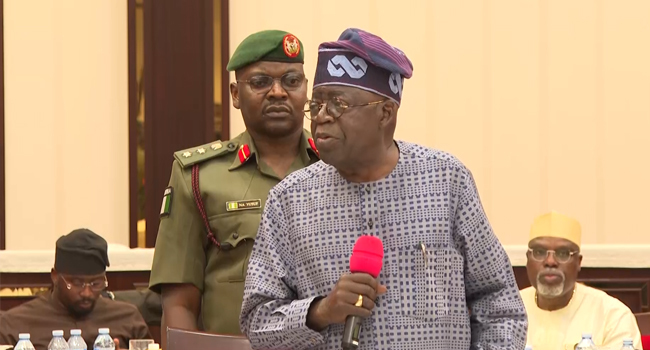
President Tinubu
The Presidency has described the African Democratic Congress as a party struggling to maintain “coherence and balance” following its recently concluded national convention, while also defending remarks by Bola Ahmed Tinubu that the opposition group interpreted as dismissive.
The response came on Saturday through Sunday Dare after members of the ADC’s National Legislators Serving and Former Forum criticised President Tinubu over comments they said referred to the party’s convention as “noise” and a “street convention.”
The ADC held its national convention at the Rainbow Event Centre in Abuja, despite what party members described as a last-minute attempt to frustrate the gathering.
ADC Criticises Presidency
The ADC forum, led by former House of Representatives member Nnenna Ukeje, accused the administration of shrinking political space and undermining democratic values.
The group argued that Nigeria is at a critical democratic stage and said the conduct of the current administration appears inconsistent with Tinubu’s earlier political record as an opposition figure who once advocated pluralism, institutional independence, and broader democratic participation.
ADC members also pointed to Tinubu’s history during military rule and Nigeria’s transition years, when he was widely regarded as a supporter of opposition politics and constitutional governance.
According to the forum, such credentials should translate into a stronger commitment to democratic openness under his presidency.
Presidency Fires Back
Responding in a lengthy statement posted on X, Dare dismissed the ADC’s criticism and accused the party of suffering from internal disorder.
The statement, titled What’s That Noise! Response to Hon. Nnenna Elendu Ukeje and the ADC Forum of National Legislators – Nigeria’s Latest Bunch of Conspiracy Theorists, argued that the opposition was attempting to create controversy where none existed.
According to Dare, some opposition parties are already attacking the electoral process and discrediting institutions even before the formal election season begins.
He described the ADC as a hastily assembled political platform searching for relevance and trying to gain public attention through allegations against the government.
“Even before the official commencement of the election season and before the polls open, the opposition, a hurriedly stitched together contraption in search of a launch pad, are screaming blue murder,” he said.
He added that repeated accusations against the administration were part of a familiar political script aimed at attracting sympathy from the international community.
Contradictions in ADC Position
Dare said the ADC’s own statement acknowledged Tinubu’s longstanding democratic credentials before later attempting to portray him as a threat to those same principles.
According to him, that contradiction weakens the opposition’s argument.
He noted that the forum had correctly highlighted Tinubu’s role in strengthening opposition politics, defending democratic space, and resisting authoritarian pressures during previous political eras.
“They reminded Nigerians that he mobilised resistance, nurtured political contestation, and remained a central pillar in sustaining democratic governance,” Dare said.
He argued that such a political record cannot suddenly be erased or reversed without evidence.
“A leader’s record is not a switch that flips overnight,” he said, insisting that Tinubu’s political convictions and democratic instincts remain intact.
‘Noise’ Comment Not Directed at ADC
On the controversy surrounding the President’s “noise” remark, Dare maintained that Tinubu did not mention the ADC directly or indirectly.
He said the President’s comments were broad and consistent with his style of addressing national issues rather than specific partisan targets.
According to Dare, the ADC’s decision to interpret the statement as a direct attack was an unnecessary overreaction.
He suggested that if the description resonated with the party, the concern may lie more with its internal conduct than with the President’s remarks.
“If the description of noise resonates, perhaps the issue is not with the statement, but with the conduct it reflects,” he said.
Defence of Institutions
Dare also rejected ADC allegations of judicial interference, calling them speculative and irresponsible.
He insisted that Nigeria’s judiciary remains constitutionally independent and warned against attempts to undermine confidence in the courts without evidence.
“Nigeria’s judiciary remains constitutionally independent, and no amount of conjecture can substitute for evidence,” he stated.
He added that politicising judicial processes for partisan advantage could weaken democratic institutions rather than protect them.
The Presidency’s remarks reflect growing tension between the ruling All Progressives Congress and opposition parties as political realignments begin ahead of future elections.
Wider Political Context
Although the next general election cycle is still some distance away, political parties have begun internal reorganisation, coalition talks, and leadership contests.
For the ADC, the recent convention was viewed as an attempt to strengthen structures and increase relevance in Nigeria’s increasingly competitive opposition landscape.
The party has sought to position itself as an alternative platform for politicians and voters dissatisfied with both the ruling APC and larger opposition blocs.
However, critics argue that smaller parties often struggle with visibility, internal unity, and nationwide organisational reach.
Tinubu’s Opposition Legacy
President Tinubu’s political history remains a recurring point of debate in Nigerian politics.
Supporters frequently cite his role in opposition coalition-building and democratic resistance during military rule, while critics say expectations are higher because of that background.
As a result, actions taken by his administration are often measured against the reformist image many associated with his earlier years in politics.
Rising Political Temperatures
Saturday’s exchange between the Presidency and ADC signals that political tensions are already beginning to rise despite the distance to the next national elections.
Analysts say such confrontations are likely to intensify as opposition parties seek space, relevance, and public attention, while the government defends its record and authority.
For now, the dispute centres on rhetoric and perception but it also reveals deeper battles over narrative, democratic legitimacy, and who defines the future direction of Nigerian politics.
As parties continue to reorganise, Nigerians can expect sharper messaging, stronger counterattacks, and a more active political climate in the months ahead.