


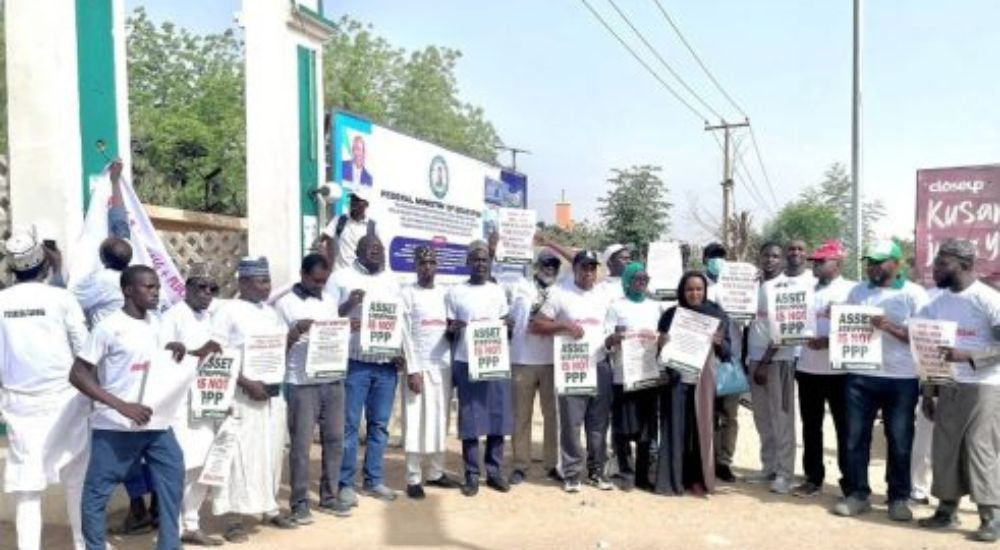
The protesters
A major controversy has emerged over a land development agreement involving Federal Government College Kano, with the school’s alumni association strongly opposing what it describes as an encroachment on institutional property and a threat to student welfare.
At the centre of the dispute is a Public-Private Partnership arrangement said to have allocated approximately 33 hectares of the college’s land to a private developer, Pluck Global Construction Company, for infrastructure development.
While government officials are said to have presented the agreement as part of efforts to modernise aging facilities and improve infrastructure within the school, members of the alumni body have rejected the deal, alleging that it undervalues the land and could compromise the long-term integrity of the institution.
Alumni Raise Objections
The alumni association, FGCKOSA, said it is deeply concerned about both the financial and security implications of the arrangement.
According to the group, the land involved in the transaction is worth tens of billions of naira, while the proposed compensation through infrastructure projects is significantly lower in value.
The projects reportedly include a sports complex, health centre, classroom renovations, and other upgrades.
However, alumni members argue that the value of those proposed facilities does not match the commercial worth of the land being ceded.
They insist that any development arrangement involving public educational land should be transparent, independently valued, and subjected to broad stakeholder consultation.
Concerns Over Student Safety
Beyond financial concerns, the association has also raised alarm over the possibility of introducing a private residential or commercial estate within the school environment.
Members warned that such development could expose students to security risks by increasing external access into what is expected to remain a controlled educational environment.
They further argued that losing portions of school land could reduce access to key communal spaces traditionally used by students for sports, recreation, worship, and extracurricular activities.
According to the alumni, preserving open spaces within schools is essential for student development, physical activity, and social wellbeing.
They said any construction that alters the character of the campus should be carefully reconsidered.
Government Position
Although full details of the agreement have not been publicly disclosed, supporters of the project are said to view the PPP arrangement as a practical solution to deteriorating infrastructure and funding constraints affecting many federal colleges.
Across Nigeria, several public schools face challenges including aging buildings, inadequate laboratories, overcrowded classrooms, and poor sporting facilities.
Public-private partnerships are increasingly being explored as a way to attract private investment into education infrastructure.
However, such arrangements often generate controversy when stakeholders believe public assets are being undervalued or transferred without due consultation.
Matter Moves to Court
The disagreement has now taken a legal dimension.
According to reports, a Federal High Court has ordered that the status quo be maintained pending determination of the dispute.
The directive effectively halts further development or construction activity on the contested land until the matter is resolved.
Legal observers say the court’s intervention is aimed at preventing irreversible changes while all parties present their claims.
The case is expected to examine issues including land ownership rights, procurement process, valuation standards, and whether the agreement aligns with the educational mandate of the institution.
Petitions to Anti-Corruption Agencies
FGCKOSA President, Shoyinka Shodunke, said the association has also petitioned key anti-corruption agencies over the matter.
According to him, petitions have been submitted to the Economic and Financial Crimes Commission and the Independent Corrupt Practices Commission.
The alumni body is seeking a full investigation into the transaction, including how the land was valued, the process leading to the agreement, and whether public interest was adequately protected.
The group maintains that accountability is necessary whenever valuable public educational assets are involved.
Appeal to President Tinubu
The association has also written to Bola Ahmed Tinubu, urging the Federal Government to review and cancel the agreement.
The alumni said the school is a legacy institution whose assets should be preserved for future generations rather than subjected to controversial commercial transactions.
They appealed for intervention to ensure that any redevelopment plan prioritises education, student safety, and transparency.
Warning to Prospective Buyers
As tensions continue to rise, FGCKOSA has advised prospective buyers, investors, and other stakeholders to exercise caution regarding any transactions connected to the disputed land.
The association stressed that the matter remains before the courts and that any dealings conducted before final resolution may carry legal and financial risks.
Such warnings are common in contested land matters where ownership, title, or development rights are under litigation.
Wider Implications
The controversy highlights a broader national debate over how government institutions should manage land assets in an era of rising urban property values and budgetary pressure.
Many schools across Nigeria occupy large parcels of land established decades ago, some of which are now located in rapidly expanding urban areas.
As a result, tensions often arise between preservation of educational spaces and commercial redevelopment interests.
For alumni of Federal Government College Kano, however, the immediate concern is clear: protecting the identity, safety, and future of their alma mater.
As the legal process unfolds, stakeholders across the education sector will be watching closely to see how the dispute is resolved and what precedent it may set for similar public asset partnerships in Nigeria.

