


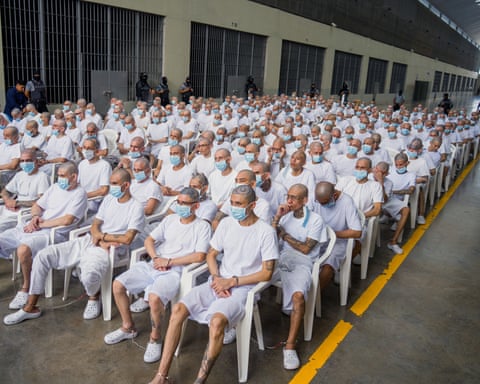
El Salvador has opened one of the largest criminal proceedings in its modern history as a court begins the mass trial of 486 alleged members of the notorious MS-13, marking another major phase in President Nayib Bukele’s aggressive campaign against organized crime.
The collective trial, which commenced on Tuesday, is taking place under the country’s prolonged state of emergency, a controversial anti-gang policy first introduced in 2022 and repeatedly extended since then. Authorities say the accused are linked to tens of thousands of crimes committed over a decade, while critics argue the process raises serious concerns over due process, legal rights, and judicial fairness.
According to prosecutors, the defendants are accused of involvement in more than 47,000 criminal acts allegedly carried out between 2012 and 2022. The charges include murder, femicide, extortion, arms trafficking, conspiracy, and participation in organized criminal networks.
Officials say many of the alleged offences were committed during years when gangs exerted significant territorial control across parts of El Salvador, intimidating communities, extorting businesses, and driving some of the highest homicide rates in the world.
Among the incidents referenced by prosecutors is a particularly deadly weekend that became one of the bloodiest periods in El Salvador since the end of its civil war. That wave of killings in 2022 prompted the Bukele administration to impose emergency measures that dramatically expanded police and military powers.
Under the emergency regime, security forces have arrested more than 91,500 people suspected of gang ties. Congress later approved legal changes allowing large groups of defendants to be prosecuted together, paving the way for mass trials such as the current case.
Supporters of the policy say the measures have transformed national security and restored public order in communities once dominated by gangs. The Bukele government maintains that its crackdown has sharply reduced murders, extortion, and fear among ordinary citizens.
Official figures cited by the government indicate that the homicide rate dropped to 1.3 per 100,000 people last year, compared with 7.8 in 2022. Bukele has frequently highlighted those numbers as evidence that his security strategy is succeeding.
The president remains highly popular domestically, with many Salvadorans crediting his administration for making neighborhoods safer and reducing the influence of violent criminal groups.
However, the trial has also renewed criticism from international observers and human rights organizations, who warn that mass prosecutions can undermine the rule of law.
Rights groups argue that trying hundreds of people together may prevent defendants from receiving individualized hearings and could limit their ability to challenge evidence presented against them.
They have also expressed concern that some detainees may have been arrested based on suspicion rather than direct proof of criminal activity.
The Inter-American Commission on Human Rights on Tuesday reiterated concerns over the prolonged emergency rule in El Salvador and urged the government to reconsider its use as a long-term crime-fighting strategy.
In a statement, the commission said the emergency regime suspends certain constitutional protections, including rights related to legal defense and privacy of communications, while also extending detention timelines.
According to critics, such measures risk normalizing extraordinary powers that should only be temporary.
Legal analysts have also noted that the Salvadoran justice system now faces the challenge of handling thousands of detainees while maintaining fair trial standards.
The 486 defendants in the present case are reportedly being held in five separate prisons, including the high-security mega-prison established under Bukele’s anti-gang campaign. That prison has become a symbol of the government’s zero-tolerance approach and has drawn global attention for its scale and strict conditions.
Prosecutors say they have assembled extensive evidence in the case, including autopsy reports, ballistic examinations, intelligence records, witness testimony, and other forensic material.
They are seeking the maximum penalties allowed by law for each offence. Authorities say an individual defendant convicted on multiple charges could face a cumulative sentence of up to 245 years in prison.
Among those on trial are alleged veteran gang leaders said to have participated in a controversial truce between the government and gangs from 2012 to 2014 during the presidency of Mauricio Funes.
That truce temporarily lowered homicide rates but was heavily criticized for empowering criminal groups and allowing gangs to strengthen their structures behind the scenes.
The current trial therefore represents not only a prosecution of alleged crimes, but also a broader attempt by the state to dismantle longstanding gang networks that shaped national life for years.
For many Salvadorans, the proceedings symbolize justice after decades of violence and intimidation. Families affected by extortion, disappearances, and killings have welcomed the crackdown and say stronger action was long overdue.
For others, the case highlights the tension between security and civil liberties.
Observers say the outcome of the trial may influence how other countries in Latin America approach gang violence, especially nations struggling with organized crime and rising public demand for tougher policing.
Bukele’s model has already attracted attention abroad, with some leaders praising his results while others caution against copying policies that weaken democratic safeguards.
As the hearings continue, the Salvadoran court will weigh thousands of allegations, massive volumes of evidence, and the fate of nearly 500 accused gang members in a case that could redefine the country’s justice system.
Whether remembered as a landmark victory against organized crime or as a warning about the dangers of emergency rule, the trial is set to become one of the most consequential legal proceedings in El Salvador’s recent history.