


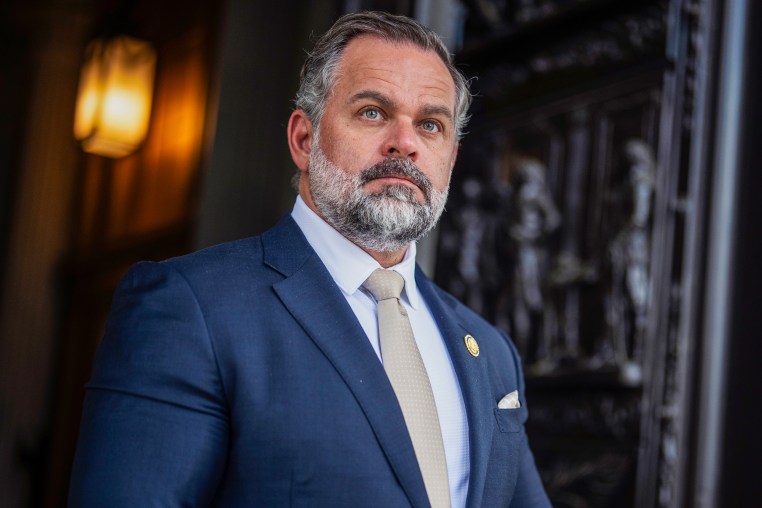
Graham Platner, an emerging Democratic contender in the race for the next United States senator from Maine, has unveiled an ambitious and combative political agenda that he says would reshape the direction of the Democratic Party if elected in 2026.
In a wide-ranging interview, Platner called on Democrats to adopt a more aggressive strategy against the administration of Donald Trump, pursue institutional reforms in Washington, and build a grassroots movement focused on economic justice, anti-war activism, and government accountability.
Platner, who has drawn comparisons to Bernie Sanders and has received the senator’s endorsement, said he sees himself as continuing Sanders’ progressive legacy. According to him, the central mission of his campaign is to challenge a political system he believes has long favored wealthy elites over working-class Americans.
He said his campaign is rooted in a belief that inequality in the United States has deepened because both political institutions and economic structures have been designed to benefit a small class of powerful interests. Platner argued that ordinary citizens need stronger representation and that Democrats must reconnect with voters through bold policy ideas and direct grassroots organizing.
The Maine candidate also said the Democratic Party must rethink how it uses power if it regains control of the Senate. He criticized what he described as a passive opposition strategy and insisted that congressional oversight should be used more forcefully.
According to Platner, a Democratic-led Senate should immediately launch investigations into alleged abuses of power by the Trump administration. He said committees should use subpoena authority extensively to summon officials from the White House and federal agencies accused of acting outside constitutional or legal boundaries.
He argued that lawmakers must hold public officials accountable through sustained hearings and transparency measures, saying Congress has a duty to scrutinize executive actions rather than simply issue statements of concern.
Platner further alleged that Trump had committed impeachable offenses, citing accusations of corruption, self-enrichment, and questionable financial dealings. While acknowledging that impeachment would require enough votes in the Senate for conviction, he said Democrats should prioritize exposing misconduct through investigations if removal is not politically feasible.
The White House has previously denied allegations of wrongdoing involving insider trading or abuse of office.
Beyond the executive branch, Platner also turned his attention to the judiciary. He called for stronger ethics standards for the Supreme Court of the United States and said lawmakers should consider broader reforms, including the possible expansion of the court.
He also suggested there are grounds for impeachment proceedings against Justices Clarence Thomas and Samuel Alito. Platner cited concerns over ethics controversies, undisclosed gifts, and questions surrounding recusals in cases involving politically connected individuals.
His remarks place him among the more progressive voices in U.S. politics who believe the federal judiciary has become overly politicized and requires structural reform.
At the same time, Platner broke with many Democrats on gun policy. He said he does not support a blanket ban on semi-automatic assault weapons, a policy long favored by many within the party.
Instead, he argued that efforts should focus on preventing dangerous individuals from obtaining firearms. He endorsed universal background checks, red-flag laws, and expanded mental health services as more practical approaches to reducing gun violence.
According to Platner, simply banning certain categories of weapons would not solve the broader problem in a country where millions of such firearms are already in circulation.
Another major plank of his platform is opposition to war and military intervention. Platner said Democrats should organize a nationwide anti-war movement in response to recent U.S. military actions involving Iran.
He accused the Democratic establishment of relying too heavily on institutional politics while neglecting public mobilization. In his view, real political power can come from organized citizens in the streets as much as from lawmakers in Congress.
Platner said the party must rediscover the value of social movements and popular activism if it hopes to energize younger voters and those disillusioned with traditional politics.
The candidate’s comments come as he gains momentum in the highly watched Maine Senate race. Several recent polls have reportedly shown him leading Democratic rival Janet Mills as well as Republican incumbent Susan Collins.
If sustained, those numbers would mark a remarkable rise for a political outsider whose background differs sharply from most career politicians. Platner has been identified as an oyster farmer, a profile that has helped reinforce his anti-establishment image.
In discussing Collins, Platner criticized the veteran senator’s long-standing argument that her seniority benefits Maine through federal spending and committee influence. Collins has highlighted more than one billion dollars in federal support she says her office has helped secure for the state.
Platner dismissed that record, arguing that obtaining federal resources is the basic responsibility of any senator, especially one with decades of experience and influence.
He further contended that Maine has suffered losses in healthcare, education, and rural economic development that outweigh the benefits Collins often cites.
The challenger also said Collins should have used her position on the powerful Senate Appropriations Committee to block legislation he says harms working families, including measures that reduce access to Medicaid and threaten rural hospitals.
Looking ahead, Platner said he would seek committee assignments in agriculture, commerce, health, labor, education, and eventually appropriations if elected. He argued that Maine would need to rebuild seniority and influence in Washington if Collins leaves office.
Within the Democratic Party, Platner also voiced opposition to continued leadership by Chuck Schumer as Senate Minority Leader. He said the caucus needs new leadership and mentioned senators such as Chris Van Hollen, Mark Kelly, Chris Murphy, and Brian Schatz as possible alternatives.
Schumer has backed Janet Mills in the Democratic primary, highlighting the ideological divide now emerging inside the party between establishment figures and insurgent progressives.
The Maine Senate contest is expected to become one of the most closely watched races of the 2026 election cycle. Maine has a history of electing moderates and independents, but growing national polarization and dissatisfaction with traditional politics have created an opening for unconventional candidates.
Platner’s campaign appears designed to harness that frustration. By combining progressive economics, institutional reform, anti-war activism, and populist rhetoric, he is presenting himself as both an heir to Sanders-style politics and a disruptive force within the Democratic Party.
Whether that message can carry him through a competitive primary and a likely bruising general election remains uncertain. But his rise has already signaled that many voters are searching for alternatives to established political figures.
As the race develops, Platner’s candidacy may become a test of whether bold progressive politics can still win statewide elections in an era of deep national division.

