


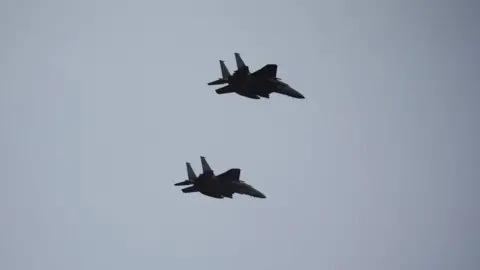
 South Korean authorities have concluded that a mid-air collision involving two military fighter jets in 2021 was caused by pilots taking photographs and videos during a routine flight mission, according to a newly released government audit report.
The findings, made public by Board of Audit and Inspection, shed new light on an incident that damaged two advanced combat aircraft and raised concerns about cockpit discipline, aviation safety culture, and the use of personal devices during military operations.
Although all crew members survived without injury, the collision resulted in costly damage to the aircraft and prompted disciplinary action against one of the pilots involved.
The accident occurred near the central South Korean city of Daegu during what was described as a standard flight mission involving two F-15K fighter jets.
The F-15K is one of South Korea’s most capable multirole combat aircraft, used for air superiority, precision strike operations, and rapid response missions. The platform is considered a major pillar of the country’s defence posture.
According to the report, the collision happened as the aircraft were returning to base.
Investigators said one of the pilots, flying the wingman aircraft, had intended to take commemorative photos during what was his final flight with that particular military unit.
The pilot had reportedly announced his plan during a pre-flight briefing, and investigators noted that taking photographs during significant flights had become a common informal practice among some military pilots at the time.
The report stated that while such actions were not properly regulated, the culture had developed over time without sufficient oversight from commanders.
During the return leg of the mission, the wingman pilot began taking pictures using his personal mobile phone while flying.
Upon noticing this, the pilot of the lead aircraft reportedly instructed another pilot on board to record video footage of the second jet.
That decision set off a sequence of dangerous manoeuvres that ended in collision.
Investigators said the wingman pilot then abruptly raised altitude and rolled the aircraft into a more visually appealing position so it could be better captured on camera.
This unexpected movement brought the two fighter jets dangerously close together.
In an effort to avoid impact, the lead aircraft attempted a rapid descent.
However, the evasive move came too late.
The two jets collided in mid-air, causing damage to the lead aircraft’s left wing and the tail stabiliser of the wingman aircraft.
Despite the seriousness of the incident, all crew members were able to maintain control of their aircraft and return safely to base.
Authorities credited the pilots with preventing a far more serious outcome, noting that loss of control at such speed or altitude could have resulted in fatalities and the destruction of both aircraft.
Military aviation experts say mid-air collisions involving combat jets are among the most dangerous non-combat incidents possible, particularly when aircraft are operating in formation.
Even minor misjudgments in spacing, altitude, or timing can produce catastrophic results because of the speeds involved.
Following the incident, the Republic of Korea Air Force suspended the wingman pilot.
He has since left military service and now works in the commercial aviation sector, according to the report.
The Air Force initially sought to recover the full repair cost of the damaged aircraft from the pilot, estimated at 880 million won, or approximately 596,000 US dollars.
That financial penalty was later challenged by the former officer, triggering a formal review by the national audit board.
During the appeal process, the pilot accepted that his sudden manoeuvre contributed directly to the collision.
However, he argued that the pilot of the lead aircraft had tacitly approved the manoeuvre because he was aware filming was taking place and had participated in the attempt to capture the footage.
The audit board ultimately agreed that responsibility did not rest solely with the wingman pilot.
In its ruling, the board reduced the penalty to 88 million won, equivalent to one-tenth of the amount originally demanded by the military.
It said the Air Force shared responsibility because it had failed to clearly regulate the personal use of cameras and mobile devices during flights.
The board also cited the pilot’s previously strong service record and his effective response after the collision, which helped ensure both aircraft landed safely.
The report did not specify whether disciplinary measures were taken against the lead aircraft’s crew or commanding officers.
That omission may fuel wider debate over command accountability and systemic culture within the Air Force.
The case has generated public attention in South Korea because it combines serious military risk with behaviour more commonly associated with social media culture and personal commemorations.
Analysts say the incident reflects how rapidly personal technology has changed professional environments, including highly controlled sectors such as the military.
Smartphones, wearable cameras, and instant sharing platforms have blurred lines between private memory-making and operational discipline.
What may appear harmless in civilian settings can become dangerous when introduced into aviation, medicine, policing, or military operations.
In combat aviation especially, pilots are expected to maintain full concentration throughout every phase of flight.
Even short distractions can affect judgment, situational awareness, radio communication, and aircraft positioning.
Many air forces worldwide restrict or ban the use of personal devices in cockpits for precisely these reasons.
The South Korean case may now encourage stricter enforcement and updated policies.
Military reform observers say the issue is likely not only about one pilot taking photographs, but about whether informal habits had become normalised without leadership intervention.
The audit board’s reference to photography as a widespread practice suggests commanders may have tolerated unsafe conduct over time.
If so, the collision may be viewed as the result of institutional complacency rather than an isolated lapse.
South Korea maintains one of the most active and technologically advanced air forces in Asia due to continuing tensions with North Korea and broader regional security pressures.
Its pilots regularly train under demanding conditions involving rapid readiness, formation flying, and joint exercises with allies including the United States.
Because of that security environment, maintaining professionalism and readiness standards is considered a national priority.
The F-15K fleet in particular represents a significant defence investment.
Any damage to such aircraft carries not only repair costs but also operational implications, including temporary reductions in readiness and additional inspection requirements across the fleet.
Public reaction in South Korea has been mixed.
Some commentators praised the board for recognising shared responsibility and avoiding what they viewed as excessive punishment for one individual.
Others argued that military pilots entrusted with expensive combat aircraft should be held to the highest standards, regardless of informal customs.
There has also been concern over the fact that the pilot later transitioned into civilian aviation.
While no evidence suggests broader safety issues, the move has renewed debate over how disciplinary records should factor into post-military employment.
Commercial airlines typically maintain strict cockpit discipline rules, and aviation regulators globally emphasise sterile cockpit procedures during key phases of flight.
The case may also influence how military organisations worldwide approach unofficial traditions.
Commemorative photos, farewell flights, symbolic gestures, and unit bonding rituals can be meaningful for morale, but experts warn they must never interfere with operational safety.
The South Korean audit report appears to send that message clearly.
By reducing the fine but still assigning personal responsibility, the board recognised both human error and institutional shortcomings.
It also highlighted that accidents often emerge from a chain of tolerated behaviours rather than a single dramatic mistake.
In the end, what began as an attempt to mark a final flight with memorable pictures became a costly safety incident involving two frontline fighter jets.
No lives were lost, and both aircraft returned safely, but the episode has become a cautionary example of distraction in high-risk environments.
For South Korea’s military, the lesson is likely to endure far beyond the repair bill: professionalism in the cockpit must always come before the camera.