


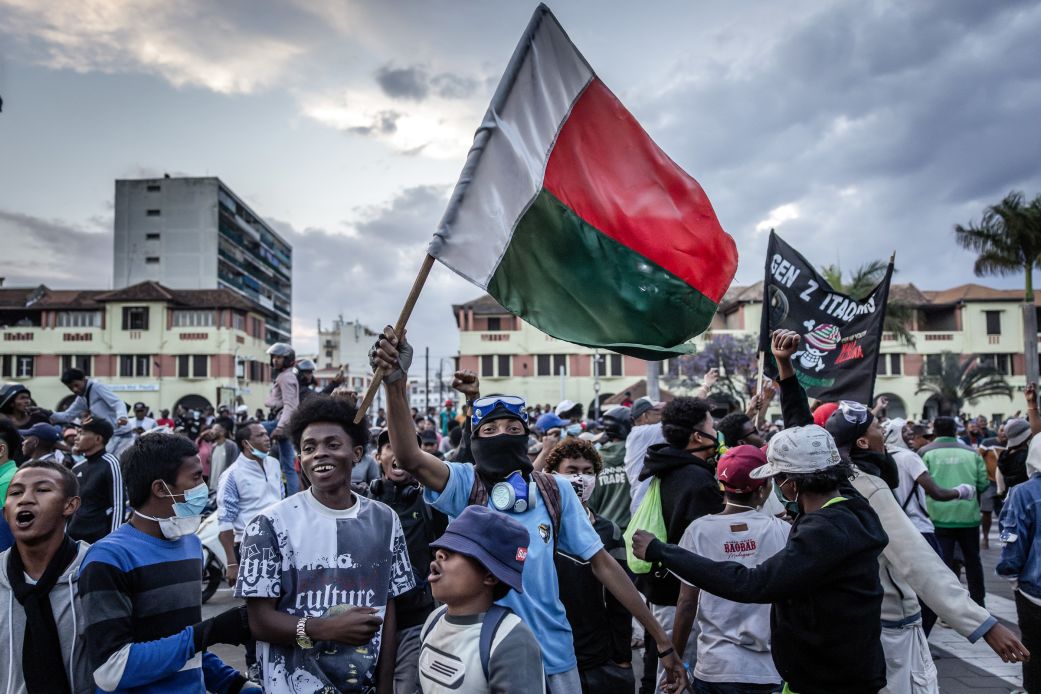
Protesters outside of Antananarivo City Hall in Antananarivo, Madagascar on October 11.
Madagascar has entered a new period of political uncertainty after youth-led protests and military intervention forced President Andry Rajoelina from power, prompting fresh debate over whether similar movements could emerge elsewhere across Africa.
The events mark a dramatic turn for the Indian Ocean island nation and reflect a growing global pattern in which younger generations particularly Generation Z are increasingly driving political unrest, demanding accountability, and challenging entrenched leadership structures.
This week, as demonstrations intensified in Madagascar, the military stepped in and assumed control, leading to Rajoelina’s departure. The president’s removal carries a striking historical parallel: Rajoelina himself first rose to power in 2009 with military backing after a youth-driven uprising forced then-president Marc Ravalomanana into exile.
Now, more than a decade later, he has been removed through a similar combination of street protests and military action.
A Familiar Political Cycle
Rajoelina, 51, was once seen as a youthful outsider challenging an older political establishment. A former disc jockey turned mayor of the capital Antananarivo, he capitalized on widespread frustration with governance and economic hardship during the 2009 political crisis.
His return to office through elections years later was presented as a democratic reset. Yet critics say his administration increasingly came to symbolize many of the same governance problems he once opposed: concentration of power, economic inequality, and limited opportunities for younger citizens.
That frustration appears to have become a catalyst for the latest protests.
The military is now reported to be backing Michael Randrianirina, commander of a powerful army unit previously linked to Rajoelina’s original rise to power.
For many protesters, the president’s removal represents only a partial success.
A spokesman for the protest movement, Elliot Randriamandrato, said recent events should be viewed as “a half-victory,” warning that the deeper struggle for democratic change is only beginning.
His remarks highlight a dilemma common to many youth uprisings: removing a leader can be easier than building a stable, representative alternative.
 Col. Michael Randrianirina, leader of the military group that seized power with the support of the army, is sworn in as interim president at the High Constitutional Court building in Antananarivo, Madagascar, on October 17, 2025.
The Rise of Generation Z Politics
The Madagascar protests are part of a broader international trend in which Generation Z—generally defined as those born from the mid-1990s to the early 2010s is emerging as a major political force.
This generation has grown up in a digitally connected world, with immediate access to information, cross-border activism, and online organizing tools. Many Gen Z citizens are politically aware, skeptical of traditional institutions, and impatient with corruption, unemployment, and elite privilege.
Across multiple continents, young people have recently played central roles in anti-government mobilizations.
In Nepal, a youth-led movement reportedly fueled by anger over a social media ban, corruption concerns, and poor economic prospects helped push out the prime minister earlier this year.
That followed another political change in 2024, reinforcing the volatility of youth-driven public pressure.
In Bangladesh, weeks of student-led demonstrations contributed to the ousting of longtime Prime Minister Sheikh Hasina. Protesters there demanded political reform, accountability, and economic fairness.
Unlike Madagascar, Bangladesh’s transition reportedly moved toward civilian leadership, with a Nobel Peace Prize winner assuming a central transitional role.
Similarly, in Sri Lanka, youth-led protests in 2022 helped topple the ruling administration amid severe economic collapse and shortages.
These examples suggest that Gen Z activism is not confined to one region or ideology. Rather, it reflects a wider generational response to governance failures and shrinking economic hope.
Why Youth Movements Are Growing in Africa
Africa has the youngest population of any continent. In many countries, the majority of citizens are under 30. This demographic reality means that youth concerns jobs, education, housing, digital freedoms, cost of living, and political inclusion are central to national stability.
Yet many African states remain governed by older political elites, some of whom have dominated politics for decades.
This disconnect can create deep frustration.
Young Africans are increasingly asking why leadership transitions remain slow, why corruption persists, and why economic growth often fails to translate into opportunity.
Social media has amplified these demands. Platforms such as TikTok, X, Facebook, Instagram, WhatsApp, and Telegram allow rapid mobilization, fundraising, message discipline, and exposure of abuses.
Where previous generations relied on political parties or unions, Gen Z movements often organize horizontally through digital networks rather than traditional structures.
That makes them harder to predict and harder to suppress.
Should African Leaders Be Concerned?
The developments in Madagascar are likely to be watched closely by governments across the continent.
Many African leaders already face pressure over inflation, unemployment, debt burdens, weak currencies, insecurity, and demands for constitutional reform.
In such environments, a trigger event fuel hikes, election disputes, corruption scandals, internet shutdowns, police violence, or shortages can rapidly escalate into national protests.
The Madagascar case shows that once youth mobilization converges with elite fractures or military dissatisfaction, leadership change can happen quickly.
That does not mean all governments are at immediate risk. Political systems differ widely, and many countries retain strong institutions or broad public legitimacy.
However, the warning signs are clear: where large youth populations feel excluded and see no peaceful path to change, unrest becomes more likely.
The Military Factor
One of the most significant aspects of Madagascar’s upheaval is the military’s role.
Youth protests alone can pressure governments, but when armed forces withdraw support from incumbents or actively intervene the political balance changes dramatically.
This has been seen in several African states in recent years where coups followed periods of public frustration.
Yet military takeovers often create new problems rather than solving old ones. They may remove unpopular leaders, but they can delay elections, restrict freedoms, and weaken constitutional norms.
That is why many analysts argue that durable change must come through institutions, not barracks.
For Madagascar’s protesters, the challenge now is ensuring their movement is not used merely to legitimize another elite power transfer.
What Leaders Can Learn
African governments seeking to avoid similar crises may need to focus less on controlling dissent and more on addressing its causes.
That includes:
- Expanding jobs and entrepreneurship opportunities
- Improving education and digital access
- Fighting corruption visibly and credibly
- Respecting term limits and democratic rules
- Allowing peaceful protest and media freedom
- Including younger voices in decision-making
Gen Z is not demanding only symbolic change. In many countries, it is demanding functioning governance.
What Comes Next for Madagascar
Madagascar now faces uncertainty over whether military control will be temporary or prolonged.
The credibility of any transition will depend on whether authorities commit to a clear constitutional roadmap, civilian participation, and credible elections.
If the military consolidates power without reform, protesters may feel betrayed.
If it facilitates genuine transition, Madagascar could become a model for negotiated change after unrest.
A New Political Era
The fall of Rajoelina underscores a broader truth: political legitimacy in the digital age is increasingly tied to performance, inclusion, and responsiveness.
For African leaders, the lesson is not that Gen Z is inherently destabilizing. It is that younger citizens are no longer willing to remain politically passive.
They are organized, connected, and numerous.
And where institutions fail to absorb their demands, the streets may do so instead.