


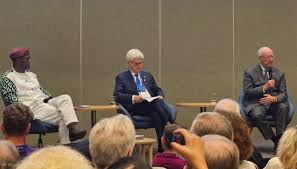
Rotary International President-Elect, Olayinka Hakeem Babalola, has reaffirmed the organisation’s unwavering commitment to eliminating polio worldwide, declaring that growing financial pressures facing global health programmes will not weaken efforts to eradicate the disease.
Addressing Rotarians ahead of officially assuming office as President of Rotary International, Babalola stressed that the fight against polio remains one of the organisation’s most important commitments and pledged that Rotary would continue to work alongside governments, health agencies and development partners until the disease is completely wiped out.
“We must keep our most important commitment: We will eradicate polio,” he declared, emphasizing that the organisation would not relent despite mounting funding constraints affecting health interventions around the world.
Innovation Expanding Access to Vaccines
Babalola highlighted progress being made in some of the world’s most difficult environments, citing Afghanistan as an example of how innovation is helping to overcome resistance to vaccination.
According to him, health workers in parts of Afghanistan are now using needle-free jet injectors to immunise children in communities where fears and mistrust had previously discouraged parents from participating in vaccination campaigns.
He said the new technology has proven effective in increasing acceptance and enabling health workers to reach children who were once inaccessible.
“In Afghanistan, medical workers are now using needle-free jet injectors to vaccinate children in communities where fear and distrust once kept families away, and it is working. Innovation is helping us reach the unreachable,” he said.
Warning Against Complacency
Despite the progress recorded over the years, Babalola warned that the global campaign against polio remains at a critical stage and cautioned against complacency.
He noted that shrinking resources and competing global priorities have placed considerable pressure on funding for health programmes, making it even more important for Rotary and its partners to remain committed.
“But we cannot rest now. Funding is under pressure globally. This is precisely the moment Rotary must hold firm. Every child protected is one step closer to a promise kept to every family in the world that will never have to know this disease,” he stated.
Focus on Sustainable Impact
The incoming Rotary leader explained that the organisation’s mission goes beyond executing projects and delivering short-term interventions. He said Rotary’s new theme, “Create Lasting Impact,” reflects a broader vision of achieving sustainable and measurable change in communities around the world.
According to him, the initiative challenges members to think beyond immediate achievements and concentrate on ensuring that the benefits of Rotary’s activities endure for generations.
“In Rotary, we give members a place to belong. We help keep students in school. We organise vaccination campaigns that protect children. These results are real, and they matter deeply. But to create lasting impact asks a harder question: What happens next?” he said.
He explained that the organisation intends to evaluate success not only by the number of projects completed, but also by the long-term transformation those projects bring to individuals and communities.
Peacebuilding as a Core Objective
Babalola also underscored Rotary’s dedication to promoting peace, insisting that peacebuilding should be an intentional goal embedded in all humanitarian and development initiatives.
“Peace must be deliberately pursued. It must be built into the design of what we do, not assumed as a by-product,” he said.
He pointed to Rotary’s Pathways to Peace and Prosperity Initiative in Colombia as an example of deliberate peacebuilding. The programme supports communities affected by decades of armed conflict, poverty and displacement through leadership training, conflict resolution mechanisms and economic empowerment initiatives.
According to him, the programme demonstrates how targeted interventions can help communities recover and foster long-term stability.
“That is what deliberate peacebuilding looks like. And that is the standard I am calling all of us to bring to our work this year,” he added.
Personal Journey Inspires Commitment to Service
Reflecting on his more than 40 years of service within Rotary, Babalola recounted how participating in a literacy programme as a young Rotaractor transformed his perspective on humanitarian service.
He recalled witnessing a woman read her own name for the first time after learning to read, describing the experience as life-changing.
“I watched a woman hold a piece of paper and read her own name for the first time. That moment redirected me. I was not simply a young man with opportunities anymore. I was a young man with a responsibility to extend those opportunities to others,” he said.
Renewed Call for Global Service
Babalola urged Rotarians across the world to remain committed to building a legacy founded on compassion, peace and hope. He stressed that Rotary’s greatest accomplishments are measured not only by completed projects, but by the lives transformed and communities empowered through sustained service.
Health experts have repeatedly warned that until polio is completely eradicated, outbreaks remain possible, making continued vaccination efforts essential. Rotary International has been one of the leading partners in the global campaign against polio for decades, contributing billions of dollars and mobilising volunteers in collaboration with governments, the World Health Organization, UNICEF and other international partners.
With only a few countries still recording cases of the disease, Babalola expressed confidence that the world is closer than ever to achieving a polio-free future, provided governments, donors and humanitarian organisations maintain their commitment to the cause.


