


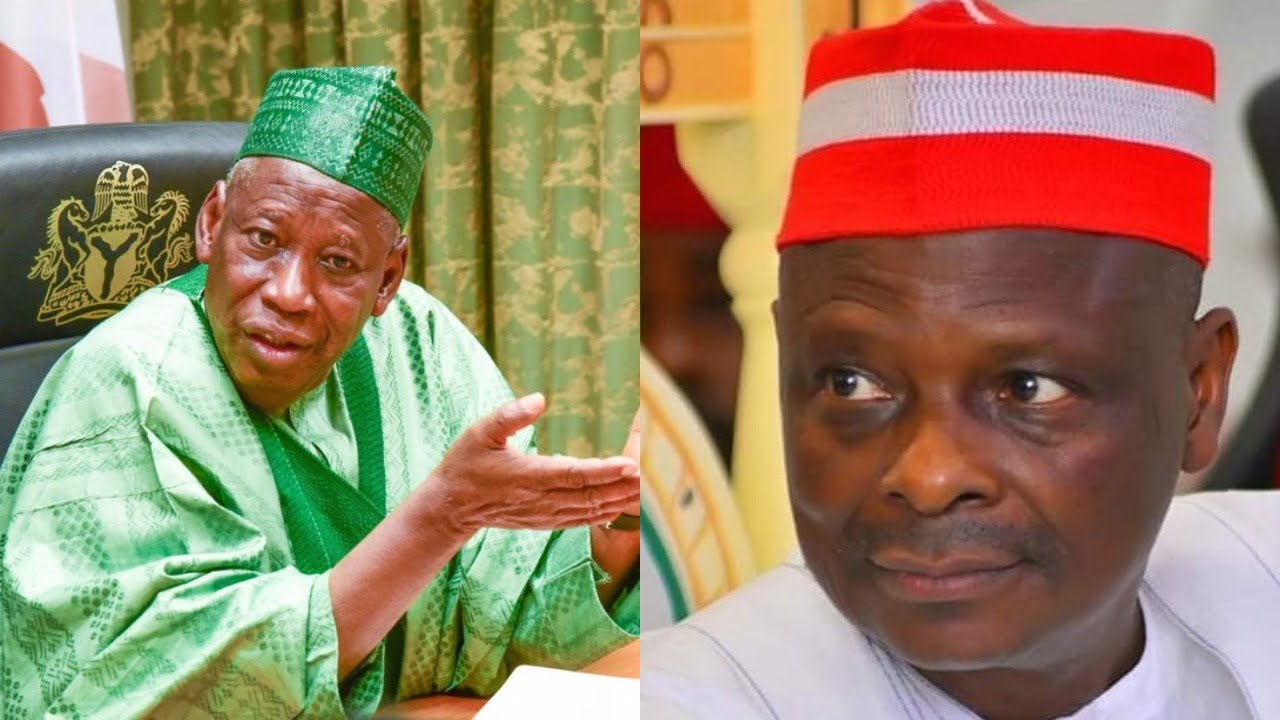
Former National Chairman of the All Progressives Congress (APC), Abdullahi Umar Ganduje, has responded to recent remarks by Senator Rabiu Musa Kwankwaso, insisting that political history shows Kwankwaso was once his junior and beneficiary in earlier stages of his career.
In a statement issued by his Chief of Staff, Comrade Muhammad Garba, while Ganduje is currently in Saudi Arabia for the Hajj pilgrimage, the former governor said politics is fundamentally built on mentorship, loyalty, and shared experience, rather than rivalry narratives being promoted in recent exchanges.
His response comes after Kwankwaso reportedly stated that “even Ganduje was once my boy,” a comment that sparked renewed debate over the long-standing political rivalry between the two Kano political heavyweights.
Ganduje, however, rejected what he described as attempts to simplify their relationship, stressing that both men supported each other at different stages of their political journeys.
He recalled that during Kwankwaso’s early rise, particularly around his emergence in national politics, he benefited from political and moral support that contributed to his advancement.
He further noted that Kwankwaso, during his time as a senior public official in the Federal Capital Territory and later as a commissioner in Kano State, frequently interacted closely with him, describing their early relationship as one of cooperation within the same political structure.
The statement also revisited the 1998 Kano governorship primaries, where Ganduje claimed he was widely believed to have performed strongly but was persuaded by senior political stakeholders to step down and accept the deputy governorship position alongside Kwankwaso in the interest of party unity.
Both men later served together as governor and deputy governor between 1999 and 2003, and again worked within overlapping political alignments in subsequent years, including the 2011–2015 political cycle in Kano State.
Ganduje argued that political relationships are dynamic and evolve over time, noting that individuals who once served in junior roles can later rise to positions of greater authority.
He referenced Governor Abba Kabir Yusuf, a former aide to Kwankwaso, who now occupies the office of governor, as an example of such political progression.
He urged political actors in Kano to avoid personal narratives that could inflame tensions, stressing that leaders should focus instead on governance, peace, and development rather than historical superiority claims.


