


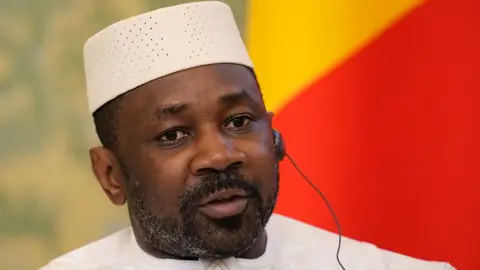
Gen Assimi Goïta promised to tackle Mali’s long-running security crisis when he seized power in 2020.
Mali’s transitional leader, Assimi Goïta, has assumed the role of defence minister following the death of his predecessor, Sadio Camara, in a deadly wave of coordinated attacks.
According to a decree broadcast on state television, Goïta will oversee the defence portfolio while continuing as head of state. He will be supported by Oumar Diarra, who has been appointed minister delegate for defence.
The development comes amid a deepening security crisis in Mali, where a coalition of jihadist and separatist groups recently launched large-scale, coordinated assaults across multiple regions. The attacks, which began on April 25, targeted several towns and cities, including areas near the capital, Bamako.
Camara was reportedly killed in a suspected suicide vehicle bombing at his residence during the offensive. The violence has been linked to an alliance between the Azawad Liberation Front and the al-Qaeda-affiliated Jama’at Nusrat al-Islam wal-Muslimin (JNIM), both of which have intensified operations against government forces.
The insurgents have since imposed partial blockades on key urban centres, including Bamako, raising concerns over the government’s ability to maintain control.
The scale of the attacks also forced Malian and allied Russian forces to withdraw from the northern city of Kidal, further exposing vulnerabilities in the country’s security framework.
In response, Malian authorities announced the arrest of several individuals, including both serving and former military personnel, allegedly involved in planning and executing the attacks. Investigations are ongoing.
Mali has also intensified military cooperation with neighbouring Niger and Burkina Faso under the Alliance of Sahel States. Joint air operations against insurgent positions were launched shortly after the attacks began.
All three countries are currently governed by military regimes and have distanced themselves from France, their former colonial power, opting instead for security partnerships with Russian forces.
Despite these efforts, militant groups continue to control significant territories across the Sahel region, underscoring the persistent instability facing Mali and its neighbours.

