


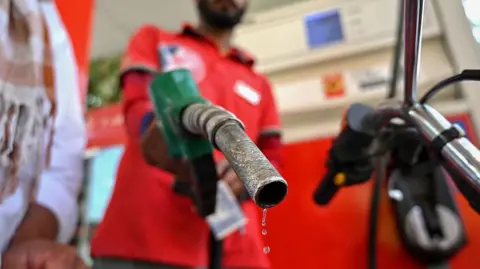
Global oil prices climbed sharply on Monday after plans for a second round of peace talks between the United States and Iran were delayed again, increasing concerns over prolonged disruption to energy supplies.
Brent Crude, the international benchmark for oil prices, rose by around 2 percent to 109.33 dollars per barrel, while U.S.-traded West Texas Intermediate also gained roughly 2 percent to 96.78 dollars.
Markets reacted after President Donald Trump confirmed that Washington had cancelled plans to send a delegation to Islamabad for further negotiations with Iranian officials.
The delay has deepened uncertainty over efforts to secure a lasting ceasefire and reopen one of the world’s most important maritime energy routes.
Strait of Hormuz Remains Key Concern
At the centre of the market reaction is the Strait of Hormuz, through which around one-fifth of the world’s crude oil and liquefied natural gas usually passes.
The waterway has been effectively disrupted since the outbreak of the conflict, severely affecting tanker traffic and fuelling fears of supply shortages.
Any prolonged closure or instability in the strait could have significant consequences for global inflation, shipping costs, and energy markets.
Oil prices have already risen more than 10 percent since Trump announced last week that he would extend a temporary ceasefire with Tehran to give Iranian leaders time to submit what he called a “unified proposal.”
However, the latest setback in talks has raised doubts over whether diplomacy can move forward quickly enough to calm markets.
Iran Continues Regional Diplomacy
Iranian Foreign Minister Seyed Abbas Araghchi said on Sunday that important discussions were continuing with Oman, which shares maritime borders with Iran near the Strait of Hormuz.
In a social media post, Araghchi said talks focused on bilateral matters and regional developments, including efforts to ensure safe maritime transit.
“Our focus included ways to ensure safe transit that is to benefit all dear neighbours and the world. Our neighbours are our priority,” he said.
Araghchi also travelled to St Petersburg on Monday for talks with Russian President Vladimir Putin, according to Iran’s state-run IRNA news agency.
The visit signals Tehran’s continued effort to strengthen diplomatic support from major regional and global partners while negotiations with Washington remain stalled.
Traders Seek Concrete Progress
Analysts say energy markets are becoming less responsive to political statements and increasingly focused on measurable developments.
Economics lecturer Goh Jing Rong of Singapore Management University said traders now want firm evidence of de-escalation rather than temporary promises.
“I think traders want concrete evidence rather than just a fragile and reversible ceasefire agreement,” he said.
That caution reflects repeated cycles of optimism followed by setbacks since the conflict began.
Many investors now appear reluctant to price in peace until there is a clear agreement on shipping access, sanctions, and military de-escalation.
Wider Economic Impact
Experts warn that higher oil prices could affect much more than petrol costs.
Sophie Huynh, a strategist at BNP Paribas, said consumers may be underestimating how deeply oil shortages can affect everyday goods.
“I think we’re underestimating the extent to which products could be affected by the oil shortage,” she said.
“We’re not consuming crude, we’re consuming products.”
She warned that if the Strait of Hormuz remains blocked for more than a few weeks, supply chain disruption could become severe.
Because oil and gas are used in transport, manufacturing, packaging, chemicals, medicines and agriculture, sustained price rises could feed through to a broad range of consumer goods.
Trump Criticises Tehran Leadership
In a Truth Social post on Saturday, Trump said too much time had been wasted organising travel for negotiators and too much work was involved in sending U.S. officials to Pakistan.
He also claimed there was confusion inside Iran’s leadership.
“There is tremendous infighting and confusion,” Trump wrote.
“Nobody knows who is in charge, including them.”
He added that Washington remained in a position of strength and said Iranian officials could contact the United States directly if they wanted to resume talks.
The remarks suggest the White House is seeking to maintain pressure on Tehran while leaving the door open for future diplomacy.
UK and Europe Monitor Cost Pressures
In the United Kingdom, officials are increasingly concerned about the domestic cost-of-living impact of rising energy prices.
The Bank of England is expected to attend another emergency COBRA government meeting on Tuesday, where ministers will discuss the possible impact of the conflict on fuel prices, inflation, and household energy bills later this year.
Motorists in Britain have already seen rising prices at fuel pumps since the conflict began.
If tensions continue, economists warn higher gas and electricity costs may follow.
Stock Markets Mixed
Financial markets showed mixed reactions to the latest developments.
London’s FTSE 100 fell 0.18 percent in early trading.
France’s CAC 40 was broadly flat, while Germany’s DAX rose 0.13 percent.
In Asia, markets closed higher despite earlier volatility caused by the conflict.
Japan’s Nikkei 225 rose 1.38 percent, extending gains of nearly 14 percent over the past month.
South Korea’s KOSPI climbed 2.15 percent and has surged more than 20 percent in the past month.
Both countries were initially hit hard because their economies rely heavily on imported Gulf energy supplies.
Outlook
With talks delayed, tanker routes disrupted, and markets nervous, investors are likely to remain focused on any sign of progress between Washington and Tehran.
Until shipping through the Strait of Hormuz normalises and diplomacy gains momentum, oil prices may remain elevated.
For governments and consumers worldwide, the cost of uncertainty is already being felt.