


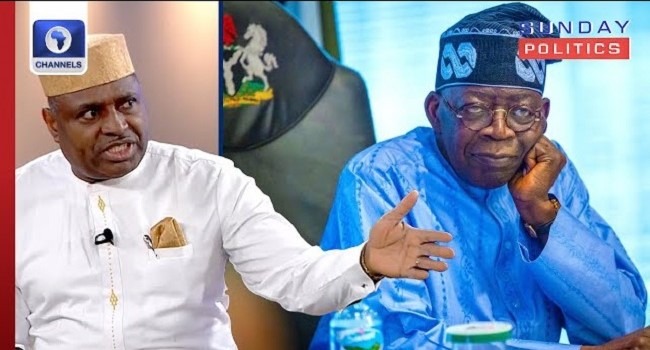
Kenneth Okonkwo says the Federal Government’s decision to remove the petrol subsidy has increased economic pressure on Nigerians and reduced the purchasing power of the naira.
Kenneth Okonkwo, spokesperson for African Democratic Congress (ADC) presidential candidate Atiku Abubakar, has criticised the Federal Government’s fuel subsidy policy, arguing that Nigerians have yet to see sufficient benefits from its removal.
Speaking on Channels Television’s Sunday Politics, Okonkwo defended Atiku’s proposal to make petrol more affordable if he wins the 2027 presidential election.
According to him, the removal of the subsidy, announced by President Bola Tinubu in May 2023, contributed to higher fuel, transportation, logistics and production costs across the country.
Okonkwo said petrol currently sells for around ₦1,300 per litre, arguing that the cost has placed significant pressure on households and businesses.
He illustrated the impact by saying that filling a 100-litre vehicle tank would cost about ₦130,000, which he described as almost twice the current minimum wage.
Atiku’s Plan Not Traditional Subsidy, Okonkwo Says
Okonkwo said Atiku’s proposed approach would not simply restore the subsidy system that existed before 2023.
Instead, he explained that the plan would focus on lowering the cost of locally refined petrol by making crude oil available to domestic refineries at affordable prices.
“Atiku is not going back to that. And cannot even go back to that. Why? We have our local refineries now working,” he said.
He said the proposed Atiku Fuel Affordability Plan (AFAP) would therefore focus on reducing production costs rather than directly subsidising fuel consumption.
‘Naira Has Lost Its Value’
The ADC chieftain also accused the Tinubu administration of weakening the purchasing power of the naira.
He compared the previous ₦30,000 minimum wage with the current ₦70,000 minimum wage, arguing that the increase in nominal wages has not translated into a corresponding improvement in Nigerians’ standard of living.
Okonkwo said the rising cost of goods and services had effectively reduced the value of what workers earn.
He further argued that increased government revenue following the subsidy removal had been offset by the rising cost of living.
Government Defends Subsidy Removal
The Federal Government has maintained that removing the petrol subsidy was necessary to redirect public funds towards development and reduce the financial burden of subsidising fuel.
Minister of Finance and Coordinating Minister of the Economy, Taiwo Oyedele, recently said the policy saved Nigeria ₦15.8 trillion between June 2023 and December 2025.
The subsidy debate has also become a major political issue ahead of the 2027 presidential election.
Atiku has said he would make petrol more affordable if elected, a position that has generated debate because he had previously supported the removal of the subsidy during the 2023 election campaign.
Okonkwo, however, maintained that Atiku’s current proposal is different from the former subsidy regime and is aimed at improving Nigerians’ purchasing power by reducing the underlying cost of fuel.


