


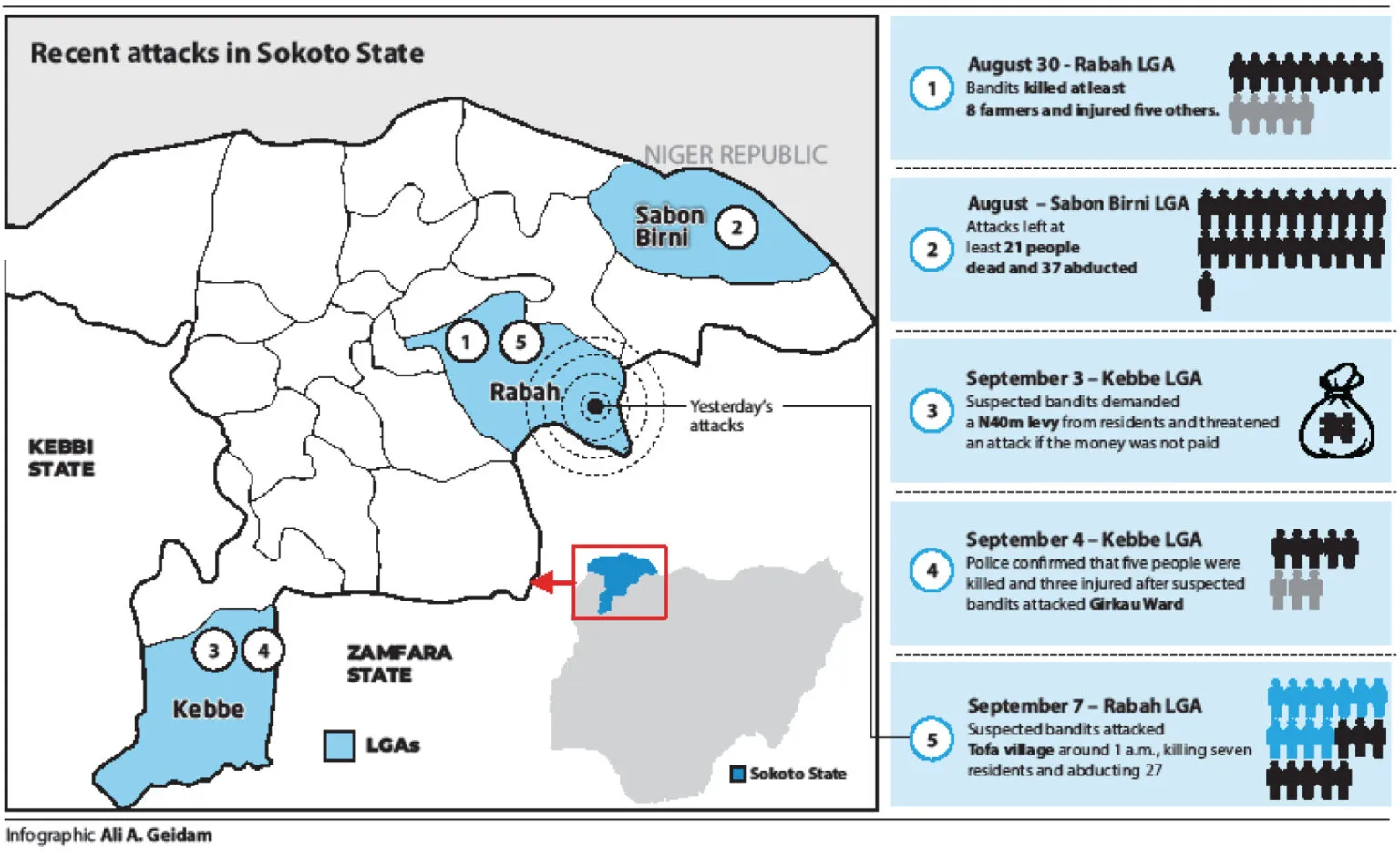
Sokoto State is facing a fresh wave of insecurity, with several communities increasingly becoming targets of bandit attacks that have reportedly left at least 15 people dead and dozens abducted across different parts of the state.
The latest attacks occurred in Rabah, Isa and Dange Shuni Local Government Areas, coming only days after similar incidents were reported in Bodinga, Kebbe, Goronyo, Tureta and Tambuwal.
The growing pattern has raised concerns that banditry is spreading beyond areas traditionally regarded as the state’s major hotspots.
In Rabah LGA, seven residents were reportedly killed when armed men invaded Tofa village at about 10pm on Sunday. Among the victims was a woman whose son was allegedly killed by the attackers.
A resident, who spoke on condition of anonymity, said the attackers entered the community while residents were asleep and opened fire.
The source identified the victims as Guda Biti, Bello Dan Makanike, Musa Dan Agaji, Mallam Dan Tani, Dan Kuluwa, Jamila and Masudu. Their remains were buried on Monday morning.
The resident said 35 people were initially abducted during the attack, although eight later escaped or were released, leaving 27 still in captivity.
In Isa LGA, residents of Tidibale village said bandits attacked the community on Saturday, killing five people and abducting about 50 others. Vehicles reportedly belonging to soldiers stationed in the area were also set ablaze.
Another attack was reported in Dange Shuni LGA, where two residents were allegedly killed in Wababe and Rumbus communities while two others were abducted.
Residents said the attackers moved through several communities, triggering panic and forcing people to flee their homes.
One resident, Uzairu Ibrahim Dilingu, said gunshots were heard around the eastern axis of the area on Sunday afternoon, while warnings about the attackers approaching caused residents in Sokondu, Wababe, Majiyya Gida and Bellar Koli to seek safety.
Another resident said the attackers remained in Wababe from Sunday evening until Monday morning, killing a mentally challenged man identified as Wadata Dan Wababe, popularly known as Achiku or Minister. The attackers allegedly looted shops and stole livestock.
Residents appealed to the government and security agencies to establish permanent security posts in vulnerable communities, saying this would allow farmers and other residents to return to their livelihoods without fear.
The chairmen of Rabah and Dange Shuni LGAs could not be reached for comment, while the Sokoto State Police Command spokesman, DSP Ahmad Rufai, said he would investigate the incidents and provide an update.
A senior security officer, however, confirmed the attacks and killings but disputed the reported number of abductees, saying the figure had been exaggerated.
A State Under Growing Pressure
The latest incidents add to a long list of attacks recorded across Sokoto in recent months.
In August alone, communities in Goronyo, Tambuwal and Kebbe reportedly suffered deadly attacks, with dozens killed or abducted. Earlier attacks in July also forced residents of several communities to abandon their homes, while large numbers of livestock were reportedly stolen.
Between June and July, attacks were reported in Tureta, Sabon Birni, Rabah, Goronyo, Wurno, Bodinga and Tambuwal, with residents repeatedly calling for stronger security measures.
The situation has also triggered concerns about the wider security implications of the violence, particularly along Sokoto’s border with Niger Republic.
Security analyst and peace-building expert Comrade Nuraddeen Bello Bodinga said the worsening situation showed that Sokoto’s security architecture required a fundamental review.
He called for better coordination among political leaders, traditional rulers, security agencies and other stakeholders, as well as improved intelligence gathering and closer coordination between ground and air operations.
Bodinga also stressed the need for greater investment in education, healthcare and employment, arguing that addressing socioeconomic vulnerabilities would help reduce the conditions exploited by criminal groups.
From Banditry to a Wider Security Threat
Security analyst Barrister Bulama Bukarti warned that the violence in Sokoto could no longer be treated simply as conventional banditry.
According to Bukarti, criminal groups are increasingly interacting with violent extremist organisations operating across the Sahel, creating a more complex and dangerous security environment.
He identified the porous border between Sokoto and Niger Republic as a major factor facilitating the movement of criminals, weapons, drugs and other supplies.
Bukarti also raised concerns over the activities of groups such as Lakurawa, Islamic State’s Sahel Province and Jama’at Nusrat al-Islam wal-Muslimin (JNIM), warning that extremist activity in the wider Sahel could increasingly affect north-western Nigeria.
He urged the government to combine military operations with stronger intelligence-sharing, tighter border control and efforts to disrupt the financing and supply networks sustaining armed groups.
Bukarti further argued that military action alone would not permanently end the crisis, stressing the need for reintegration programmes and economic opportunities for vulnerable young people.
With attacks spreading into communities previously considered relatively safer, residents and security experts are increasingly calling for a coordinated and proactive strategy to prevent Sokoto from becoming an even larger centre of bandit and extremist activity.