


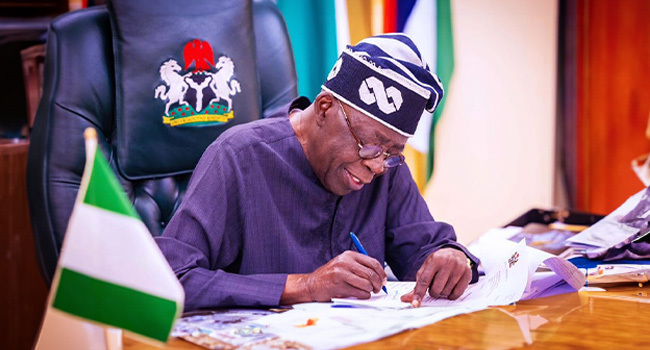
President Bola Tinubu
Bola Ahmed Tinubu has formally requested the approval of the Senate of Nigeria for a fresh $516.3 million foreign syndicated loan to support the construction of the proposed Sokoto–Badagry Superhighway, one of the flagship infrastructure projects under his administration.
The request was conveyed in a letter read during plenary on Thursday by Godswill Akpabio, who presided over proceedings in the upper legislative chamber.
According to the communication, President Tinubu is seeking a Senate resolution in accordance with Sections 16 and 21 of the Debt Management Office (Establishment) Act, 2011, which requires legislative approval for external borrowing by the Federal Government.
The proposed loan facility is expected to finance Sections 1, Phase 1A and 1B of the highway project, with funding to be arranged through Deutsche Bank AG.
Strategic National Infrastructure Project
President Tinubu described the Sokoto–Badagry highway as a major national infrastructure initiative under the Renewed Hope Agenda, his administration’s policy framework focused on economic reform, infrastructure expansion, and national development.
He said the superhighway is intended to significantly improve road connectivity across the country, reduce travel time, enhance logistics efficiency, and support the movement of goods and people through strategic economic corridors.
The road project is expected to span approximately 1,000 kilometres, linking northern and southern Nigeria through multiple states and commercial zones.
Once completed, the route will connect:
- Sokoto State
- Kebbi State
- Niger State
- Kwara State
- Oyo State
- Ogun State
- Lagos State
The highway will run from Illela, near Nigeria’s border with Niger Republic, to Badagry on the Atlantic coast.
Officials say the corridor is designed to open trade routes, integrate agricultural belts with urban markets, and stimulate regional commerce.
Financing Structure
President Tinubu explained that the external financing package would be supported by a partial risk guarantee from the Islamic Corporation for the Insurance of Investment and Export Credit, commonly known as ICIEC.
Such guarantees are typically used to reduce lender exposure and improve borrowing terms for sovereign-backed infrastructure financing.
In addition to the foreign loan, the Federal Government is expected to provide counterpart funding exceeding ₦265 billion.
This domestic contribution will cover:
- Land acquisition
- Compensation to affected communities and property owners
- Related infrastructure obligations
- Ancillary project requirements
The combination of external borrowing and local counterpart financing reflects the large scale and complexity of the highway development.
Loan Terms
According to the President, the proposed facility is structured over a nine-year tenure, including a three-year grace period before principal repayments begin.
The interest rate is pegged at the Chicago Mercantile Exchange SOFR benchmark plus 5.3 percent per annum.
SOFR, or the Secured Overnight Financing Rate, is widely used internationally as a reference rate for loans and debt instruments.
Government officials believe the structure provides manageable medium-term financing for a project expected to generate long-term economic value.
President Tinubu also informed lawmakers that the Federal Executive Council has already approved the financing plan.
Senate Action
Following the reading of the request, Senate President Akpabio referred the matter to the Senate Committee on Local and Foreign Debts for legislative review.
He directed the committee to examine the proposal and report back to the Senate within one week.
The committee is expected to assess:
- The necessity of the borrowing
- Loan terms and repayment implications
- Project viability
- Fiscal sustainability
- Compliance with statutory debt procedures
Its report will guide final Senate consideration of the request.
Akpabio Defends Borrowing for Infrastructure
In remarks supporting the proposal, Akpabio said borrowing for productive national infrastructure is preferable when the funds are tied to projects that improve public welfare and national development.
He noted that investment in road networks can help improve safety, reduce accidents, lower transport costs, and foster stronger national integration.
Supporters of the plan argue that strategic borrowing for infrastructure can stimulate growth if projects are well executed and economically beneficial.
Economic Significance
The Sokoto–Badagry corridor is viewed as one of the most ambitious road projects proposed in recent years.
If completed successfully, analysts say it could:
- Reduce freight bottlenecks between northern producers and southern ports
- Improve interstate commerce
- Strengthen agricultural supply chains
- Encourage industrial investment along the route
- Generate employment during construction and operation
- Improve passenger mobility across regions
The project also carries symbolic significance, physically linking the far northwest to the southwest coast.
Debt Concerns
However, new borrowing requests often attract scrutiny amid Nigeria’s rising public debt obligations and debt servicing pressures.
Economists have repeatedly emphasized that external loans should be tied to transparent, high-impact capital projects capable of boosting productivity and generating measurable returns.
Questions likely to arise during Senate deliberations include:
- Whether projected benefits justify the cost
- Whether timelines are realistic
- How repayment obligations will affect future budgets
- Whether project execution capacity is sufficient
Outlook
With the request now before the Senate, the next stage will depend on the recommendations of the debt committee and the broader response of lawmakers.
If approved, the financing would allow the Federal Government to proceed with critical early phases of the superhighway.
For the Tinubu administration, the project represents a major test of its infrastructure agenda and its argument that carefully structured borrowing can be used to unlock long-term national growth.
For Nigerians, attention will now focus on whether the proposed highway can move from legislative approval to visible construction progress and eventual economic transformation.