


The release of President Bola Ahmed Tinubu’s nomination documents for the 2027 presidential election by the Independent National Electoral Commission (INEC) has reignited public debate over his educational qualifications.
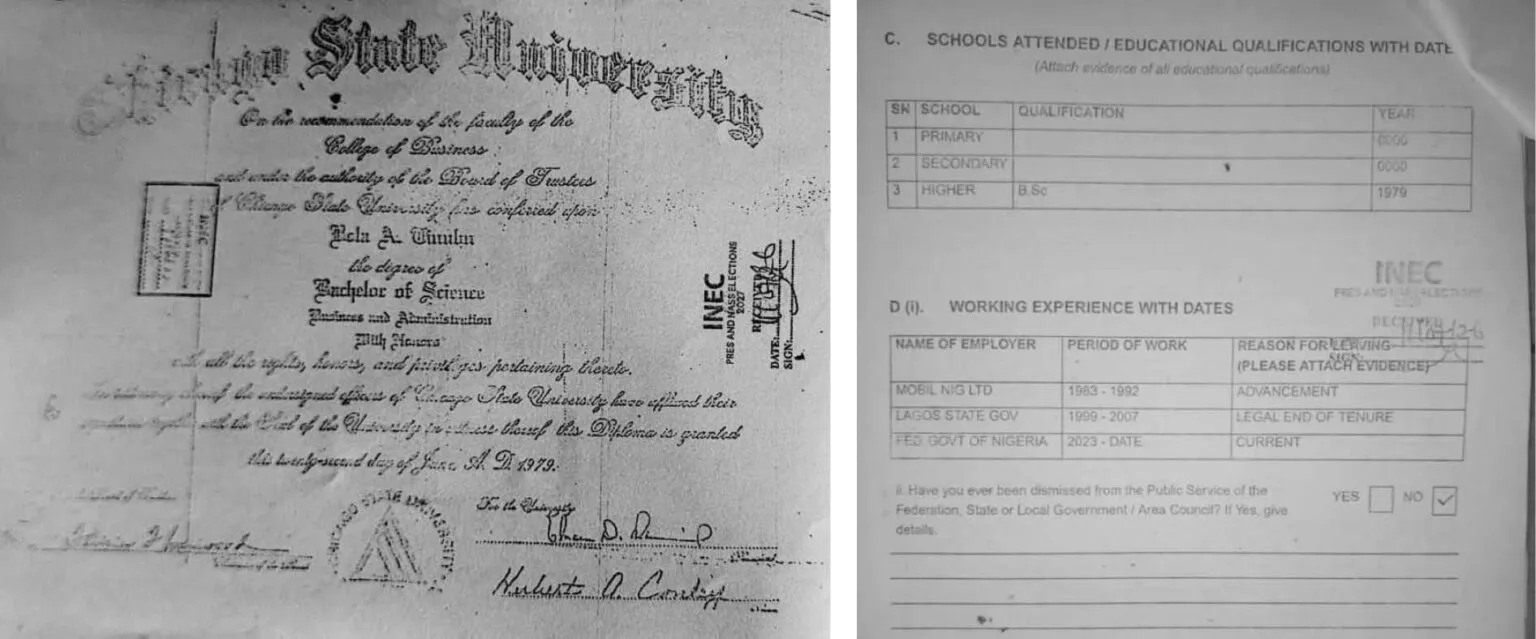
The controversy stems from the documents published by INEC, which list only Tinubu’s Bachelor of Science in Business Administration from Chicago State University (1979) and his National Youth Service Corps (NYSC) certificate. The sections designated for primary and secondary school qualifications on the summary page of the form were left blank.
The omission has revived discussions surrounding Tinubu’s educational records, an issue that featured prominently during the legal disputes following the 2023 presidential election.
Lawyers Offer Differing Interpretations
Legal experts have expressed mixed views on the implications of the missing entries.
Senior Advocate of Nigeria (SAN), Mumini Jimoh, said presidential candidates are expected to possess at least a secondary school qualification or its equivalent under the Constitution. However, he suggested the omission was likely an administrative or uploading error rather than evidence that the president failed to meet constitutional requirements.
Another SAN, Mohammed Abeni, argued that leaving out primary and secondary school qualifications naturally raises questions, especially considering the long-standing public debate over Tinubu’s academic records.
Constitutional lawyer Danjuma John noted that Section 318 of the Constitution defines “School Certificate or its equivalent” broadly, covering qualifications such as the Senior Secondary School Certificate Examination (SSCE), Grade II Teacher’s Certificate, or other recognised equivalents.
In contrast, Senior Advocate Taiye Oniyide maintained that the omission has no legal consequence, arguing that Tinubu’s university degree represents a qualification higher than the constitutional minimum.
INEC Says It Does Not Verify Certificates
Responding to the growing debate, INEC clarified that it does not authenticate the academic certificates submitted by candidates before making them public.
According to the commission, its responsibility under the Electoral Act 2026 is to publish candidates’ personal particulars and supporting documents for public scrutiny. Any dispute regarding the authenticity or adequacy of those documents, it said, is a matter for the courts.
Opposition Parties Demand Answers
The African Democratic Congress (ADC) described the omission as troubling, saying it raises legitimate questions that deserve public clarification.
ADC National Publicity Secretary Bolaji Abdullahi said the absence of Tinubu’s primary and secondary school qualifications could reinforce speculation about his educational background and urged the president to provide a clear explanation.
The Nigeria Democratic Congress (NDC) also questioned the omission, describing it as unusual and calling on the Presidency to explain why the details were not included.
Labour Party Dismisses Concerns
The Labour Party, however, downplayed the controversy, arguing that the Electoral Act does not require candidates to submit primary and secondary school certificates as mandatory documents.
Its National Publicity Secretary, Ken Asogwa, noted that Tinubu’s eligibility had already been challenged in court after the 2023 presidential election, with both the Presidential Election Petition Court and the Supreme Court affirming his qualification to contest.
Atiku Calls for Transparency
Former Vice President and ADC presidential candidate Atiku Abubakar said that if the reports about the omitted qualifications are accurate, the issue goes beyond a simple administrative oversight.
According to him, Nigerians deserve complete transparency from anyone seeking the country’s highest office, urging the Presidency to provide clear and verifiable explanations instead of dismissing public concerns.
Former Minister of Sports Solomon Dalung also called on President Tinubu to explain why the sections for his primary and secondary school qualifications were left blank, arguing that openness is essential to maintaining public trust.
Presidency Yet to Respond
As of the time this report was filed, neither the Presidency nor the ruling All Progressives Congress (APC) had issued an official response to the concerns raised over the published documents.
A Controversy That Refuses to Fade
Questions surrounding Tinubu’s educational credentials first gained national attention during the 2023 presidential election petitions. Although Chicago State University confirmed that Tinubu graduated in 1979 with a degree in Business Administration, disputes over the diploma submitted to INEC became a central issue in the post-election legal battle.
Both the Presidential Election Petition Court and the Supreme Court ultimately ruled that the evidence presented did not establish certificate forgery and upheld Tinubu’s election.
With the 2027 presidential race gathering momentum, the latest publication of candidates’ credentials has once again placed the issue in the spotlight, triggering renewed political debate over transparency, constitutional requirements and public accountability.
Tinubu’s 2027 INEC Documents Spark Fresh Controversy Over Educational Qualifications


- Advertisment -