


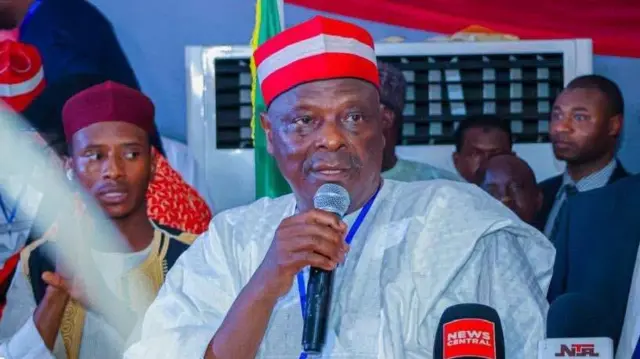
The Action Democratic Congress (ADC) has indicated that its emerging opposition coalition is set to expand further, with more prominent political figures expected to join in the coming weeks.
This development follows the recent inclusion of Rabiu Kwankwaso, a significant political figure whose entry is seen as a major boost to the coalition’s growing influence ahead of the 2027 general elections.
Coalition Growth Signals Shifting Political Landscape
Speaking during an interview on Sunrise Daily, a programme on Channels Television, the ADC’s National Publicity Secretary, Bolaji Abdullahi, expressed confidence that the coalition would continue to attract high-profile politicians across the country.
“The coalition is getting bigger. We envisaged from the beginning that it would grow,” Abdullahi said.
He noted that while Kwankwaso was not initially part of the alliance, his eventual inclusion demonstrates the coalition’s ability to draw in influential figures over time.
“Kwankwaso was not with us initially, but he is with us now. We expect that in the coming days, more people-more bigwigs-will come in,” he added.
Key Political Figures Align With ADC
The coalition already boasts an impressive lineup of prominent politicians, reflecting a broad-based effort to unify opposition forces under a single platform.
Among those aligned with the ADC-led coalition are:
- Atiku Abubakar
- Peter Obi
- Rotimi Amaechi
- Aminu Tambuwal
- Nasir El-Rufai
The involvement of these figures underscores what observers describe as a strategic realignment within Nigeria’s political space, particularly among opposition leaders seeking to challenge the dominance of the ruling party.
A United Front Against the APC
At the core of the coalition’s formation is a shared objective: to present a united and formidable opposition capable of unseating the All Progressives Congress (APC) in the 2027 general elections.
For years, Nigeria’s opposition parties have struggled with fragmentation, internal disputes, and competing ambitions, factors that have often weakened their electoral chances.
The ADC coalition appears to be an attempt to overcome these longstanding challenges by bringing together diverse political actors under a common agenda.
According to Abdullahi, unity remains the most critical factor in achieving meaningful political change.
“The only way to achieve meaningful political change in this country is for all opposition forces to come together under one platform,” he said.
Blame and Reflection: APC and Internal Challenges
While highlighting the coalition’s progress, Abdullahi also pointed to the role of the ruling APC in contributing to the challenges faced by opposition parties.
He accused the ruling party of creating conditions that have complicated the operations of opposition groups, though he did not provide specific details during the interview.
At the same time, he acknowledged that internal weaknesses within opposition parties have also played a role in their struggles.
- These include:
- Leadership disputes
- Lack of cohesionCompeting political ambitions
- Structural inefficiencies
By admitting these challenges, Abdullahi suggested that the coalition represents both a response to external pressure and an effort at internal reform.
INEC Decision as a Turning Point
A significant factor that has shaped the coalition’s evolution is a recent decision by the Independent National Electoral Commission (INEC).
On April 1, INEC reportedly derecognised a faction of the ADC leadership led by former Senate President David Mark.
While the decision initially posed a challenge for the party, Abdullahi said it ultimately had an unintended positive effect by bringing opposition leaders closer together.
“That action created adversity for us, but adversity has a way of bringing people together more than we could have done on our own,” he said.
According to him, the development forced political actors within the coalition to reassess their priorities and focus on the bigger picture.
Adversity as a Unifying Force
Abdullahi described the current moment as a defining phase in the effort to build a strong and cohesive opposition movement.
He noted that the challenges faced by the party and its allies have helped clarify what is at stake, encouraging leaders to look beyond personal ambitions.
“That action brought all the leaders closer and made them realise that what is at stake is bigger than individual ambition,” he said.
This sentiment reflects a broader recognition among opposition figures that unity is essential if they are to compete effectively in future elections.
Building a Shared Agenda
Beyond political alliances, the coalition is also expected to develop a shared policy framework that can resonate with Nigerians.
Observers note that simply uniting political figures may not be enough; the coalition will need to articulate clear solutions to national challenges such as:
- Economic instability
- Inflation and cost of living
- Unemployment
- Insecurity
Governance and accountability
For the ADC coalition, building consensus around these issues will be critical in gaining public trust and support.
Challenges Ahead
Despite its growing momentum, the coalition faces several potential challenges.
Managing Diverse Interests
With multiple high-profile politicians involved, balancing competing interests and ambitions could prove difficult.
Leadership Structure
Determining leadership roles within the coalition may become a sensitive issue as more figures join.
Public Perception
Voters may scrutinize the coalition’s motives, questioning whether it represents genuine reform or political convenience.
Electoral Strategy
Translating political unity into electoral success will require careful planning, grassroots mobilisation, and effective communication.
Confidence in the Coalition’s Direction
Despite these challenges, Abdullahi expressed optimism about the coalition’s prospects.
He maintained that the ADC and its partners are on the right path and that the growing interest from political heavyweights is a sign of confidence in the project.
“This is a defining moment in the effort to bring people together to pursue a common objective and agenda,” he said.
His comments suggest that the coalition’s leadership sees the current alignment as more than a temporary arrangement, but rather as a long-term political strategy.
Looking Ahead to 2027
With the 2027 general elections still some time away, the coming months are expected to be crucial for the coalition.
Key developments to watch include:
- Additional high-profile defections or alignments
- Formalisation of coalition structures
- Policy announcements and campaign strategies
- Engagement with voters across the country
If the coalition continues to expand and consolidate, it could significantly reshape Nigeria’s political landscape.