


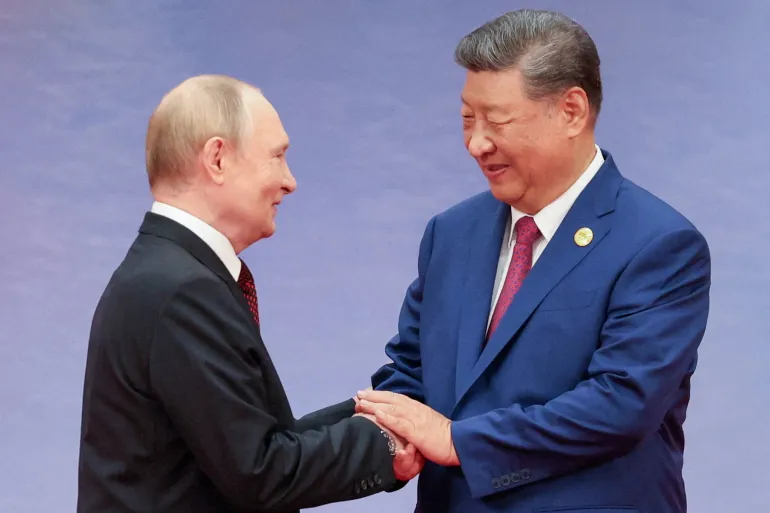
Relations between China and Russia continue to deepen, with analysts arguing that shifting United States foreign policy under President Donald Trump has, unintentionally, reinforced their strategic alignment rather than weakened it.
This development comes amid renewed diplomatic activity between Beijing and Moscow. Chinese President Xi Jinping recently hosted Russian President Vladimir Putin for high-level discussions, shortly after engaging with U.S. leadership, signalling continued coordination between the two powers on economic, security, and geopolitical issues.
Trade between China and Russia has surged, rising by nearly 20 percent in the first four months of the year. Energy cooperation remains a central pillar of the partnership, with both sides exploring expanded oil and gas agreements. Reports indicate renewed momentum on long-delayed projects such as the Power of Siberia 2 pipeline, alongside increased Russian energy exports to China.
Beyond energy, military and industrial cooperation has also strengthened. Chinese firms continue to supply components and technology that support Russian manufacturing capacity, particularly as Moscow maintains its military operations in Ukraine. This growing economic interdependence has further solidified what both governments describe as a “strategic partnership without limits.”
Observers say the relationship is also driven by shared geopolitical concerns. Both Beijing and Moscow increasingly view the United States and its allies as unpredictable and overly interventionist in global affairs, particularly in regions such as Eastern Europe and the Indo-Pacific.
The article also notes historical shifts in the relationship. During the Cold War era, China and the former Soviet Union were ideological rivals despite their communist alignment.
Relations only began to improve significantly after the end of the Cold War, as both countries adjusted to a unipolar world dominated by the United States.
Today, analysts argue that Western policies including NATO expansion, sanctions on Russia, and rising tensions over Taiwan have accelerated the convergence between Beijing and Moscow. In response, both countries have strengthened coordination in trade, energy, and diplomacy, presenting a more unified stance on global issues.
However, critics caution that while the partnership is growing, it is still shaped by mutual interests rather than full trust. Both countries continue to prioritise national advantage even as they align on broader strategic goals.
Overall, the strengthening China–Russia relationship reflects a shifting global order in which both powers are positioning themselves as counterweights to U.S. influence, with developments in Ukraine, the Middle East, and global trade tensions further reinforcing their cooperation.