


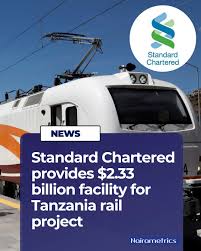
The decision by Standard Chartered to arrange financing for Tanzania’s Standard Gauge Railway (SGR) project is far more than a transportation story. It is a defining economic and geopolitical moment for East Africa. Unlike many African infrastructure announcements that remain trapped in memorandums, feasibility studies, or political speeches, this project has moved beyond rhetoric into execution. The financing is secured, construction is advancing, and measurable results are already emerging from completed sections of the railway.
At the center of this development is the 430-kilometre electrified railway connecting Makutupora to Isaka in Tanzania. This section is strategically important because Isaka serves as a gateway to regional trade routes extending into Rwanda, Burundi, Uganda, and the Democratic Republic of the Congo. For decades, these landlocked countries have depended heavily on expensive and unreliable road transportation to access ports along the Indian Ocean. The result has been high import costs, inflated consumer prices, delays in trade, and reduced industrial competitiveness.
The railway fundamentally changes that equation.
Electric rail systems dramatically reduce transportation costs compared to heavy trucking. Goods that previously required weeks to move across East Africa due to border delays, damaged roads, fuel shortages, and insecurity can now be transported in days with greater reliability and lower operational expenses. This has direct implications for food prices, fuel distribution, manufacturing costs, mining exports, and regional commerce.
The significance becomes clearer when examining the operational Dar es Salaam–Dodoma segment. Nearly six million passengers have already used the line, demonstrating strong public adoption and commercial viability. More importantly, the railway has reduced fuel consumption by approximately 17 million litres while cutting carbon emissions by over 50 percent. These are not future projections from consultants or political promises from campaign platforms. They are measurable economic and environmental outcomes already recorded from existing operations.
This achievement places East Africa in a unique position on the continent. While many African regions continue to struggle with fragmented infrastructure, inconsistent policy implementation, corruption, insecurity, and debt concerns, East Africa has quietly pursued long-term regional integration through transport corridors, energy projects, ports, and cross-border trade agreements.
Several factors explain why East Africa is currently outperforming many other African regions in infrastructure development.
First, there is stronger regional coordination. Organizations such as the East African Community have consistently pushed member states toward integrated trade and transportation systems. Unlike isolated national projects, East African infrastructure is often designed with regional connectivity in mind. Railways, highways, and ports are planned to serve multiple countries simultaneously, increasing their economic value and attracting international financing.
Second, there is increasing political recognition that infrastructure is economic power. Modern economies are built on the efficient movement of goods, people, electricity, and digital communication. Countries that reduce transport costs become manufacturing hubs, trade centers, and investment destinations. Tanzania’s railway project positions the country as a critical logistics gateway for Central and East Africa.
Third, East Africa has demonstrated growing confidence in executing large-scale projects gradually rather than waiting for perfect conditions. Instead of postponing development indefinitely due to financial constraints or political uncertainty, countries like Tanzania are implementing infrastructure in phases, proving viability section by section. This creates investor confidence and public trust.
However, the broader question remains: why are many other African regions struggling to replicate this progress?
One major obstacle is policy inconsistency. Across several African countries, infrastructure projects often change direction whenever governments change. New administrations abandon previous projects, renegotiate agreements, or delay implementation due to political rivalries. Investors avoid environments where long-term policy stability is uncertain.
Another challenge is corruption and procurement inefficiency. Infrastructure financing requires transparency, accountability, and technical competence. When projects are inflated, poorly supervised, or politically manipulated, costs rise while quality declines. This discourages both private investors and development finance institutions.
Security instability is another critical issue. Railways and highways require stable corridors for construction and operation. Regions affected by insurgency, terrorism, armed conflict, or persistent political violence face difficulties attracting the scale of financing needed for transformational infrastructure.
Energy reliability also remains a barrier. Electrified rail systems depend on stable electricity generation and transmission networks. Many African countries still struggle with inconsistent power supply, limiting industrial expansion and modern transport systems.
Debt management concerns equally play a role. Some governments have accumulated unsustainable debt through poorly structured loans that failed to generate productive economic returns. Investors are therefore becoming more cautious, demanding commercially viable projects with clear repayment potential before committing capital.
To sustain and expand the success of projects like the Tanzania SGR, several critical steps must be taken.
First, regional governments must prioritize cross-border integration rather than isolated national infrastructure. Railways should connect ports to industrial zones, mining centers, agricultural belts, and neighboring countries to maximize economic impact.
Second, African governments must strengthen institutional transparency and procurement systems. Independent oversight, competitive bidding, and financial accountability are essential to maintaining investor confidence.
Third, there must be long-term investment in energy infrastructure. Electrified transport systems require stable power generation through hydroelectric, gas, solar, wind, and regional energy pools.
Fourth, customs and border systems must be modernized. Fast rail transport loses efficiency if cargo remains trapped for days at border checkpoints due to bureaucracy and corruption.
Fifth, African financial institutions and pension funds should increasingly participate in infrastructure financing. Dependence solely on foreign lenders limits ownership and long-term sustainability.
Finally, governments must ensure infrastructure projects directly benefit citizens through job creation, industrial growth, affordable transportation, and lower commodity prices. Public support becomes stronger when people experience visible economic improvements in their daily lives.
The Tanzania Standard Gauge Railway represents more than steel tracks and electric trains. It symbolizes a changing African economic reality in which infrastructure is becoming the foundation of regional power, trade influence, and industrial transformation. East Africa’s progress demonstrates that development is not simply about natural resources or political speeches. It is about execution, continuity, strategic planning, and regional cooperation.
If sustained, this railway corridor could redefine trade patterns across East and Central Africa for generations, turning the region into one of the continent’s most important economic engines.