


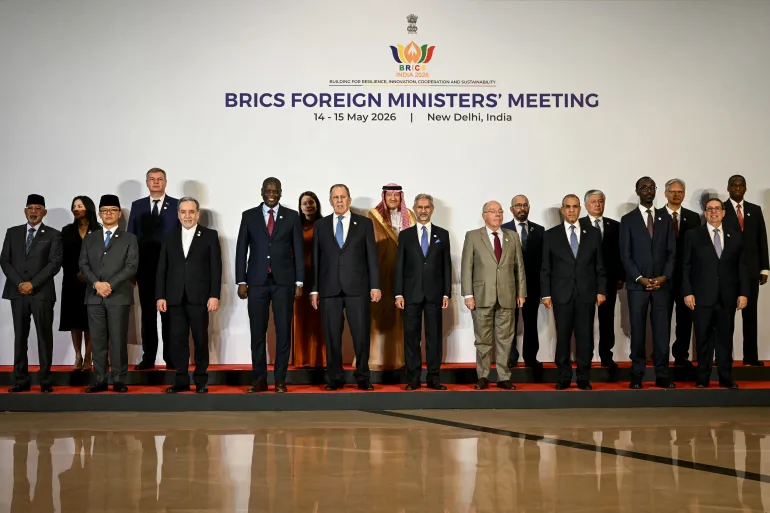
The ongoing conflict involving Iran, the United States, and Israel is exposing growing divisions within the BRICS alliance, raising questions about the bloc’s ability to maintain unity on major global security issues.
A two-day meeting of BRICS foreign ministers in New Delhi ended without a joint position on the Iran conflict, with the final outcome document acknowledging only that “differing views” remain among member states.
The failure to reach consensus marks the second consecutive BRICS meeting under India’s 2026 chairmanship to conclude without a unified statement on the escalating Middle East crisis.
The meeting, hosted by Indian External Affairs Minister Subrahmanyam Jaishankar, brought together representatives from the expanded 10-member BRICS bloc, including Brazil, Russia, India, China, South Africa, Iran, the United Arab Emirates, Egypt, Ethiopia, and Indonesia.
The talks unfolded as the conflict between Iran and the US-Israel alliance entered its 77th day, following military strikes launched against Iranian nuclear and military facilities in February. Since then, tensions have spread across the region, with Iran closing the Strait of Hormuz to commercial shipping, disrupting global energy markets and increasing fears of wider instability.
At the centre of the disagreement within BRICS is the sharp divide between Iran and the United Arab Emirates, both now full members of the bloc despite supporting opposing sides in the conflict.
 Iran’s Foreign Minister Abbas Araghchi attends the BRICS foreign ministers’ meeting at Bharat Mandapam in New Delhi, India, on May 14, 2026.
Iranian Foreign Minister Abbas Araghchi reportedly urged BRICS to condemn what he described as US and Israeli aggression and called for concrete action against violations of international law.
However, the UAE’s representative accused Iran of threatening regional security through missile and drone attacks targeting Gulf infrastructure and military facilities.
The confrontation reportedly intensified behind closed doors, with Iran accusing the UAE of assisting US military operations and allowing attacks to be launched from Emirati territory. Abu Dhabi strongly rejected the allegations.
The diplomatic dispute highlighted the challenge facing BRICS as it expands into a broader geopolitical coalition with members holding conflicting foreign policy interests.
India attempted to steer discussions toward common ground, focusing on calls for diplomacy, regional stability, safe maritime trade routes, and protection of civilian lives.
However, negotiators failed to agree on language assigning blame or condemning any side.
Analysts say the impasse reflects the limitations of BRICS as a political bloc. While the alliance has increasingly presented itself as a voice for the Global South and an alternative to Western-led institutions, its members often hold deeply different strategic priorities.
Despite divisions over Iran, the ministers reportedly made progress in other areas, reaching agreements on more than 60 issues, including trade, energy cooperation, climate action, digital infrastructure, and reform of global financial institutions.
Political observers say the Iran conflict has become a major test of BRICS cohesion, especially as the bloc seeks to expand its global influence amid shifting geopolitical alliances.
Experts also note that countries like Pakistan are attempting to position themselves as neutral mediators between rival powers, reflecting a broader global trend toward flexible diplomacy rather than rigid bloc politics.
The disagreement over Iran underscores the growing difficulty of maintaining consensus within increasingly diverse international alliances during periods of heightened geopolitical tension.