


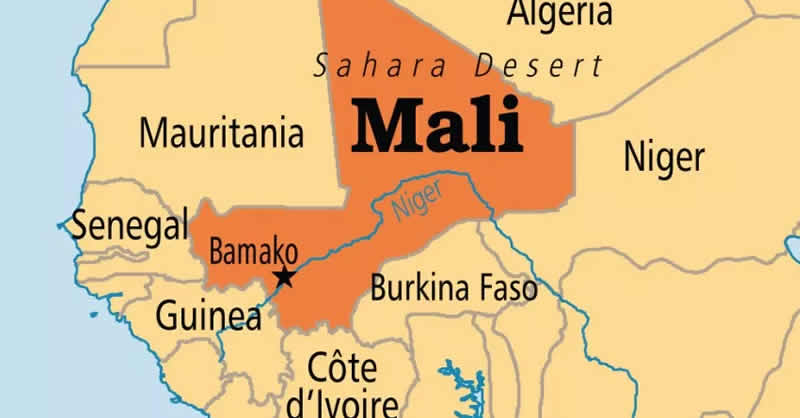
The military government in Mali has ruled out any possibility of negotiations with jihadist and separatist armed groups following a wave of coordinated attacks that rocked the country in late April and exposed the growing security crisis facing the Sahel nation.
Malian Foreign Affairs Minister, Abdoulaye Diop, made the government’s position clear while addressing Malian diplomats, insisting that authorities would not enter into talks with what he described as terrorist organisations responsible for years of bloodshed and instability across the country.
“The government of Mali does not envisage any dialogue with the lawless terrorist armed groups that bear responsibility for the tragic events our people have been experiencing for years,” Diop declared.
The statement comes in the aftermath of devastating attacks carried out on April 25 and 26 by an alliance of jihadist and separatist fighters. The attacks targeted several strategic locations stretching from the northern desert region of Kidal to Kati, a major military town near the capital, Bamako, covering a distance of more than 1,500 kilometres.
Security analysts described the operation as one of the most coordinated and far-reaching offensives in Mali’s recent history, highlighting the increasing operational capacity of armed groups despite years of military campaigns.
Among those killed in the attacks was Mali’s Defence Minister, Sadio Camara, alongside several Malian soldiers. The death of such a senior government official has intensified concerns about the vulnerability of the country’s military leadership and the deteriorating security situation.
The attacks were reportedly carried out by the al-Qaeda-linked extremist group Jama’at Nusrat al-Islam wal-Muslimin (JNIM), working alongside Tuareg separatist fighters from the Azawad Liberation Front. The alliance has emerged as a significant threat to the Malian state, particularly in the northern regions where separatist sentiments and jihadist activity have persisted for over a decade.
Following the attacks, Mali’s junta leader, Assimi Goita, appointed himself as defence minister and vowed to intensify military operations against the insurgents. Goita described the situation as “extremely grave” but assured citizens that the government remained in control.
Authorities have also launched investigations into possible internal collaboration with the attackers. A military court is reportedly probing five soldiers suspected of maintaining links with the armed groups involved in the offensive.
The northern city of Kidal, long considered a stronghold of Tuareg separatists, is now said to be under the control of the rebel alliance, alongside surrounding territories. Reports also indicate that the alliance has imposed restrictions and blockades affecting access routes to the capital, Bamako, further heightening fears of instability and economic disruption.
In the aftermath of the attacks, several opposition politicians and military personnel were reportedly detained or abducted, raising concerns among observers about political tensions and possible crackdowns by the military authorities.
Mali has struggled with insecurity since 2012, when Tuareg rebels and Islamist militants launched an uprising in the north, triggering years of violence that later spread across the wider Sahel region. Armed groups linked to Al-Qaeda and Islamic State have continued to exploit weak governance, ethnic tensions and porous borders to expand their operations.
The crisis deepened after military coups in 2020 and 2021 brought the current junta to power. Since then, Mali’s rulers have cut ties with former colonial power France, expelled United Nations peacekeepers, and strengthened security cooperation with Russia in an effort to combat insurgency.
Despite these measures, violence has continued to escalate, with growing concerns that instability in Mali could further destabilise neighbouring countries across West Africa and the wider Sahel region.

