


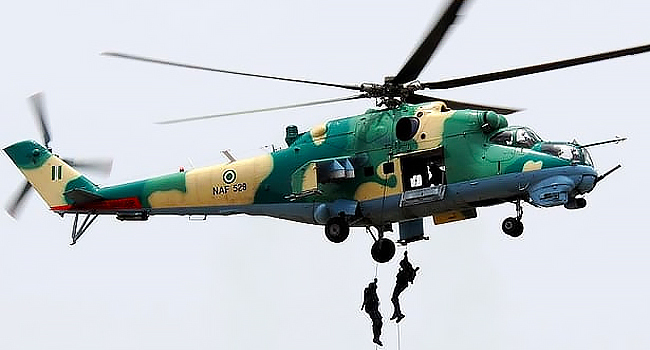
The Nigerian Air Force has intensified its ongoing counterterrorism campaign in the North-East, recording what officials described as a major operational success after fresh air strikes reportedly killed several terrorists in the Yuwe axis of the Sambisa Forest.
According to the military, the latest operation forms part of sustained pressure being mounted against insurgent groups operating within the forest and surrounding areas. The Sambisa Forest has long been regarded as one of the most significant hideouts for terrorist factions in Nigeria, making it a strategic target in the country’s prolonged fight against insurgency.
In a statement released on Tuesday, the Director of Public Relations and Information at the Headquarters of the Nigerian Air Force, Ehimen Ejodame, said the air operation was carefully planned and executed after intelligence reports confirmed the movement and presence of active terrorist elements in the area.
He explained that the strikes were launched following credible intelligence that was further verified through Intelligence, Surveillance and Reconnaissance operations. According to him, surveillance assets identified suspected fighters occupying fortified structures and bunkers hidden within the Yuwe axis of the forest.
The military said once the targets were confirmed, Nigerian Air Force platforms were deployed to engage the identified locations with precision-guided munitions. The strikes reportedly destroyed the structures, neutralised multiple fighters, and wiped out key logistics facilities used by the insurgents.
Ejodame noted that subsequent battle damage assessments carried out after the strikes confirmed the success of the operation.
According to the statement, the latest attack is another sign that the Nigerian Air Force remains committed to denying terrorists safe havens and weakening their operational capabilities through sustained aerial bombardment.
Military authorities say the continued tempo of operations has significantly disrupted insurgent networks, limiting their movement and placing them under increasing pressure.
Officials believe repeated air and ground offensives are forcing many fighters into desperate survival tactics rather than coordinated attacks.
The Nigerian Air Force stated that terrorists in the region are becoming increasingly exposed as their camps, supply routes, and support infrastructure are systematically targeted.
Security analysts have often described air power as one of the most decisive tools in the campaign against insurgency, particularly in difficult terrains such as the Sambisa Forest, where thick vegetation and remote hideouts can make ground offensives more challenging.
By relying on intelligence-driven operations, the military says it can strike hostile positions more accurately while reducing risks to troops and civilian communities.
The latest operation also received commendation from the Chief of Air Staff, Sunday Aneke, who praised personnel involved in the mission and reaffirmed the force’s determination to continue its offensive against terrorist groups.
According to Aneke, the Nigerian Air Force will sustain relentless intelligence-based operations until all terrorist elements are completely neutralised.
He said the service remains committed not only to national security, but also to the protection of military personnel and the safety of civilians across affected communities.
His remarks come at a time when security agencies are under pressure to deliver stronger results against insurgent attacks, kidnappings, and armed violence in several parts of the country.
The North-East region has faced years of insecurity linked to terrorist groups whose activities have caused widespread displacement, destruction of property, and loss of lives. Communities in states such as Borno State, Yobe State, and Adamawa State have repeatedly borne the brunt of attacks.
The Sambisa Forest, in particular, has become symbolic in Nigeria’s anti-terror war due to its history as a stronghold for insurgents. Over the years, several operations have been launched there by Nigerian forces, resulting in the destruction of camps and rescue of captives.
Even so, remnants of terrorist cells have continued to use parts of the forest and nearby areas for regrouping, storing weapons, and launching attacks on civilian and military targets.
That is why the military considers continued pressure on locations such as Yuwe essential to preventing insurgents from rebuilding their networks.
The Nigerian Air Force also emphasized that while carrying out such missions, it remains guided by established rules of engagement and international best practices aimed at minimising civilian casualties.
The force said it continues to take precautions during operations to ensure non-combatants are protected, especially in conflict zones where insurgents sometimes operate near vulnerable communities.
This assurance is particularly important because modern counterinsurgency efforts increasingly require balancing military effectiveness with humanitarian responsibility.
Residents in many North-East communities have consistently welcomed successful military operations, hoping they will lead to safer roads, reopened farmlands, and the return of normal economic activities.
Farmers, traders, and displaced families across the region continue to look to security agencies for lasting peace that will allow them rebuild their lives.
Military successes in areas like Sambisa can also improve humanitarian access, allowing aid agencies and government institutions to reach populations affected by years of violence.
However, experts often caution that military victories alone may not fully end insurgency unless they are supported by long-term strategies such as border security, deradicalisation programmes, intelligence sharing, youth employment, and community development.
Still, sustained air strikes remain a critical component of the broader security response, especially when used to dismantle camps, logistics bases, and command centres.
The latest strike in Yuwe sends a clear signal that terrorist groups hiding in remote enclaves are still under active surveillance and remain vulnerable to precision attacks.
For the Nigerian Air Force, the operation also reinforces growing emphasis on intelligence-led warfare, where surveillance technology, target verification, and rapid strike capability are combined to deliver more effective outcomes.
Officials say such strategies will continue as long as threats persist.
The renewed assurance from the Chief of Air Staff suggests that more coordinated operations may be expected in coming weeks as security agencies intensify efforts to reclaim remaining terrorist enclaves.
For communities across the North-East, every successful strike raises hopes that the region may gradually move closer to lasting peace after years of conflict.
Although challenges remain, the destruction of fortified positions, elimination of fighters, and disruption of supply networks in the Sambisa Forest represent another important step in Nigeria’s ongoing battle against terrorism.
As the military sustains pressure from the air and on the ground, authorities say their objective remains clear: to completely neutralise terrorist elements, restore security to affected communities, and protect the lives and property of all Nigerians.

