


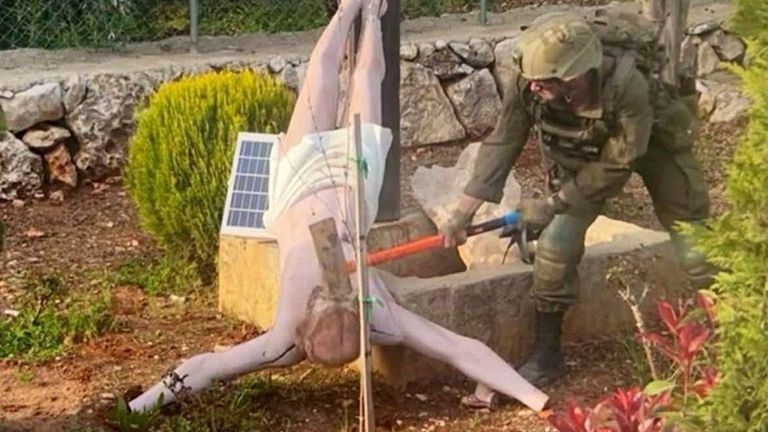
Two Israeli soldiers have been sentenced to 30 days in military detention and removed from combat duties after the destruction of a statue of Jesus in southern Lebanon sparked international condemnation and renewed scrutiny over the conduct of troops operating in civilian communities.
The incident, which emerged publicly after photographs circulated online over the weekend, reportedly took place in the Christian village of Debel during Israeli military operations in the area. Images showed one soldier using a sledgehammer to smash the religious statue, while another soldier was said to have photographed the act.
The case quickly generated outrage across social media, religious communities, and diplomatic circles, where critics described the act as deeply offensive and disrespectful to Christian heritage and places of worship.
Following the backlash, the Israel Defense Forces launched an internal inquiry into the matter.
According to a statement issued by the military on Tuesday, investigators found that two soldiers were directly involved in the destruction of the statue. As a result, both were sentenced to 30 days in jail and removed from frontline combat roles.
The Israeli military said the actions of the soldiers violated established standards of conduct and did not reflect the values or orders of the armed forces.
“The inquiry determined that the soldiers’ conduct completely deviated from IDF orders and values,” the statement said.
Military authorities also disclosed that six additional soldiers were present at the scene but failed to intervene, prevent the damage, or report the incident afterward.
Those personnel have now been summoned for what the military described as clarification discussions, after which further command-level disciplinary measures may be imposed.
The response suggests Israeli authorities are attempting to demonstrate accountability not only for those who carried out the act, but also for others who allegedly failed in their duty to stop it.
The destruction of the statue has resonated far beyond the immediate military disciplinary case because of the religious symbolism involved.
Images of Jesus hold profound significance for Christians around the world, and attacks on such symbols are often viewed as acts of desecration rather than mere property damage.
The location of the incident in a Christian-majority village in southern Lebanon added further sensitivity, especially in a region where religious identity and historical memory remain deeply important.
Many observers noted that Christian communities in Lebanon have long maintained churches, shrines, and public religious monuments that form part of the country’s diverse cultural and spiritual landscape.
Damage to those symbols can therefore carry political as well as religious implications.
The case also comes amid heightened tensions between Israel and Lebanon, where cross-border hostilities, military operations, and regional instability have increased pressure on civilians living near conflict zones.
In such environments, respect for civilian property, cultural heritage, and religious sites is considered a critical part of military discipline under international humanitarian norms.
Although governments and militaries often investigate battlefield incidents involving unlawful violence or destruction, symbolic acts against sacred objects tend to generate especially strong reactions because they are seen as avoidable and provocative.
Israeli Prime Minister Benjamin Netanyahu reportedly condemned the act in strong terms after the controversy widened.
His intervention underscored the political sensitivity of the issue, particularly as Israel seeks to manage diplomatic relations with Christian communities abroad and regional actors monitoring military conduct in Lebanon.
While details of Netanyahu’s remarks were limited, the condemnation indicates that the matter reached the highest levels of government.
For the Israeli military, the disciplinary action may also be aimed at reinforcing operational rules for troops deployed in complex civilian environments.
Modern military forces frequently stress the importance of maintaining discipline, respecting local populations, and avoiding conduct that can inflame tensions or undermine strategic objectives.
Acts viewed as mocking religion or damaging sacred symbols can rapidly become propaganda tools for opponents and complicate diplomatic efforts.
Analysts say that is one reason armed forces often respond swiftly to incidents involving religious or cultural desecration.
The summoning of six additional soldiers who allegedly witnessed the act without intervening also raises broader questions about responsibility within military units.
Many professional codes of conduct require personnel not only to avoid wrongdoing themselves, but also to report misconduct by colleagues.
Failure to do so can suggest tolerance of indiscipline and weaken command authority.
By expanding the inquiry beyond the two directly involved soldiers, the military appears to be signalling that passive complicity may also carry consequences.
The incident has also revived debate about protecting religious heritage during armed conflict.
Across the Middle East, churches, mosques, monasteries, cemeteries, and shrines hold centuries of historical value and remain central to community identity.
Damage to such places or symbols can deepen trauma for already vulnerable civilian populations.
Lebanon, in particular, is known for its religious diversity, with Christian, Muslim, and Druze communities coexisting across different regions. Southern villages such as Debel are part of that plural social fabric.
For local residents, the destruction of a public religious icon may be experienced as an attack on communal dignity as much as on a statue itself.
International reactions to the case reflect wider concern over preserving respect for civilian communities during military operations.
Human rights groups and religious leaders have often called on all parties in conflict zones to safeguard holy places and prevent acts that could fuel sectarian hostility.
Whether further disciplinary measures follow the current sanctions may depend on the outcome of the additional reviews involving the six other soldiers.
For now, the jailing of the two soldiers represents a rare and visible acknowledgment of wrongdoing tied to religious vandalism during military deployment.
The case serves as a reminder that in conflict situations, seemingly isolated acts by individual soldiers can carry global consequences when they touch faith, identity, and sacred symbols.
As tensions persist in the region, many will be watching to see whether accountability in this case leads to stronger enforcement of standards designed to protect civilians and respect religious heritage.