


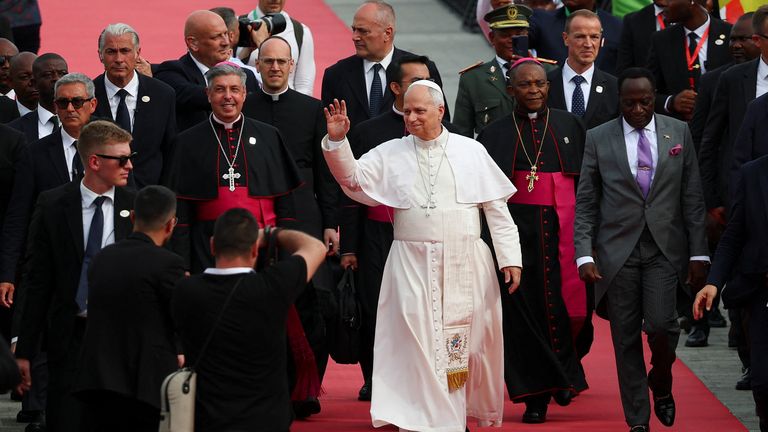
Pope Leo XIV has dismissed suggestions that his ongoing trip to Africa is centered on a public dispute with U.S. President Donald Trump, insisting that peacebuilding, dialogue, and pastoral outreach remain the true focus of his visit.
Speaking to journalists aboard the papal plane on Saturday while travelling from Yaoundé to Luanda, the pope said it was “not in my interest” to engage in any debate with Trump. He explained that commentary surrounding the trip had been shaped by political tensions rather than the real purpose of his journey.
According to the pope, media narratives about the visit became distorted after Trump criticised him publicly through posts on his Truth Social platform shortly before the African tour began.
“There has been a certain narrative about the visit that has not been accurate in all of its aspects,” the pope said. He added that much of what had followed was “commentary on commentary,” with observers trying to interpret statements through a political lens.
The remarks mark the clearest effort yet by Pope Leo to distance his 11-day Africa mission from growing attention on his relationship with the White House.
Tensions Before the Africa Tour
Before the pope departed on April 13 for his four-country African tour, Trump launched a series of criticisms against him online. Though the exact nature of those comments was not detailed during the latest exchange, they reportedly continued for several days and generated international headlines.
The confrontation quickly became unusual because it involved two American figures occupying globally influential roles one as President of the United States and the other as the first American pope in the history of the Catholic Church.
The clash drew strong reactions from political commentators, religious observers, and international media outlets, many of whom framed the pope’s Africa visit as unfolding against a backdrop of political hostility from Washington.
However, Pope Leo said that interpretation misses the real meaning of the trip.
Pope Says Speech Was Misread
The pope specifically addressed reactions to a speech he delivered on Thursday in Bamenda, where he lamented a world damaged by “a handful of tyrants” and criticised leaders who spend “billions of dollars” on war.
Some commentators viewed those remarks as an indirect response to Trump.
But Pope Leo firmly rejected that suggestion.
He explained that the address had been prepared two weeks earlier, long before Trump made any public comments about him.
“The talk that I gave at the prayer meeting for peace was prepared two weeks ago,” he said. “And yet it was looked at as if I was trying to debate again the president, which is not in my interest at all.”
His clarification suggests frustration that messages intended for peace advocacy were being interpreted through the prism of American politics.
JD Vance Responds
U.S. Vice President JD Vance later responded on X, welcoming the pope’s comments.
Vance said he was grateful to Pope Leo for clarifying his intentions and added that public narratives often exaggerate conflict.
“While the media narrative constantly gins up conflict and yes, real disagreements have happened and will happen the reality is often much more complicated,” he wrote.
Vance, a Catholic convert, also acknowledged that popes naturally speak on moral issues, while elected governments must apply principles within the realities of governance.
His statement appeared to soften tensions and suggest room for coexistence despite differences.

Longest Trip of His Pontificate
Pope Leo’s current Africa visit is the longest journey of his papacy so far and reflects the strategic importance of the continent to the future of global Catholicism.
According to Vatican statistics, around one-fifth of the world’s Catholics now live in Africa, making it one of the fastest-growing regions for the Church.
The pope’s itinerary includes four countries and focuses on strengthening faith communities, encouraging clergy, promoting interfaith cooperation, and supporting peace initiatives in areas affected by conflict and poverty.
Speaking aboard the aircraft, Pope Leo said his mission is fundamentally pastoral.
“I primarily come to Africa as a pastor, as the head of the Catholic Church, to be with, to celebrate with, to encourage and accompany all of the Catholics throughout Africa,” he said.
He added that the visit is also about “dialogue, promotion of fraternity, true understanding, acceptance, peacebuilding with people of all faiths.”
Africa at the Centre of Catholic Growth
The pope’s emphasis on Africa reflects the demographic shift taking place within the Catholic Church. While attendance has declined in parts of Europe and North America, many African nations continue to record growth in Catholic membership, seminaries, and youth participation.
Countries across the continent have increasingly become central to Vatican planning, leadership development, and missionary activity.
By choosing Africa for his longest trip yet, Pope Leo is signaling both recognition of that growth and a desire to deepen the Church’s presence in the region.
Politics vs. Pastoral Mission
The public exchange with Trump has added an unexpected political dimension to the tour, but the pope’s latest comments show a clear effort to move beyond confrontation.
Rather than engage in a transatlantic war of words, Pope Leo is attempting to redirect attention toward issues he considers more urgent: peace, justice, fraternity, and spiritual leadership.
His message also serves as a reminder that papal visits often carry diplomatic significance but are primarily religious missions.
For now, the Vatican appears determined to keep the Africa tour focused on communities, worship, and reconciliation rather than international political disputes.
Looking Ahead
As Pope Leo continues his journey across Africa, attention will remain on whether tensions with the Trump administration cool further or resurface.
But from the pope’s own words, the priority is clear.
This trip, he says, is not about debating presidents. It is about accompanying believers, building bridges across faiths, and advancing peace on a continent that is increasingly central to the future of the Catholic Church.

