


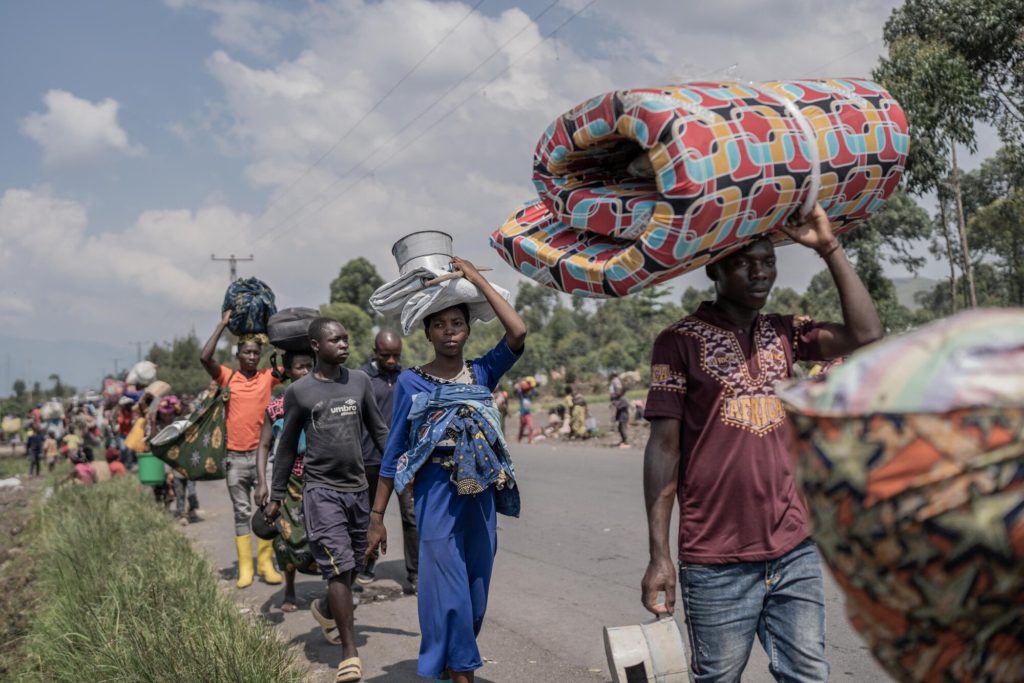
Eastern Democratic Republic of Congo is experiencing a sharp escalation in armed violence, with reports of mass killings, renewed rebel offensives, and allegations of mass graves surfacing across conflict-affected territories in North Kivu and Ituri provinces.
Security sources and humanitarian monitors report that since early April 2026, multiple attacks attributed to armed groups operating in the region have left dozens of civilians dead, with entire villages displaced amid ongoing clashes between government forces and militia coalitions.
In North Kivu, fighting has intensified along the Rutshuru–Masisi–Nyiragongo axis, where the March 23 Movement (M23) and allied armed factions are reportedly engaged in sustained confrontations with the Armed Forces of the Democratic Republic of Congo (FARDC).
The military spokesperson for FARDC, Brigadier General Sylvain Ekenge, confirmed that government forces are conducting “defensive and offensive operations” in response to coordinated rebel advances, though he declined to provide exact casualty figures, citing ongoing verification.
Local civil society groups in Goma and Beni report that several villages in Masisi territory were attacked between April 5 and April 11, 2026, resulting in the deaths of civilians, including women and children. Witness accounts describe armed incursions, house burnings, and forced displacement toward overcrowded IDP camps near Goma.
In Ituri province, particularly in Djugu and Irumu territories, militia activity linked to CODECO and ADF-aligned factions has also intensified. Humanitarian workers say multiple communities were targeted in nighttime raids, leaving residents with limited access to aid corridors.
One humanitarian coordinator in Bunia described the situation as “one of the most unstable periods in recent months,” citing restricted access for relief convoys due to roadblocks and active combat zones.
The most alarming reports emerging from local monitors involve allegations of mass graves discovered in remote parts of North Kivu, particularly near Kitchanga and Mweso, following heavy clashes between rival armed groups.
While these claims have not yet been independently verified by international investigators, local human rights observers say evidence from community testimonies suggests large-scale killings may have occurred during recent offensives.
In Kinshasa, government officials have urged caution over unverified reports, with presidential communications teams stating that investigations are underway under the direction of President Félix Tshisekedi.
Authorities insist that any confirmed atrocities will be prosecuted, while also accusing rebel coalitions of using misinformation to influence international perception of the conflict.
There are also growing allegations that drone strikes have been used in recent FARDC operations targeting rebel positions in North Kivu. Residents in parts of Masisi and Rutshuru reported hearing aerial bombardments and witnessing explosions in remote forested zones believed to be rebel strongholds.
Military officials have neither confirmed nor denied the use of drone technology, but sources within the security sector indicate that surveillance and precision strike capabilities have been expanded in recent months as part of intensified counterinsurgency operations.
MONUSCO, the United Nations peacekeeping mission in the DRC, has expressed concern over the deteriorating security environment, warning that civilian protection remains extremely difficult due to fluid frontlines and limited access to high-risk areas.
The United Nations Office for the Coordination of Humanitarian Affairs (OCHA) reports a growing displacement crisis, with thousands of families fleeing toward Goma, Bukavu, and Bunia. Makeshift camps are overstretched, with shortages of food, clean water, and medical supplies.
Aid agencies warn that continued fighting could push the region into a deeper humanitarian emergency, particularly as road access remains blocked in several territories.
Local health worker Dr. Jean-Marie Kambale, operating in Beni, described overwhelmed clinics receiving victims of machete attacks, gunshot wounds, and trauma-related injuries.
In Kinshasa, government spokespersons have reiterated that national security forces are engaged in “restoring territorial integrity” and dismantling armed networks destabilizing the east of the country.
Military coordination is being overseen under the national defense structure led by Chief of General Staff Lt. Gen. Christian Tshiwewe, with operations concentrated in North Kivu and Ituri.
Officials maintain that external support to armed groups remains a concern, though they have not publicly detailed specific foreign actors involved in the latest escalation.
Security analyst Dr. Annie Kabuya, based in Kinshasa, noted that the current cycle of violence reflects overlapping rebel fragmentation, resource competition, and weakened governance structures.
She added that without coordinated regional intervention, the violence risks further spreading toward South Kivu and destabilizing broader Great Lakes security arrangements.
As fighting continues across multiple fronts, civilians remain trapped between armed factions, military operations, and limited humanitarian access.
Eastern DR Congo remains in a rapidly deteriorating security situation, with rising civilian casualties, displacement, and unverified but deeply concerning reports of mass atrocities adding urgency to international calls for intervention and accountability.