


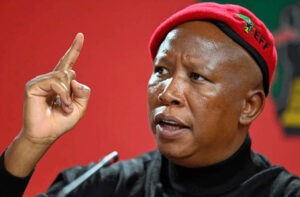
Julius Malema Sentenced to Five Years for Firearm Offence, Granted Bail Pending Appeal
South African opposition politician Julius Malema has been sentenced to five years in prison after being found guilty of unlawfully possessing and discharging an assault rifle during a political rally in 2018. However, the Economic Freedom Fighters (EFF) leader will remain free for now after the court granted him leave to appeal the sentence.
The ruling marks a significant moment in South Africa’s political and legal landscape, given Malema’s status as one of the country’s most controversial and influential opposition figures. Known for his fiery rhetoric and confrontational style, Malema has long been a polarizing figure, admired by supporters and heavily criticized by opponents.
Court Conviction and Sentencing
The sentence was handed down on Thursday in a court sitting in KuGumpo, formerly known as East London. Proceedings were broadcast live, drawing widespread national attention and prompting strong reactions from supporters and critics alike.
Malema had been convicted in October on charges relating to the illegal possession of a firearm and firing it into the air during an EFF political gathering six years ago. Video footage of the incident circulated widely at the time, sparking public debate and eventually leading to legal action.
Despite efforts by his legal team to challenge the conviction, the court dismissed his bid to overturn the guilty verdict, maintaining that he had violated South Africa’s firearms laws. His lawyers argued that the gunshots were celebratory in nature and not intended to harm anyone.
Nevertheless, the magistrate ruled that the seriousness of the offence warranted a custodial sentence.
Bail Pending Appeal
Although sentenced to five years behind bars, Malema was granted permission to appeal the sentence. As a result, he has been released and will remain out of prison until the appeal process is concluded.
This decision offers temporary relief to the EFF and its supporters, many of whom had gathered outside the courthouse in anticipation of the ruling. The crowd, dressed in the party’s signature red berets, sang liberation songs and chanted slogans throughout the hearing.Political analysts say the appeal process could take months, meaning Malema is likely to continue leading his party while the legal battle unfolds.
Malema Reacts Strongly
Following his release, Malema addressed supporters outside the courthouse and launched a scathing attack on the judiciary. He accused Magistrate Twanet Olivier of racial bias and claimed the judgement was influenced by outside forces.
According to Malema, the magistrate did not independently draft her rulings, alleging that an “invisible hand” was guiding the proceedings.
His comments are likely to spark renewed debate over judicial independence and political accountability in South Africa. Critics may view his remarks as an attempt to undermine the legal system, while supporters may interpret them as resistance against what they believe is politically motivated prosecution.
Role of AfriForum in the Case
The case against Malema was initiated by AfriForum, a small but vocal conservative advocacy group that has frequently clashed with the EFF leader.
AfriForum has previously criticized Malema over his use of the anti-apartheid struggle song containing the phrase “Kill the Boer,” arguing that the chant constitutes hate speech and encourages violence against white Afrikaners. However, South African courts have previously rejected those claims, ruling in favour of Malema’s right to sing the historical protest song in its political context.
This latest conviction is seen by some observers as another chapter in the ongoing legal and ideological battles between Malema and AfriForum.
Political Implications for the EFF
The sentencing comes at a sensitive time for the EFF. In the 2024 general elections, the party secured just under 10 percent of the national vote and currently holds 39 seats in Parliament.
While the EFF remains one of South Africa’s most visible opposition movements, its electoral performance has shown signs of stagnation amid growing competition from newer political parties.
Malema remains the party’s central figure and most recognizable voice. His charisma, populist messaging, and outspoken criticism of inequality, land ownership, and corruption have helped shape the EFF’s identity since its founding in 2013.
Party officials have described the firearm case as an attempt to silence their leader and weaken the movement. Some supporters have reportedly threatened nationwide protests should Malema ultimately be imprisoned.
Parliamentary Consequences
Beyond the immediate legal battle, the case may have constitutional consequences for Malema’s political future.
Under South African law, any lawmaker who receives a prison sentence of 12 months or more without the option of a fine and whose conviction is upheld after all appeals can be disqualified from serving in Parliament.
If Malema’s appeal fails and the sentence is confirmed, he could lose his seat in the National Assembly and be barred from holding office for a specified period.
Such an outcome would significantly reshape South Africa’s opposition politics and raise major questions about the EFF’s leadership succession.
A Divisive but Influential Figure
Julius Malema has long occupied a unique place in South African politics. Once a youth leader within the ruling African National Congress (ANC), he later founded the EFF after being expelled from the party.
Since then, he has built a political brand centered on radical economic transformation, nationalization of key industries, land redistribution, and anti-establishment activism.
Supporters view him as a fearless champion of the poor and marginalized. Opponents see him as inflammatory, divisive, and reckless.
The latest court ruling adds another layer to a political career already marked by controversy, legal disputes, and headline-grabbing statements.
What Happens Next?
Attention will now turn to the appeals process, which could determine not only Malema’s personal freedom but also the future direction of the EFF.
For now, he remains free and politically active. But the final outcome of the case could have lasting implications for South Africa’s opposition landscape, parliamentary representation, and public confidence in the justice system.
As the country watches closely, the Malema case underscores the often-complex intersection of politics, law, and power in modern South Africa.