


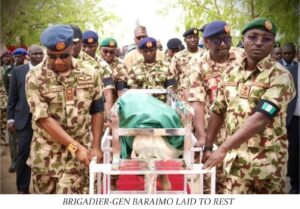
Nigeria on Wednesday held a solemn military burial ceremony for Brigadier General Omo Braimah, Captain Ismail, and other fallen soldiers who lost their lives in active service, as they were laid to rest with full military honours at the Maimalari Cantonment Cemetery in Maiduguri, Borno State.
The ceremony, marked by full military rites, brought together senior government officials, top military commanders, and grieving colleagues in a powerful display of national mourning and respect for personnel who paid the ultimate price in service to the country.
The burial underscored the continued human cost of Nigeria’s long-running counterinsurgency operations in the North-East, where the Armed Forces have battled extremist groups, including Boko Haram and its offshoots, for over a decade.
Full Military Honours for Fallen Heroes
The remains of Brigadier General Omo Braimah, Captain Ismail, and other deceased personnel were received with full military honours, including ceremonial processions, gun salutes, and solemn tributes from fellow officers.
Military officials described the rites as a symbolic recognition of the courage, discipline, and sacrifice demonstrated by the fallen officers throughout their service careers.
According to officials at the event, the ceremony was not only a farewell but also a reminder of the daily risks faced by members of the Armed Forces in defence of Nigeria’s sovereignty and territorial integrity.
The atmosphere at the Maimalari Cantonment Cemetery was deeply emotional, as colleagues, friends, and families of the deceased gathered to pay their final respects. Uniformed personnel stood in formation as the national flag was carefully folded and presented, symbolising honour and gratitude for their service.
Top Government and Military Dignitaries in Attendance
The high-profile burial ceremony was attended by several prominent figures in Nigeria’s security and political leadership.
Among them was Borno State Governor, Professor Babagana Umara Zulum, who has been at the forefront of state-level coordination of humanitarian and security responses in the insurgency-hit region.
Also present was the Minister of Defence, General Christopher Musa (retd.), alongside the Chief of Defence Staff, General Olufemi Oluyede, and the Chief of Army Staff, Lieutenant General Waidi Shaibu. Other senior military officers and service chiefs also attended the ceremony, reflecting the significance of the loss within Nigeria’s defence community.
Their presence underscored the national importance attached to the sacrifices made by personnel on the frontlines of the counterterrorism campaign.
Tributes to Courage and Sacrifice
In separate tributes delivered during the ceremony, senior military and government officials described the fallen officers as brave patriots who demonstrated unwavering commitment to duty even in the face of extreme danger.
They praised the officers for their discipline, professionalism, and loyalty to the nation, noting that their contributions would remain a lasting part of Nigeria’s military history.
The leaders stressed that the sacrifices made by Brigadier General Braimah, Captain Ismail, and their colleagues should serve as a reminder of the price of peace and the resilience required to sustain national security efforts.
According to them, the legacy of the fallen soldiers would continue to inspire both serving personnel and future generations of military officers.
A senior military representative at the ceremony noted that the Armed Forces remain committed to honouring those who fall in the line of duty, while also intensifying efforts to ensure that their sacrifices are not in vain.
The Human Cost of Nigeria’s Counterinsurgency
The deaths of Brigadier General Braimah and other soldiers come amid Nigeria’s prolonged military campaign in the North-East, where security forces have been engaged in operations against insurgent groups for more than 10 years.
The conflict, which began as an uprising by Boko Haram, has evolved into a complex security challenge involving splinter factions, banditry, and cross-border extremist networks operating in the Lake Chad Basin region.
Thousands of military personnel, civilians, and aid workers have lost their lives since the conflict escalated, while millions have been displaced from their homes.
Despite sustained military operations and territorial gains in several areas, the insurgency has remained active, with periodic attacks on military formations, rural communities, and humanitarian routes.
The Nigerian Armed Forces have repeatedly emphasised that such losses are part of the high-risk environment in which troops operate, particularly in remote and volatile regions where insurgents frequently deploy guerrilla tactics, ambushes, and improvised explosive devices.
Maimalari Cantonment: A Symbol of Military Resolve
The Maimalari Cantonment in Maiduguri, where the burial took place, remains one of the most strategic military installations in Nigeria’s North-East theatre of operations. It has served as a key command centre for counterinsurgency operations and coordination of regional security efforts.
Over the years, the cantonment has also become a symbolic site for honouring fallen soldiers, reflecting both the sacrifices made and the ongoing commitment of the Nigerian military to restore stability in the region.
Wednesday’s burial further reinforced the cantonment’s role as a place of remembrance and military heritage.
National Reflection on Security and Sacrifice
The solemn event also sparked renewed reflection on Nigeria’s security challenges and the sacrifices required to maintain national unity and territorial integrity.
Officials at the ceremony reiterated the importance of supporting the Armed Forces through sustained investment in training, equipment, and welfare, noting that the effectiveness of military operations is closely tied to the well-being and morale of personnel.
They also called for continued public support and national solidarity in the fight against insurgency and other security threats.
Legacy of Service and Honour
As the ceremony concluded, military honours were rendered for the final time, marking the end of the earthly journey of Brigadier General Braimah, Captain Ismail, and their fellow soldiers.
Their names were etched once again into the collective memory of the Armed Forces as symbols of duty, sacrifice, and patriotism.
While their deaths add to the long list of military casualties in Nigeria’s conflict zones, officials said their legacy will endure through the continued efforts of those still serving on the frontlines.
For many in attendance, the ceremony was not just a farewell, but a solemn reminder that the pursuit of peace often comes at a heavy cost one borne daily by Nigeria’s men and women in uniform.
The fallen officers were finally laid to rest amid full military honours, closing a chapter marked by service, sacrifice, and national duty, but leaving behind a legacy that officials say will continue to inspire Nigeria’s armed forces for years to come.